

India marks 100 years of Raj Kapoor, the ‘first showman of Bollywood’

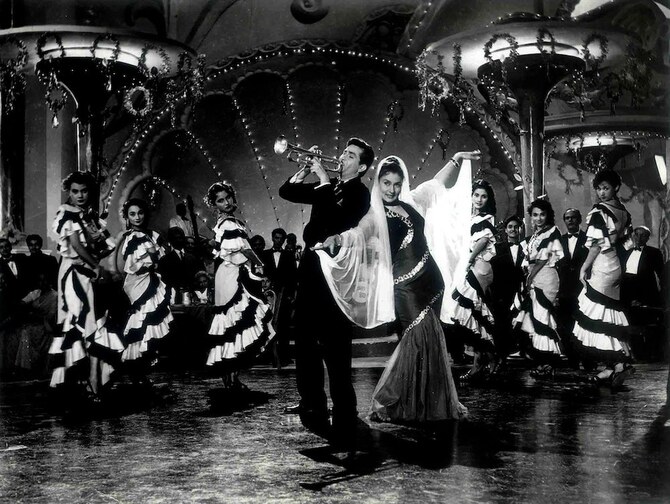
Raj Kapoor in a still from ‘Awara’ (1951), a crime drama directed by Kapoor and written by Khwaja Ahmad Abbas. (Film Heritage Foundation)
Short Url
Updated 14 December 2024
Follow

India marks 100 years of Raj Kapoor, the ‘first showman of Bollywood’

  • Retrospective of Kapoor’s films held in 40 Indian cities on Dec. 13-15
  • He starred in more than 60 films, directing more than a dozen of them

NEW DELHI: India marked on Saturday the 100th birth anniversary of Raj Kapoor, remembering the legendary actor and director, whose enduring legacy continues to shape and inspire Indian cinema.

Considered one of India’s greatest and most influential actors and filmmakers, Kapoor is fondly known as the “first showman of Bollywood” and the “greatest showman of Indian cinema.”

He was born on Dec. 14, 1924, in Peshawar, now Pakistan, from where his family later moved to Mumbai.

The son of actor Prithviraj Kapoor, he debuted alongside his father at the age of 10 in “Inquilab,” a Hindi film about an earthquake in Bihar. He went on to star in more than 60 films, directing more than a dozen of them.

Nearly four decades after his death in 1988, Kapoor remains one of India’s most-loved icons. His birthday anniversary is celebrated with a retrospective of 10 of his iconic films screened in 40 cities across India this weekend.

Marking Kapoor’s birthday on Saturday morning, India’s Prime Minister Narendra Modi paid tribute to the “visionary filmmaker, actor and the eternal showman” in a series of social media posts, saying he “was not just a filmmaker but a cultural ambassador who took Indian cinema to the global stage.”

One of Kapoor’s most famous films, “Awara” (1951), was the first Indian movie to reach the global stage. Known overseas as “The Vagabond,” it became an overnight sensation in South Asia, and soon found box-office success also in East Asia, Africa, the Middle East and Eastern Europe.

“Even today Awara is a film that is etched in my mind,” fellow film star Amitabh Bachchan wrote on X in celebration of Kapoor’s birthday. “You are amazed by his fantastical imagination.”

The film blends social themes with the genres of crime, romantic comedy and musical melodrama, featuring a character based on “the Little Tramp,” a role Kapoor also explored in other films, earning him another nickname: the “Charlie Chaplin of Indian cinema.”

For many Indians, the characters in his films were ones they could relate to.

“What strikes you is how poor people are portrayed there. They are shown as someone who is trying to survive in a world dominated by rich people and industrialists and businessmen. The main character is an outsider in the world of rich people and still manages to make inroads in their lives through his character and innocence. This appeals to me,” said Ghanshyam Datt Varma, a teacher in Chittorgarh who runs a Raj Kapoor fan page on Facebook.

“I started my life as a commoner, someone at the margin of society, and through my hard work I became a schoolteacher, despite all the hurdles. I feel the character in Raj Kapoor’s films, like ‘Sangam,’ ‘Mera Naam Joker,’ and so ... He was really a showman, a film personality who portrayed people of India and their struggle so beautifully.”

The film’s theme song, “Awara Hoon,” is still celebrated globally and has been rated among the greatest Bollywood songs of all time many times.

“I grew up watching his films and singing the songs of his films,” said Rahul Prakash, a lawyer from Patna.

Kapoor is for him a “legend-like hero who taught not one but many generations the ultimate meaning of love. A visionary director who gave birth to characters that were imaginary but also realistic,” he said.

“The way he portrayed the character of a common man on the silver screen — in such a simple and natural way — is immortal.”

Kapoor’s films were commercial successes not only in South Asia but also in the Middle East, the Caribbean, Africa and in the Soviet bloc.

“Raj Kapoor was not only a Bollywood personality but an international personality. He promoted India’s soft power through his films. His films were very popular in Russia because of the theme he chose and the pomp and gaiety he showed,” Rana Siddiqui Zaman, film critic, told Arab News.

“He is also one of the first directors to give roles to Pakistani artists. In the film ‘Heena,’ the main female character is from Pakistan. There is no other filmmaker in the industry who drove international filmmakers to call the Mumbai film industry ‘Bollywood.’”


Italian police fire tear gas as protesters clash near Winter Olympics hockey venue

Updated 08 February 2026
Follow

Italian police fire tear gas as protesters clash near Winter Olympics hockey venue

  • Police vans behind a temporary metal fence secured the road to the athletes’ village, but the protest veered away, continuing on a trajectory toward the Santagiulia venue

MILAN: Italian police fired tear gas and a water cannon at dozens of protesters who threw firecrackers and tried to access a highway near a Winter Olympics venue on Saturday.
The brief confrontation came at the end of a peaceful march by thousands against the environmental impact of the Games and the presence of US agents in Italy.
Police held off the violent demonstrators, who appeared to be trying to reach the Santagiulia Olympic ice hockey rink, after the skirmish. By then, the larger peaceful protest, including families with small children and students, had dispersed.
Earlier, a group of masked protesters had set off smoke bombs and firecrackers on a bridge overlooking a construction site about 800 meters (a half-mile) from the Olympic Village that’s housing around 1,500 athletes.
Police vans behind a temporary metal fence secured the road to the athletes’ village, but the protest veered away, continuing on a trajectory toward the Santagiulia venue. A heavy police presence guarded the entire route.
There was no indication that the protest and resulting road closure interfered with athletes’ transfers to their events, all on the outskirts of Milan.
The demonstration coincided with US Vice President JD Vance’s visit to Milan as head of the American delegation that attended the opening ceremony on Friday.
He and his family visited Leonardo da Vinci’s “The Last Supper” closer to the city center, far from the protest, which also was against the deployment of US Immigration and Customs Enforcement agents to provide security to the US delegation.
US Homeland Security Investigations, an ICE unit that focuses on cross-border crimes, frequently sends its officers to overseas events like the Olympics to assist with security. The ICE arm at the forefront of the immigration crackdown in the US is known as Enforcement and Removal Operations, and there is no indication its officers are being sent to Italy.
At the larger, peaceful demonstration, which police said numbered 10,000, people carried cardboard cutouts to represent trees felled to build the new bobsled run in Cortina. A group of dancers performed to beating drums. Music blasted from a truck leading the march, one a profanity-laced anti-ICE anthem.
“Let’s take back the cities and free the mountains,” read a banner by a group calling itself the Unsustainable Olympic Committee. Another group called the Association of Proletariat Excursionists organized the cutout trees.
“They bypassed the laws that usually are needed for major infrastructure project, citing urgency for the Games,” said protester Guido Maffioli, who expressed concern that the private entity organizing the Games would eventually pass on debt to Italian taxpayers.
Homemade signs read “Get out of the Games: Genocide States, Fascist Police and Polluting Sponsors,” the final one a reference to fossil fuel companies that are sponsors of the Games. One woman carried an artificial tree on her back decorated with the sign: “Infernal Olympics.”
The demonstration followed another last week when hundreds protested the deployment of ICE agents.
Like last week, demonstrators Saturday said they were opposed to ICE agents’ presence, despite official statements that a small number of agents from an investigative arm would be present in US diplomatic territory, and not operational on the streets.