South Korea’s President Yoon impeached over martial law bid

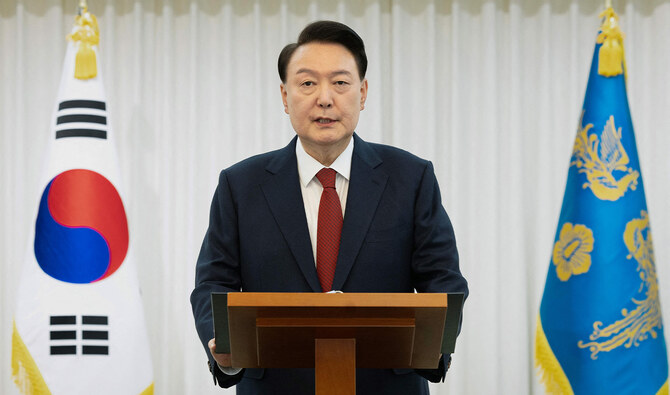
This handout photo taken on December 14, 2024 and released by the South Korean Presidential Office shows President Yoon Suk Yeol giving a public address from his official residence in Seoul. (Photo by Handout / South Korean Presidential Office / AFP)
Short Url
Updated 14 December 2024
Follow

South Korea’s President Yoon impeached over martial law bid

  • Hundreds of thousands of people took to streets of the capital Seoul in rival rallies for and against Yoon on Saturday
  • In a televised address, Yoon said he would ‘step aside’ but did not apologize for his botched bid to impose martial law

Seoul: South Korean lawmakers on Saturday impeached President Yoon Suk Yeol over his failed martial law bid, with the opposition declaring a “victory of the people.”
The vote capped over a week of intense political drama in the democratic South following Yoon’s failed attempt to impose martial law on December 3.
Hundreds of thousands of people took to the streets of the capital Seoul in rival rallies for and against Yoon on Saturday.
In a televised address following the parliamentary vote, the impeached Yoon said he would “step aside” but did not apologize for his botched bid to impose martial law.
Out of 300 lawmakers, 204 voted to impeach the president on allegations of insurrection while 85 voted against.
Three abstained, with eight votes nullified.
With the impeachment, Yoon has been suspended from office while South Korea’s Constitutional Court deliberates on the vote.
The court has 180 days to rule on Yoon’s future.
Chief Justice Moon Hyung-bae vowed to hold “a swift and fair trial.”
If the court backs his removal, Yoon will become the second president in South Korean history to be successfully impeached.
Prime Minister Han Duck-soo — now the nation’s interim leader — told reporters he would “devote all my strength and efforts to ensure stable governance.”
Two hundred votes were needed for the impeachment to pass, and opposition lawmakers needed to convince at least eight parliamentarians from Yoon’s conservative People Power Party (PPP) to switch sides.
“Today’s impeachment is the great victory of the people,” opposition Democratic Party floor leader Park Chan-dae said following the vote.
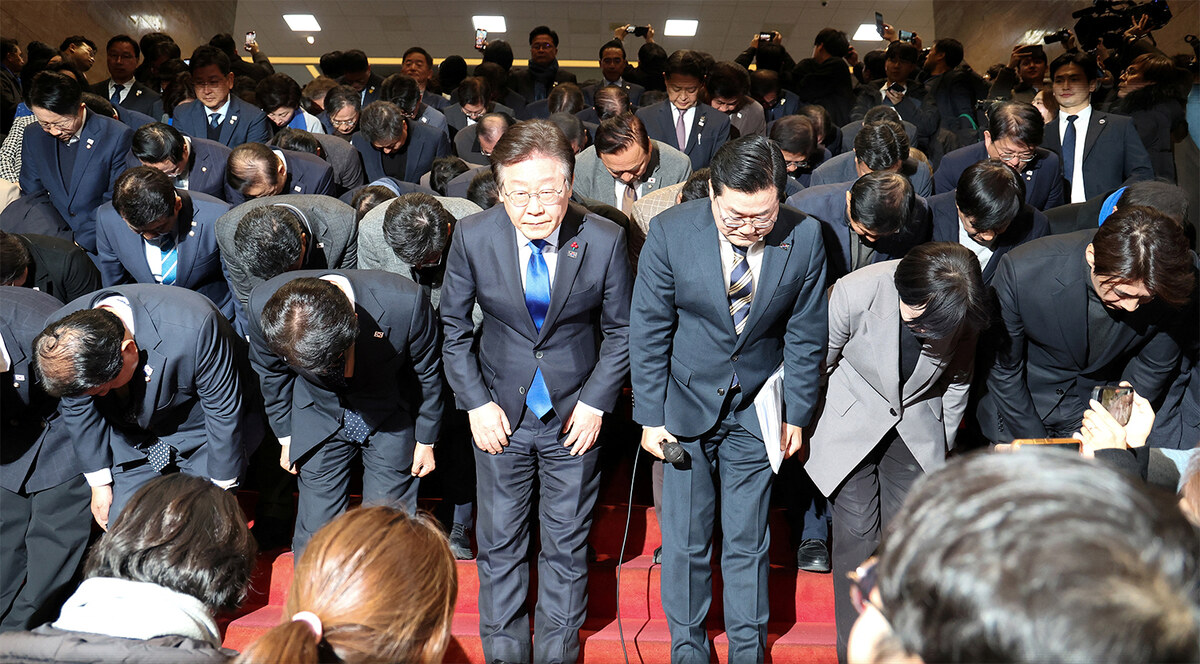


Lee Jae-myung, leader of the main opposition Democratic Party and lawmakers of the party bow after the South Korean parliament passed a second impeachment motion against President Yoon Suk Yeol, at the National Assembly in Seoul, South Korea, December 14, 2024. (Yonhap via REUTERS)

PPP lawmaker Kim Sang-wook told broadcaster JTBC that Yoon had “completely betrayed the values of conservatism.”
“That is why we, as ruling party lawmakers, have decided to remove him ourselves,” he said.
A Seoul police official told AFP at least 200,000 people had massed outside parliament in support of removing the president.
Choi Jung-ha, 52, danced in the street after the vote.
“Isn’t it amazing that we, the people, have pulled this off together?” she told AFP.
“I am 100 percent certain the Constitutional Court will side with the impeachment.”
On the other side of Seoul near Gwanghwamun square, police estimated 30,000 had rallied in support of Yoon, blasting patriotic songs and waving South Korean and American flags.
“Yoon had no choice but to declare martial law. I approve of every decision he has made as president,” supporter Choi Hee-sun, 62, told AFP before the vote.
The Democratic Party said ahead of the vote that impeachment was the “only way” to “safeguard the Constitution, the rule of law, democracy and South Korea’s future.”
“We can no longer endure Yoon’s madness,” spokeswoman Hwang Jung-a said.
At the rally outside parliament supporting impeachment, volunteers gave out free hand warmers on Saturday morning to fight the subzero temperatures, as well as coffee and food.
K-pop singer Yuri of the band Girls’ Generation — whose song “Into the New World” has become a protest anthem — said she had prepaid for food for fans attending the demonstration.
“Stay safe and take care of your health!” she said on a superfan chat platform.
One protester said she had rented a bus so parents at the rally would have a place to change diapers and feed their babies.
Another said they had initially planned to spend their Saturday hiking.
“But I came here instead to support my fellow citizens,” Kim Deuk-yun, 58, told AFP.
Yoon’s future will now be determined by the court, which has previously blocked an impeachment.
In 2004, then-president Roh Moo-hyun was removed by parliament for alleged election law violations and incompetence, but the Constitutional Court later reinstated him.
The court currently only has six judges, meaning their decision must be unanimous.
Following Saturday’s vote, parliament speaker Woo Won-shik said the National Assembly would seek to nominate three more judges to the court as soon as possible.
“The future of South Korea lies within its people,” he said.
Yoon remained unapologetic and defiant as the fallout from his disastrous martial law declaration deepened and an investigation into his inner circle has widened.
His approval rating — never very high — plummeted to 11 percent, according to a Gallup Korea poll released Friday.
The same poll showed that 75 percent supported his impeachment.
Following Yoon’s impeachment on Saturday, a spokeswoman for the European Union called for a “swift and orderly resolution” to the political crisis in South Korea in line with the country’s constitution.


What is Trump’s ‘Board of Peace’?

Updated 10 sec ago
Follow

What is Trump’s ‘Board of Peace’?

  • Countries asked to pay $1 billion for a permanent spot on the board
  • The board was originally conceived to oversee the rebuilding of Gaza

BRUSSELS: US President Donald Trump’s government has asked countries to pay $1 billion for a permanent spot on his “Board of Peace” aimed at resolving conflicts, according to its charter seen by AFP.

The board was originally conceived to oversee the rebuilding of Gaza, but the charter does not appear to limit its role to the occupied Palestinian territory.

WHAT WILL IT DO?

The Board of Peace will be chaired by Trump, according to its founding charter.

It is “an international organization that seeks to promote stability, restore dependable and lawful governance, and secure enduring peace in areas affected or threatened by conflict,” reads the preamble of the charter sent to countries invited to participate.

It will “undertake such peace-building functions in accordance with international law,” it adds.

WHO WILL RUN IT?

Trump will be chairman but also “separately serve as inaugural representative” of the US.

“The chairman shall have exclusive authority to create, modify, or dissolve subsidiary entities as necessary or appropriate to fulfil the Board of Peace’s mission,” the document states.

He will pick members of an executive board to be “leaders of global stature” to “serve two-year terms, subject to removal by the chairman.”

He may also, “acting on behalf of the Board of Peace,” “adopt resolutions or other directives.”

The chairman can be replaced only in case of “voluntary resignation or as a result of incapacity.”

WHO CAN BE A MEMBER?

Member states must be invited by the US president, and will be represented by their head of state or government.

Each member “shall serve a term of no more than three years,” the charter says.

But “the three-year membership term shall not apply to member states that contribute more than USD $1,000,000,000 in cash funds to the Board of Peace within the first year of the charter’s entry into force,” it adds.

The board will “convene voting meetings at least annually,” and “each member state shall have one vote.”

But while all decisions require “a majority of member states present and voting,” they will also be “subject to the approval of the chairman, who may also cast a vote in his capacity as chairman in the event of a tie.”

WHO’S ON THE EXECUTIVE BOARD?

The executive board will “operationalize” the organization’s mission, according to the White House, which said it would be chaired by Trump and include seven members:

US Secretary of State Marco Rubio

Steve Witkoff, Trump’s special negotiator

Jared Kushner, Trump’s son-in-law

Tony Blair, former UK prime minister

Marc Rowan, billionaire US financier

Ajay Banga, World Bank president

Robert Gabriel, loyal Trump aide on the National Security Council

WHICH COUNTRIES ARE INVITED?

Dozens of countries and leaders have said they have received an invitation.

They include China, India, Russia’s President Vladimir Putin, Ukraine’s Volodymyr Zelensky and Canada’s Prime Minister Mark Carney.

Egypt’s President Abdel Fattah El-Sisi and Argentina’s President Javier Milei have also confirmed an invite.

Other countries to confirm invites include Jordan, Brazil, Paraguay, Pakistan and a host of nations from Europe, Central Asia and the Middle East.

WHO WILL JOIN?

Countries from Albania to Vietnam have indicated a willingness to join the board.

Hungarian Prime Minister Viktor Orban, Trump’s most ardent supporter in the European Union, is also in.

Canada said it would take part, but explicitly ruled out paying the $1-billion fee for permanent membership.

It is unclear whether others who have responded positively — Armenia, Belarus, Kazakhstan, Morocco and Vietnam among them — would be willing to pay the $1 billion.

WHO WON’T BE INVOLVED?

Long-time US ally France has indicated it will not join. The response sparked an immediate threat from Trump to slap sky-high tariffs on French wine.

Zelensky said it would be “very hard” to be a member of a council alongside Russia, and diplomats were “working on it.”

WHEN DOES IT START?

The charter says it enters into force “upon expression of consent to be bound by three States.”