

Pakistan launches scholarships for 300 Bangladeshi students amid push to forge closer ties

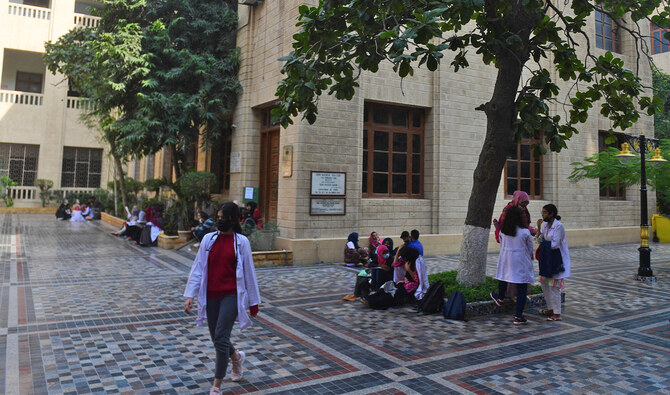
In this picture taken on January 13, 2022, students gather at a yard of the Dow University of Health Sciences in Karachi, Pakistan. (AFP/File)
Short Url
Updated 14 December 2024
Follow

Pakistan launches scholarships for 300 Bangladeshi students amid push to forge closer ties

  • Pakistan, Bangladesh have sought to improve bilateral ties since former PM Hasina’s ouster
  • Fully funded scholarship program supported by NUST, Comsats and LUMS, says state media 

ISLAMABAD: Pakistan’s government this week launched a new program through which it will provide fully funded scholarships to 300 Bangladeshi students, state-run media reported, as Islamabad establishes closer ties with Dhaka under a new Bangladeshi administration. 

The scholarship program is backed by Pakistan’s education ministry and supported by leading universities such as NUST, Comsats, and Lahore University of Management Sciences (LUMS), the Pakistan Television News reported. 

“During a recent meeting, officials urged universities to promote the program in Bangladesh through events and an online portal,” PTV News said on Friday. 

“The scholarships seek to enhance educational exchanges and cultural connections between the two countries.”

Established together as one independent nation in 1947, Bangladesh won liberation from then-West Pakistan in 1971. Relations between the two countries continued to deteriorate during former Bangladesh prime minister Sheikh Hasina’s administration, which prosecuted several members of the Jamaat-e-Islami (JI) party for war crimes relating to the 1971 conflict.

However, relations between Pakistan and Bangladesh have improved since Hasina was ousted in a bloody student-led protest in August. Islamabad’s ties with Dhaka have also improved as Bangladesh’s relations with India, where Hasina has sought refuge, have deteriorated.

Pakistan’s foreign office said in September that Islamabad sought “robust, multifaceted, friendly relations” with Bangladesh to ensure peace and stability in the region.

Sharif met Dr. Yunus in New York in September at a ceremony hosted by the Bangladeshi leader to mark the completion of 50 years of Bangladesh’s membership in the United Nations.

Both sides agreed to forge stronger ties and enhance bilateral cooperation in various fields during their meeting. 


Pakistan PM calls for faster CPEC implementation, pledges security for Chinese workers

Updated 27 February 2026
Follow

Pakistan PM calls for faster CPEC implementation, pledges security for Chinese workers

  • Shehbaz Sharif pushes expanded cooperation in agriculture, IT and mining under CPEC phase two
  • Chinese envoy reaffirms Beijing’s support for Pakistan’s sovereignty and economic development

ISLAMABAD: Prime Minister Shehbaz Sharif on Friday called for speeding up projects under the China-Pakistan Economic Corridor (CPEC) and pledged stronger security guarantees for Chinese workers and investments, during a meeting with China’s ambassador in Islamabad.

Sharif made the remarks as the two countries strive to launch the second phase of CPEC, a multibillion-dollar infrastructure and energy initiative launched in 2015 as part of China’s Belt and Road Initiative (BRI).

CPEC’s first phase focused largely on power generation and transport infrastructure aimed at easing Pakistan’s chronic energy shortages and improving connectivity. The second phase seeks to expand cooperation into industrial development, with an emphasis on special economic zones and export-oriented growth.

“While highlighting the importance of accelerating ongoing CPEC projects, the Prime Minister stressed on the need to enhance cooperation in agriculture and IT and mining & minerals,” said a statement circulated by the PM Office after the meeting.

“He also underscored Pakistan’s resolve to provide a secure and conducive environment for Chinese personnel, investments, and institutions in Pakistan,” it added.

Chinese nationals and projects in Pakistan have faced security threats in the past, including attacks by militant groups targeting infrastructure sites and convoys. Islamabad has repeatedly vowed to tighten security and has deployed special protection units for Chinese workers.

China is Pakistan’s closest ally in the region and a key economic partner, with CPEC widely regarded by Islamabad as central to long-term economic growth.

During the meeting, the prime minister conveyed greetings to Chinese President Xi Jinping and Premier Li Qiang, particularly on the occasion of the Chinese New Year.

China’s Ambassador to Pakistan, Jiang Zaidong, reiterated Beijing’s support for Pakistan’s sovereignty and socioeconomic development, according to the statement. Both sides also exchanged views on regional and international issues and agreed to maintain close coordination.