

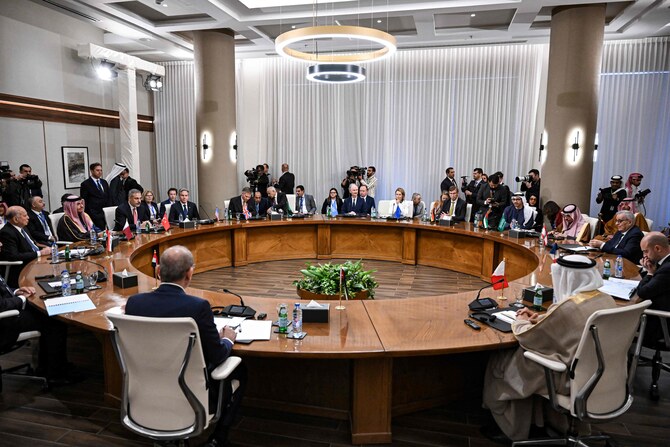

AQABA, Jordan: Saudi Arabia’s Foreign Minister Prince Faisal bin Farhan joined top diplomats from the US, Turkiye, the European Union and Arab nations in Jordan on Saturday for talks on Syria following the ousting of President Bashar Assad earlier this week.
Prince Faisal led the Kingdom’s delegation at the meeting, held under the auspices of the Arab League, which focused on supporting a Syrian-led transitional political process to address the challenges faced by the Syrian people.
Discussions emphasized restoring Syria's national institutions, ensuring the country's sovereignty and territorial integrity, and supporting the aspirations of its citizens for a secure and dignified life.
The meeting also included prominent officials, such as Prince Musab bin Mohammed Al-Farhan and Saudi Ambassador to Jordan Nayef Al-Sudairy.
A final communique issued on Saturday after the meeting expressed firm support for the Syrian people and emphasized the need for a peaceful, inclusive, and Syrian-led political transition, guided by UN Resolution 2254.
This would include forming a transitional governing body, drafting a new constitution, and conducting UN-supervised elections, the statement said.
The ministers called for a cessation of military operations, protection of Syrian state institutions, and efforts to combat terrorism.
They stressed the importance of the delivery of humanitarian aid, enabling the voluntary return of refugees, national reconciliation, and transitional justice.
The meeting condemned Israeli violations in Syrian territories and reaffirmed the Golan Heights as occupied Syrian land.
The diplomats also pledged to support Syria’s unity, sovereignty, and reconstruction, while coordinating with Arab and international partners to secure the Syrian people’s aspirations for a stable and secure future, the Saudi Press Agency reported.
Outgoing US President Joe Biden’s administration has begun engaging with the victorious militant groups including Hayat Tahrir Al-Sham (HTS), which led a lightning assault that ended in the capture of Damascus on Sunday.
Biden sent Secretary of State Antony Blinken to the region this week to seek support for principles that Washington hopes will guide Syria’s political transition, such as respect for minorities.
Meanwhile Syria’s northern neighbor Turkiye has for years supported Syrian opposition forces looking to oust Assad and is poised to play an influential role in Damascus.
Turkish Foreign Minister Hakan Fidan said on Friday that his country’s embassy in the Syrian capital would resume work on Saturday, after Turkiye’s intelligence chief visited this week.
Syria’s neighbor Jordan was hosting Saturday’s gathering in Aqaba. Russia and Iran, who were Assad’s key supporters, were not invited.
Blinken, UN Special Envoy for Syria Geir Pederson and EU foreign policy chief Kaja Kallas, Fidan and foreign ministers from Jordan, Iraq, Lebanon, Egypt, the UAE, Bahrain and Qatar met around a circular table at a Jordanian government guesthouse. There was no Syrian representative at the table.
Blinken, meeting Pederson at his hotel earlier on Saturday, said it was a time of “both opportunity but also real challenge” for Syria.
Turkiye and the United States, both NATO members, have conflicting interests when it comes to some of the militants. Turkiye-backed militants in northern Syria have clashed with the Kurdish-led Syrian Democratic Forces (SDF).
The SDF, which controls some of Syria’s largest oil fields, is the main ally in a US coalition against Daesh militants. It is spearheaded by YPG militia, a group that Ankara sees as an extension of Kurdistan Workers Party (PKK) militants who have fought the Turkish state for 40 years and who it outlaws.
Blinken told Turkish officials during a visit to Ankara on Thursday and Friday that Daesh must not be able to regroup, and the SDF must not be distracted from its role of securing camps holding Daesh fighters, according to a US official with the US delegation. Turkish leaders agreed, the official said.
Fidan told Turkish TV later on Friday that the elimination of the YPG was Turkiye’s “strategic target” and urged the group’s commanders to leave Syria.
* With Reuters


