

Rising geopolitical tensions impact global path toward net-zero emissions: WEF

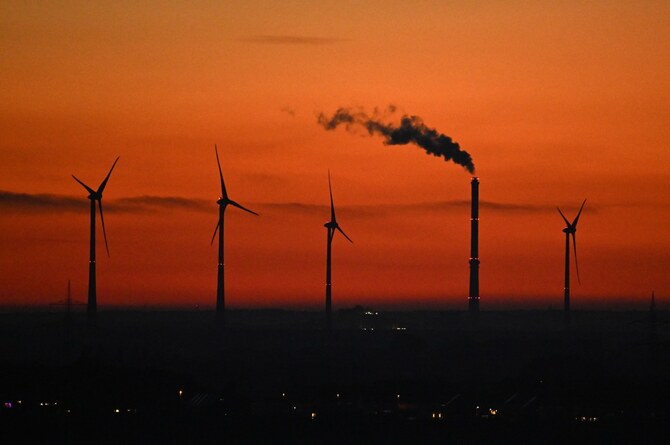
Saudi Arabia was the second-most oil-producing country (12 percent) after the US (20 percent) in 2023. (Supplied)
Short Url
Updated 13 December 2024
Follow

Rising geopolitical tensions impact global path toward net-zero emissions: WEF

DUBAI: Rising geopolitical tensions, such as those in the Middle East, impact the global path toward net-zero emissions by driving up energy prices and straining global supply chains.

This is one of the findings of the World Economic Forum’s latest edition of the Net-Zero Industry Tracker, which tracks the progress of energy transition in eight sectors — steel, aluminum, cement, primary chemicals, oil and gas, aviation, shipping and trucking — that account for nearly 40 percent of global emissions.

The tracker “highlights opportunities and challenges to further accelerate GHG (greenhouse gas) emissions reductions in eight industrial and transport sectors that all play fundamental roles in driving global economic activity and connectivity, and in which reducing emissions can be challenging,” said Espen Mehlum, head of energy transition intelligence and regional acceleration at the Centre for Energy and Materials at WEF.

These eight sectors “achieved an impressive 0.9 percent reduction in absolute emissions from 2022 to 2023, compared to global energy-related emissions, which rose by 1.3 percent in the same period,” he told Arab News.

The current rate of progress, however, is not enough to meet net-zero targets. This will require an estimated $30 trillion in additional investments by 2050, with 57 percent coming from industries other than the eight mentioned in the report, as well as “good policies, technological progress and demand for green products,” said Mehlum. 

The tracker highlights the role of data and artificial intelligence as powerful tools to support the transition to net zero.

The use of generative AI holds the potential to improve capital efficiency by 5-7 percent, reducing capital requirements by $1.5 trillion to $2 trillion in the eight sectors. 

However, the tracker cautions against the excessive use of AI, which is expected to raise electricity demand. 

The oil and gas sector represents 10 percent of global GHG emissions — the highest among the eight analyzed — and 14 percent of global carbon dioxide equivalent emissions.

Saudi Arabia was the second-most oil-producing country (12 percent) after the US (20 percent) in 2023.

The Kingdom also ranked second, followed by the UAE and Kuwait in third and fourth place, in terms of countries with the lowest CO2 emissions from oil production in 2022.

Methane emissions make up nearly half of all GHG emissions from oil and gas operations, so to achieve net zero in this sector, WEF suggests accelerating reductions in methane emissions, incentivizing these reductions, and increasing investments in electrification to help manage costs.

The report stressed the need for markets outside Europe and the US, which are already advanced, to ramp up efforts in scaling methane abatement policies.

It also spotlighted the importance of international collaborations such as the Oil and Gas Decarbonization Charter, a global industry charter dedicated to accelerating climate action within the industry, and the UAE-US Partnership for Accelerating Clean Energy.


Saudi Arabia, Japan trade rises 38% between 2016 and 2024, minister says

Updated 11 January 2026
Follow

Saudi Arabia, Japan trade rises 38% between 2016 and 2024, minister says

RIYADH: Trade between Saudi Arabia and Japan has increased by 38 percent between 2016 and 2024 to reach SR138 billion ($36 billion), the Kingdom’s investment minister revealed.

Speaking at the Saudi-Japanese Ministerial Investment Forum 2026, Khalid Al-Falih explained that this makes the Asian country the Kingdom’s third-largest trading partner, according to Asharq Bloomberg.

This falls in line with the fact that Saudi Arabia has been a very important country for Japan from the viewpoint of its energy security, having been a stable supplier of crude oil for many years.

It also aligns well with how Japan is fully committed to supporting Vision 2030 by sharing its knowledge and advanced technologies.

“This trade is dominated by the Kingdom's exports of energy products, specifically oil, gas, and their derivatives. We certainly look forward to the Saudi private sector increasing trade with Japan, particularly in high-tech Japanese products,” Al-Falih said.

He added: “As for investment, Japanese investment in the Kingdom is good and strong, but we look forward to raising the level of Japanese investments in the Kingdom. Today, the Kingdom offers promising opportunities for Japanese companies in several fields, including the traditional sector that links the two economies: energy.”

The minister went on to note that additional sectors that both countries can also collaborate in include green and blue hydrogen, investments in advanced industries, health, food security, innovation, entrepreneurship, among others.

During his speech, Al-Falih shed light on how the Kingdom’s pavilion at Expo 2025 in Osaka achieved remarkable success, with the exhibition receiving more than 3 million visitors, reflecting the Japanese public’s interest in Saudi Arabia.

“The pavilion also organized approximately 700 new business events, several each day, including 88 major investment events led by the Ministry of Investment. Today, as we prepare for the upcoming Expo 2030, we look forward to building upon Japan’s achievements,” he said.

The minister added: “During our visit to Japan, we agreed to establish a partnership to transfer the remarkable Japanese experience from Expo Osaka 2025 to Expo Riyadh 2030. I am certain that the Japanese pavilion at Expo Riyadh will rival the Saudi pavilion at Expo Osaka in terms of organization, innovation, and visitor turnout.”

Al-Falih also shed light on how Saudi-Japanese relations celebrated their 70th anniversary last year, and today marks the 71st year of these relations as well as how they have flourished over the decades, moving from one strategic level to an even higher one.