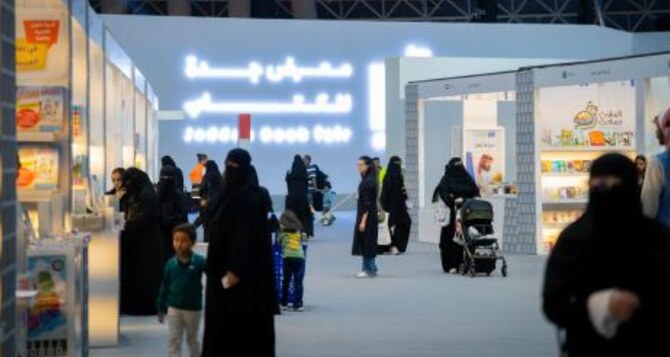
JEDDAH: The Jeddah Book Fair 2024 officially opened on Thursday, bringing together more than 1,000 publishing houses and local and international agencies from 22 countries with displays featured in more than 450 pavilions.
The fair, organized by the Saudi Authority for Literature, Publishing, and Translation and held at the Jeddah Superdome, will run until Dec. 21.
It features a cultural program with more than 100 activities, including lectures, workshops and seminars led by more than 170 experts from various fields.
Dr. Abdullatif Al-Wasil, general director of the General Administration of Publishing, highlighted the importance of the event, saying: “The Jeddah Book Fair reflects the commission’s commitment to supporting, developing, and promoting literature and culture in Saudi Arabia.”
He emphasized the fair’s leading role in presenting the efforts of local, Arab, and international writers and fostering interactive opportunities for visitors through a variety of artistic and literary activities. This initiative aligns with efforts to position Jeddah as a historic cultural center. Al-Wasil said: “The Jeddah Book Fair is not just an exhibition but a celebration of creativity, knowledge, and collaboration. It’s a chance to bring together diverse voices, talents, and cultures, fostering opportunities for a global exchange of ideas, literature, and artistry while solidifying Jeddah’s role as a cultural and historical hub for the region.”
A significant highlight of the fair is its interactive area for children aged 2 to 12. This dedicated space offers 40 unique activities that focus on writing, storytelling, theater, animation, and creative workshops, ensuring a fun and educational experience. Children can enjoy interactive storytelling sessions, handicraft workshops, and activities.
Mohammed Ali Hussein, who visited the fair with his children, said: “This fair definitely promotes a love of reading and helps children understand its value. My kids enjoyed the workshop activities designed for young readers, where they learned the basics of creating a cartoon novel and how to write a story. The fair is both educational and insightful.”
The fair also features a Manga Corner. Khalid Alatiq, the section organizer, said that it is a popular space for graphic storytelling enthusiasts to explore comics and visual narratives. Visitors can enjoy an array of content, including characters such as Satoru Gojo from “Jujutsu Kaisen” and Naruto Uzumaki.
Meanwhile, the Saudi authors pavilion features the latest publications by Saudi writers, allowing visitors to engage with local talent. Moreover, visitors will benefit from a discounted book area, part of the fair’s efforts to make books accessible to everyone.
Another notable feature of the fair is its celebration of the Year of the Camel, a tribute to the cultural significance of camels in the Arabian Peninsula. A special pavilion focuses on educating visitors about the camel’s historical and cultural importance, highlighting its references in the Qur’an, hadith, and centuries of Arab poetry.
Mehemoud Fateh, organizer from the King Abdulaziz Foundation for Research and Archives, told Arab News: “Our official participation aims to play a vital role in disseminating the historical and cultural narratives of the Arabian Peninsula.
“We are dedicated to introducing the valuable publications and research produced by King Abdulaziz House, ensuring that the region’s legacy and heritage are accessible to a wider audience,” he said.
“This initiative highlights the significance of preserving past and fostering cultural awareness, which strengthens our national identity.”
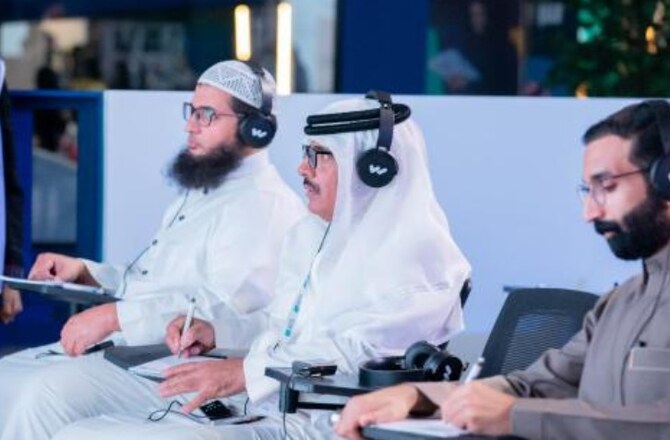
The fair also has a cultural theater, a space hosting daily performances that blend literature, art and music. Visitors can take part in workshops on writing and publishing, while engaging in dialogue sessions. A series of cultural discussions highlighted key aspects of Saudi literature and creativity.
One panel, “The Culture of Pseudonyms,” featured Mohammed Al-Mushwah and poet Abdullah Al-Ghabeen, moderated by journalist Mohammed Al-Ateeq. Dr. Al-Mushwah clarified the distinction between nicknames and pseudonyms, explaining: “A pseudonym implies borrowing and reflects an individual’s desire to express themselves without revealing their identity. Poets were the first to adopt pseudonyms as a way to freely convey their emotions without the constraints of their personal identities.”
Al-Ghabeen said pseudonyms are not unique to Arab culture, mentioning Saudi figures such as Samira Khashoggi, who published under the name Samira bint Al-Jazeera, and Huda Al-Arini, who went by Ghaida Al-Manfa. “What’s intriguing is that pseudonyms sometimes reflect traits that are completely different from the true personalities of their owners,” he added.
The “Your Book, Cinematic Criticism” workshop presented by Egyptian critic Ahmed Shawky captivated attendees with an exploration of film criticism and filmmaking essentials.
Shawky delved into critical writing methods and highlighted the importance of interpreting films through social and cultural lenses to foster a comprehensive critical vision. Discussing the critic’s role, he said: “The critic’s role is to serve as a cultural bridge between the film and its audience, providing an objective and unbiased analysis free from external influences that might compromise its integrity.” The session presented film criticism not just as an analysis but as an art form, requiring creativity and precision.
The first day of the book fair also featured the panel “Images and Stories: A History of Place,” with Ghada Abalkhail and poet Abdullah Al-Faris, moderated by Manal Al-Amri. Abalkhail argued that images express reality through the construction of imagination, urging attendees to carefully interpret visual media to avoid reinforcing stereotypes. She said: “Images communicate without the need for translation.”
Al-Faris, on the other hand, focused on storytelling’s potential to shape the image of a place. He spoke about visual documentation’s role in enhancing various types of tourism, saying: “Every image contains a story, and visual documentation plays a role in enhancing tourism — whether it’s religious tourism, heritage tourism, or tourism focused on language and customs.”
Al-Faris also acknowledged the impact of Saudi Arabia’s Vision 2030, noting that literature and social media are key tools for preserving culture and enhancing tourism, positioning Saudi Arabia as a destination for creative and cultural exchange.
A session with acclaimed novelist Osama Al-Muslim explored his fantasy novel “The Opportunist,” which is centered on a mysterious riddle, a lone survivor, and resurfacing crimes. “Readers of my previous works will find a continuity that makes this novel more enjoyable, but new readers may need to read it more than once to uncover its details,” he said. “Repetition in characters quickly reveals the writer’s identity, which I strive to avoid.”
He also noted the growing prominence of Arabic novels in the cultural scene, saying: “Each era has its interest, and today, novels dominate the cultural scene, much like poetry did in the past.”
The Jeddah Book Fair is the third major book fair in Saudi Arabia this year, following the Riyadh International Book Fair in October and the Madinah Book Fair in August.
Dalia Al Harbi, a writer currently working on her own book, shared her experience at the fair: “Visiting the fair and speaking with authors and publishing houses has taught me a great deal. I gained insights into the writing process, the publication workflow, and how to connect with publishing houses more effectively. Events like these offer an invaluable opportunity to learn firsthand and gain a deeper understanding of the industry.”
The fair is open to the public, entry is free, and welcomes visitors every day from 11 a.m. to midnight, except on Fridays when it opens at 2 p.m. until midnight.


![]()
![]()
![]()

Jeddah Book Fair 2024 opens its doors to culture, literature, and knowledge

Short Url
https://arab.news/pjrda
Jeddah Book Fair 2024 opens its doors to culture, literature, and knowledge
- The fair, organized by the Saudi Authority for Literature, Publishing, and Translation and held at the Jeddah Superdome, will run until Dec. 21
- It features a cultural program with more than 100 activities


Latest updates


© 2026 SAUDI RESEARCH & PUBLISHING COMPANY, All Rights Reserved And subject to Terms of Use Agreement.