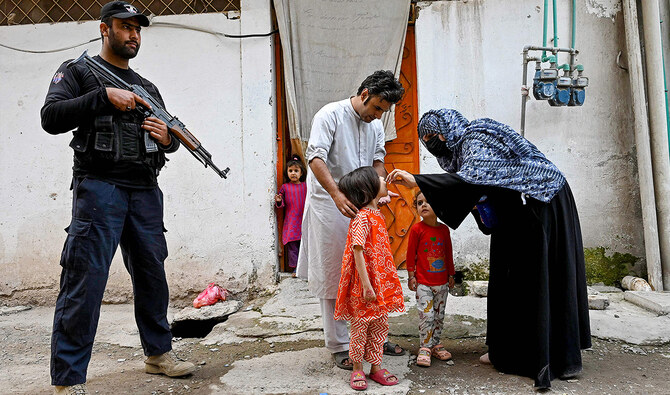
PESHAWAR: Pakistani authorities have postponed a planned anti-polio vaccination campaign in the northwestern Kurram district, a senior health official said on Friday, citing a fragile security situation after weeks of deadly sectarian clashes in the region.
The development came as the South Asian country reported four new cases of the polio virus that brought the nationwide tally to 63 this year. Pakistan and the neighboring Afghanistan are the only two countries in the world where polio remains an endemic.
Kurram, a former semi-autonomous tribal region bordering Afghanistan, has a long history of violent conflicts and the recent clashes between Shiite and Sunni communities, which began on Nov. 21, killed 133 people in the restive region.
Though a council of tribal elders, or jirgah, backed by the Khyber Pakhtunkhwa provincial government, this month managed a ceasefire between the warring tribes, security situation remains fragile in the district where road closures have led to shortage of medicines and food.
“Yes, the anti-polio campaign in Kurram has been postponed delayed for now. After improvement in the security environment and reopening of roads, new dates for polio eradication campaign will be announced for the district,” Dr. Qaisar Khan, the Kurram district health officer (DHO), told Arab News.
Pakistan will launch its next anti-polio vaccination campaign from Dec. 16 till Dec. 22 to reach more than 44 million children under the age of five in 143 districts across the country, according to the official.
Pakistan is a Sunni-majority country, but Kurram has a large Shiite population, and the communities have clashed for decades. Provincial authorities last Sunday dispatched a batch of essential medicines via helicopter to the volatile district to ease the suffering of residents.
Pakistan’s chief health officer said on Nov. 10 an estimated 500,000 children had missed polio vaccination during the last countrywide inoculation drive.
This year, the country’s polio program has confirmed 26 polio cases in Balochistan, 18 in Khyber Pakhtunkhwa, 17 in Sindh, and one each in Punjab and the federal capital of Islamabad.
Poliovirus, which can cause crippling paralysis particularly in young children, is incurable and remains a threat to human health as long as it has not been eradicated. Immunization campaigns have succeeded in most countries and have come close in Pakistan, but persistent problems remain.
In the early 1990s, Pakistan reported around 20,000 cases annually but in 2018 the number dropped to eight cases. Six cases were reported in 2023 and only one in 2021.
Pakistan’s polio program began in 1994 but efforts to eradicate the virus have since been undermined by vaccine misinformation and opposition from some religious hard-liners who say immunization is a foreign ploy to sterilize Muslim children or a cover for Western spies. Militant groups also frequently attack and kill members of polio vaccine teams.
In July 2019, a vaccination drive in Khyber Pakhtunkhwa was thwarted after mass panic was created by rumors that children were fainting or vomiting after being immunized.
Public health studies in Pakistan have shown that a lack of knowledge about vaccines, together with poverty and rural residency, are also factors that commonly influence whether parents vaccinate their children against polio.


Pakistan postpones anti-polio drive in northwestern district amid fragile security situation
https://arab.news/8ywmc
Pakistan postpones anti-polio drive in northwestern district amid fragile security situation

- Kurram has a long history of violent conflicts and recent clashes between Shiite, Sunni communities, which began on Nov. 21, killed 133 people
- The development comes as the South Asian country reports four new cases of the polio virus that have brought the nationwide tally to 63 this year

India to make Rafale jets with France in boost to defense ties, Macron says
- India last week gave clearance to buy 114 more Rafale jets for country’s air force, besides planes, missiles
- Rafale jets flown by the Indian Air Force were in the spotlight during India’s conflict with Pakistan last May
NEW DELHI: France and India are entering a new era of defense cooperation with plans to jointly produce Rafale fighter jets as well as helicopters, French President Emmanuel Macron said on Thursday, adding France also hopes to sell more submarines to India.
India’s expected order for another 114 Rafales is a “new step forward” in defense ties between the two countries and France hopes to see this replicated with submarines as well, Macron told reporters at the end of a three-day visit to India.
“On Rafale, what we want to do is expand. India confirmed a few days ago its willingness to command a new bunch of Rafales... 114... and to co-produce in India,” Macron said.
The Defense Acquisition Council of India’s defense ministry last week gave initial clearance to acquire 114 more Rafale jets for the air force, besides other planes and missiles, months after the worst fighting in decades between India and Pakistan.
So far, India has purchased 36 Rafales for its air force and ordered another 26 marine versions of the jet for the navy.
Details of the Rafale deal including plans for co-production, expected to be sealed after technical and commercial negotiations, are yet to be made public. Indian media reports have said that the 114 jets manufactured by Dassault Aviation are expected to cost 3.25 trillion rupees ($35.65 billion).
They have also reported that up to 90 of the 114 jets could be produced in India with a joint venture partner who is yet to be identified.
“Rafale is absolutely key,” Macron said. “I hope we will do it on submarines. We offered additional capacities.”
The Indian navy operates six French Scorpene submarines and local media reports say there are plans to order more.
On Tuesday, Macron and Indian Prime Minister Narendra Modi announced the first H125 helicopter assembly line, made in India by a joint venture between Airbus and Tata Advanced Systems, as well as a plan to jointly produce HAMMER missiles in India, by Safran and India’s state-owned Bharat Electronics.
Rafale jets flown by the Indian Air Force were in the spotlight during India’s conflict with Pakistan last May.
Reuters reported that Pakistan’s Chinese-made J-10C jets shot down at least one Rafale, citing US officials.
New Delhi has confirmed losses in the air but has not acknowledged a Rafale being shot down.


