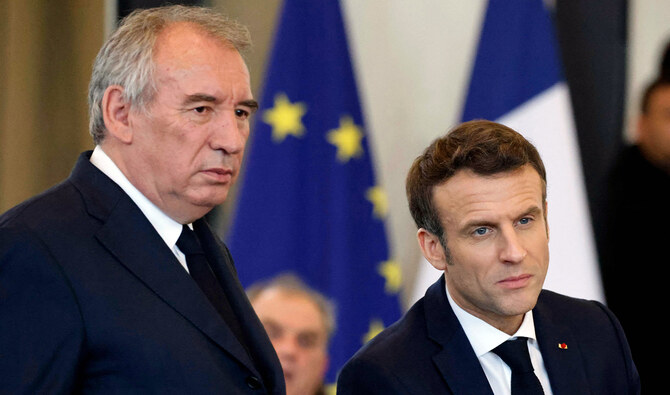
PARIS: French President Emmanuel Macron named Francois Bayrou as his fourth prime minister of 2024 on Friday, tasking the veteran centrist with steering the country out of its second major political crisis in the last six months.
The priority for Bayrou, a close Macron ally, will be passing a special law to roll over the 2024 budget, with a nastier battle over the 2025 legislation looming early next year. Parliamentary pushback over the 2025 bill led to the downfall of former Prime Minister Michel Barnier’s government.
Bayrou, 73, is expected to put forward his list of ministers in the coming days, but will likely face the same existential difficulties as Barnier in steering legislation through a hung parliament comprising three warring blocs. His proximity to the deeply unpopular Macron will also prove a vulnerability.
Jordan Bardella, the president of the far-right National Rally party, said they would not be calling for an immediate no-confidence motion against Bayrou.
France’s festering political malaise has raised doubts about whether Macron will complete his second presidential term, which ends in 2027. It has also lifted French borrowing costs and left a power vacuum in the heart of Europe, just as Donald Trump prepares to return to the White House.
Macron spent the days after Barnier’s ouster speaking to leaders from the conservatives to the Communists, seeking to lock in support for Bayrou. Marine Le Pen’s far-right National Rally and the hard-left France Unbowed were excluded.
Any involvement of the Socialist Party in a coalition may cost Macron in next year’s budget.
“Now we will see how many billions the support of the Socialist Party will cost,” a government adviser said on Friday.
NO LEGISLATIVE ELECTION BEFORE SUMMER
Macron will hope Bayrou can stave off no-confidence votes until at least July, when France will be able to hold a new parliamentary election, but his own future as president will inevitably be questioned if the government should fall again.
Bayrou, the founder of the Democratic Movement (MoDem) party which has been a part of Macron’s ruling alliance since 2017, has himself run for president three times, leaning on his rural roots as the longtime mayor of the south-western town of Pau.
Macron appointed Bayrou as justice minister in 2017 but he resigned only weeks later amid an investigation into his party’s alleged fraudulent employment of parliamentary assistants. He was cleared of fraud charges this year.
Bayrou’s first real test will come early in the new year when lawmakers need to pass a belt-tightening 2025 budget bill.
However, the fragmented nature of the National Assembly, rendered nigh-on ungovernable after Macron’s June snap election, means Bayrou will likely be living day-to-day, at the mercy of the president’s opponents, for the foreseeable future.
Barnier’s budget bill, which aimed for 60 billion euros in savings to assuage investors increasingly concerned by France’s 6 percent deficit, was deemed too miserly by the far-right and left, and the government’s failure to find a way out of the gridlock has seen French borrowing costs push higher still.


![]()

France’s Macron names veteran centrist ally Bayrou as prime minister
Short Url
https://arab.news/4urfu
France’s Macron names veteran centrist ally Bayrou as prime minister
- The priority for Francois Bayrou, a close Macron ally, will be passing a special law to roll over the 2024 budget
- Parliamentary pushback over the 2025 bill led to the downfall of former Prime Minister Michel Barnier’s government
Latest updates


© 2026 SAUDI RESEARCH & PUBLISHING COMPANY, All Rights Reserved And subject to Terms of Use Agreement.