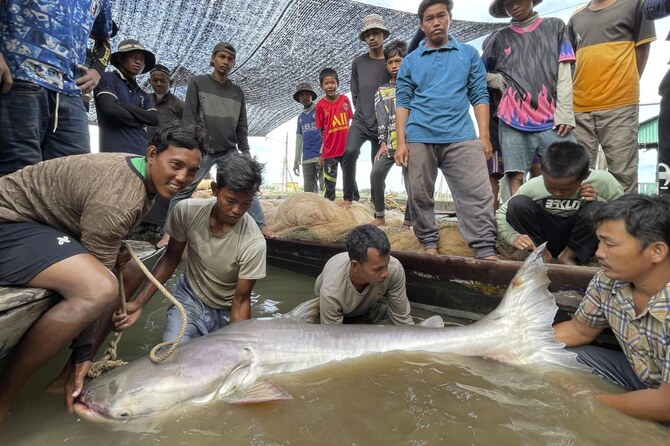
HANOI: Six critically endangered Mekong giant catfish — one of the largest and rarest freshwater fish in the world — were caught and released recently in Cambodia, reviving hopes for the survival of the species.
The underwater giants can grow up to 3 meters long and weigh up to 300 kilograms, or as heavy as a grand piano. They now are only found in Southeast Asia’s Mekong River but in the past inhabited the length of the 4,900-kilometer-long river, all the way from its outlet in Vietnam to its northern reaches in China’s Yunnan province.
The species’ population has plummeted by 80 percent in recent decades due to rising pressures from overfishing, dams that block the migratory path the fish follow to spawn and other disruptions.
Few of the millions of people who depend on the Mekong for their livelihoods have ever seen a giant catfish. To find six of the giants, which were caught and released within 5 days, is unprecedented.
The first two were on the Tonle Sap river, a tributary of the Mekong not far from Cambodian capital Phnom Penh. They were given identification tags and released. On Tuesday, fishermen caught four more giant catfish including two longer than 2 meters that weighed 120 kilograms and 131 kilograms, respectively. The captured fish were apparently migrating from their floodplain habitats near Cambodia’s Tonle Sap Lake northward along the Mekong River, likely to spawning grounds in northern Cambodia, Laos or Thailand.
“It’s a hopeful sign that the species is not in imminent, like in the next few years, risk of extinction, which gives conservation activities time to be implemented and to continue to bend the curve away from decline and toward recovery,” said Dr. Zeb Hogan, a University of Nevada Reno research biologist who leads the US Agency for International Development-funded Wonders of the Mekong project.
Much is still unknown about the giant fish, but over the past two decades a joint conservation program by the Wonders of the Mekong and the Cambodian Fisheries Administration has caught, tagged and released around 100 of them, gaining insights into how the catfish migrate, where they live and the health of the species.
“This information is used to establish migration corridors and protect habitats to try to help these fish survive in the future,” said Hogan.
The Mekong giant catfish is woven into the region’s cultural fabric, depicted in 3,000-year-old cave paintings, revered in folklore and considered a symbol of the river, whose fisheries feed millions and are valued at $10 billion annually.
Local communities play a crucial role in conservation. Fishermen now know about the importance of reporting accidental catches of rare and endangered species to officials, enabling researchers to reach places where fish have been captured and measure and tag them before releasing them.
“Their cooperation is essential for our research and conservation efforts,” Heng Kong, director of Cambodia’s Inland Fisheries Research and Development Institute, said in a statement.
Apart from the Mekong giant catfish, the river is also home to other large fish including the salmon carp, which was thought to be extinct until it was spotted earlier this year, and the giant sting ray.
That four of these fish were caught and tagged in a single day is likely the “big fish story of the century for the Mekong”, said Brian Eyler, director of the Washington-based Stimson Center’s Southeast Asia Program. He said that seeing them confirms that the annual fish migration was still robust despite all the pressures facing the environment along the Mekong.
“Hopefully what happened this week will show the Mekong countries and the world that the Mekong’s mighty fish population is uniquely special and needs to be conserved,” he said.

Huge and rare Mekong catfish spotted in Cambodia, raising conservation hopes
https://arab.news/c6xje
Huge and rare Mekong catfish spotted in Cambodia, raising conservation hopes
- Few of the millions of people who depend on the Mekong for their livelihoods have ever seen a giant catfish
- The species’ population has plummeted by 80% due to rising pressures from overfishing, dams and other disruptions
The shootings in Minneapolis are upending the politics of immigration in Congress
- Many GOP lawmakers continue to embrace the Trump administration’s deportation strategy
WASHINGTON: The shooting deaths of two American citizens during the Trump administration’s deportation operations in Minneapolis have upended the politics of immigration in Congress, plunging the country toward another government shutdown.
Democrats have awakened to what they see as a moral moment for the country, refusing funds for the Department of Homeland Security’s military-style immigration enforcement operations unless there are new restraints. Two former presidents, Barack Obama and Bill Clinton, have broken from retirement to speak out.
At the same time, Republicans who have championed President Donald Trump’s tough approach to immigration are signaling second thoughts. A growing number of Republicans want a full investigation into the shooting death of Alex Pretti and congressional hearings about US Immigration and Customs Enforcement operations.
“Americans are horrified & don’t want their tax dollars funding this brutality,” Sen. Chris Van Hollen, D-Md., wrote on social media. “Not another dime to this lawless operation.”
The result is a rapidly changing political environment as the nation considers the reach of the Trump administration’s well-funded immigration enforcement machinery and Congress spirals toward a partial federal shutdown if no resolution is reached by midnight Friday.
“The tragic death of Alex Pretti has refocused attention on the Homeland Security bill, and I recognize and share the concerns,” said Sen. Susan Collins of Maine, the GOP chair of the Appropriations Committee, in brief remarks Monday.
Still, she urged colleagues to stick to the funding deal and avoid a “detrimental shutdown.”
Searching for a way out of a crisis
As Congress seeks to defuse a crisis, the next steps are uncertain.
The White House has indicated its own shifting strategy, sending Trump’s border czar Tom Homan to Minneapolis to take over for hard-charging Border Patrol Commander Gregory Bovino, which many Republicans see as a potential turning point to calm operations.
“This is a positive development — one that I hope leads to turning down the temperature and restoring order in Minnesota,” Senate Majority Leader John Thune posted about Homan.
Behind the scenes, the White House is reaching out to congressional leaders, and even individual Democratic senators, in search of a way out of another government shutdown.
At stake is a six-bill government funding package, not just for Homeland Security but for Defense, Health and other departments, making up more than 70 percent of federal operations.
Even though Homeland Security has billions from Trump’s big tax break bill, Democrats are coalescing around changes to ICE operations. “We can still have some legitimate restriction on how these people are conducting themselves,” said Sen. Ruben Gallego, D-Arizona
But it appears doubtful the Trump administration would readily agree to Democrats’ demands to rein in immigration operations. Proposals for unmasking federal agents or limiting their reach into schools, hospitals or churches would be difficult to quickly approve in Congress.
White House press secretary Karoline Leavitt said that while conversations are underway, Trump wants to see the bipartisan spending package approved to avoid the possibility of a government shutdown.
“We absolutely do not want to see that funding lapse,” Leavitt said.
Politics reflect changing attitudes on Trump’s immigration agenda
The political climate is a turnaround from just a year ago, when Congress easily passed the Laken Riley Act, the first bill Trump signed into law in his second term.
At the time, dozens of Democrats joined the GOP majority in passing the bill named after a Georgia nursing student who was killed by a Venezuelan man who had entered the country illegally.
Many Democrats had worried about the Biden administration’s record of having allowed untold immigrants into the country. The party was increasingly seen as soft on crime following the “defund the police” protests and the aftermath of the death of George Floyd at the the hands of law enforcement.
But the Trump administrations tactics changed all that.
Just 38 percent of US adults approve of how Trump is handling immigration, down from 49 percent in March, according to an AP-NORC poll conducted in January, shortly after the death of Renee Good, who was shot and killed by a ICE officer in Minnesota.
Last week, almost all House Democrats voted against the Homeland Security bill, as the package was sent the Senate.
Then there was the shooting death of Pretti over the weekend in Minneapolis.
Rep. Tom Suozzi of New York, who was among the seven Democrats who had voted to approve the Homeland Security funds, reversed course Monday in a Facebook post.
“I hear the anger from my constituents, and I take responsibility for that,” Suozzi wrote.
He said he “failed to view the DHS funding vote as a referendum on the illegal and immoral conduct of ICE in Minneapolis.”
Voting ahead as shutdown risk grows
Senate Democratic Leader Chuck Schumer said Monday the responsibility for averting another shutdown falls to Republicans, who have majority control, to break apart the six-bill package, removing the homeland funds while allowing the others to go forward.
“We can pass them right away,” Schumer said.
But the White House panned that approach and House Speaker Mike Johnson, who has blamed Democrats for last year’s shutdown, the longest in history, has been mum. The GOP speaker would need to recall lawmakers to Washington to vote.
Republicans believe they will be able to portray Democrats as radical if the government shuts down over Homeland Security funds, and certain centrist Democrats have warned the party against strong anti-ICE language.
A memo from centrist Democratic group Third Way had earlier warned lawmakers against proposals to “abolish” ICE as “emotionally satisfying, politically lethal.” In a new memo Monday it proposed “Overhauling ICE” with top-to-bottom changes, including removing Homeland Security Secretary Kristi Noem from her job.
GOP faces a divide on deportations
But Republicans also risk being sideways with public opinion over Trump’s immigration and deportation agenda.
Republicans prefer to keep the focus on Trump’s ability to secure the US-Mexico border, with illegal crossings at all-time lows, instead of the military-style deportation agenda. They are particularly sensitive to concerns from gun owners’ groups that Pretti, who was apparently licensed to carry a firearm, is being criticized for having a gun with him before he was killed.
GOP Sen. Rand Paul, the chairman of the Homeland Security and Government Oversight Committee, demanded that acting ICE director Todd Lyons appear for a hearing — joining a similar demand from House Republicans over the weekend.
At the same time, many GOP lawmakers continue to embrace the Trump administration’s deportation strategy.
“I want to be very clear,” said Sen. Rick Scott, R-Fla., in a post. “I will not support any efforts to strip DHS of its funding.”
And pressure from their own right flank was bearing down on Republicans.
The Heritage Foundation chastised those Republicans who were “jubilant” at the prospect of slowing down ICE operations. “Deport every illegal alien,” it said in a post. “Nothing less.”


