

Pakistan top court allows army to announce military trial verdicts of pro-Khan protesters

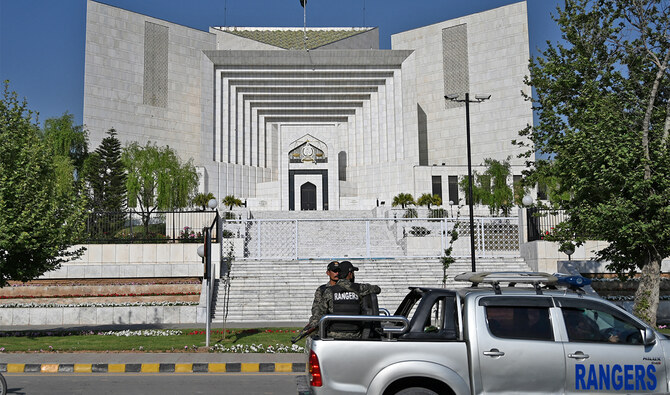
Rangers patrolalong a street past Pakistan's Supreme Court in Islamabad on April 5, 2022. (AFP/File)
Short Url
Updated 13 December 2024
Follow

Pakistan top court allows army to announce military trial verdicts of pro-Khan protesters

  • On Oct. 23 last year, three-member Supreme Court panel had declared military trials of civilians unconstitutional, suspending all proceedings
  • On Dec 13, six-member bench provisionally approved military court trials of over 100 supporters of ex-premier Imran Khan 

ISLAMABAD: Pakistan’s Supreme Court on Friday conditionally allowed military courts to announce the reserved verdicts of 85 civilians tried over their alleged involvement in last year’s May 9 riots, a major blow to the party of jailed ex-premier Imran Khan that the violence has been linked to. 

The ruling comes a little over a year after a three-member bench of the top court said last October military trials of civilians were unconstitutional and ordered the trials of some 103 people moved to civilian criminal courts, a relief for dozens accused of ransacking military installations during protests after the brief arrest of Khan on May 9, 2023. However, on December 13, 2023, a six-member bench conditionally suspended its own Oct. 23 ruling, pending a final judgment as it heard a set of intra-court appeals (ICAs).

Hundreds of alleged Khan supporters were arrested after they stormed military and government installations, and even torched a top commander’s house, following the former premier’s brief arrest by paramilitary soldiers in a land bribe case. Though Khan was released just days after the violence of May 9, he was arrested again that August following an accountability court’s ruling in another corruption case and has been in jail since, facing a slew of legal charges he says are trumped up to keep him away from politics. 

The military initiated army court trials of at least 103 people accused of involvement in the violence and there have been widespread reports it also plans to prosecute Khan under the Pakistan Army Act on charges of treason and attempting to incite a mutiny in the military.

Announcing Friday’s verdict, Justice Aminuddin Khan, the head of the constitutional bench said:

“Suspects who can be accorded concessions in their sentences, should be given so and released … Suspects who cannot be released should be moved to jails once their sentence has been pronounced.”

In March, a six-member SC bench had also conditionally allowed military courts to pronounce reserved verdicts in the May 9 cases. It had also modified its Dec. 13 injunction, ordering that military courts could commence trials but they would not convict or acquit any suspects as long as the government-instituted intra-court appeals were pending.

Local and global rights groups have expressed concerns over the military trials, saying such courts do not have the same standards of evidence and due process as civilian courts.

Pakistan’s Army Act of 1952 established military courts primarily to try members of the military or enemies of the state, and they operate under a separate legal system.

The decision to use military courts was taken by the government of Khan’s rival, Shehbaz Sharif, and backed by the army.


Pakistan, Jordan agree to enhance cooperation in trade, energy, investment

Updated 05 February 2026
Follow

Pakistan, Jordan agree to enhance cooperation in trade, energy, investment

  • Pakistan, Jordan hold inter-ministerial commission meeting in Islamabad to discuss cooperation in several sectors
  • Both sides agree to form working group, Jordan-Pakistan Business Council to accelerate trade and investment cooperation

ISLAMABAD: Pakistan and Jordan have agreed to enhance cooperation in trade, investment, banking, energy and other economic sectors, Commerce Minister Jam Kamal Khan said on Thursday. 

The understanding was reached between the two sides at a meeting of the Pakistan-Jordan Inter-ministerial Commission in Islamabad on Thursday. 

Pakistan enjoys cooperation with Jordan in several sectors including trade, defense and minerals. Jordan was the fifth country to recognize Pakistan after it secured independence in 1947. The two nations established formal diplomatic ties in 1948. 

“Areas which cover a very diversified sectoral approach from trade and investment, industrial development, banking and finance, agriculture and livestock, higher education, vocational training, labor, health, climate change, maritime, energy, mineral resources and many more,” Khan said at a news conference with Jordanian Minister of Industry and Trade Yarub Qudah. 

The Pakistani minister said it was a “very good opportunity” for both sides to transform their brotherly relations into economic cooperation. 

Qudah agreed with Khan, saying it was time for Islamabad and Amman to take their economic and trade relations to “a totally different level.”

“We have also agreed to have a working group that will work this year on different sectors and also the establishment of the Pakistan-Jordan Business Council,” he said.

He invited Khan to Jordan to hold talks on further cooperation, adding that the 11th meeting of the inter-ministerial commission will be held in Jordan next year. 

The bilateral trade between Pakistan and Jordan stood at $46.58 million in 2023. Pakistan’s main exports to Jordan include textiles, rice, ethyl alcohol, polymers of styrene, sugar confectionaries, nuts and dried fruits.

Meanwhile, Pakistan mainly imports mineral and chemical fertilizers, ferrous waste and scrap, inorganic acids, chemicals, medicaments and seeds from Jordan.