- Pakistan wants to consolidate its role as a pivotal trade and transit hub for landlocked Central Asian republics
- Tajikistan is Pakistan’s closest neighbor in Central Asia with narrow strip through Wakhan corridor separating them
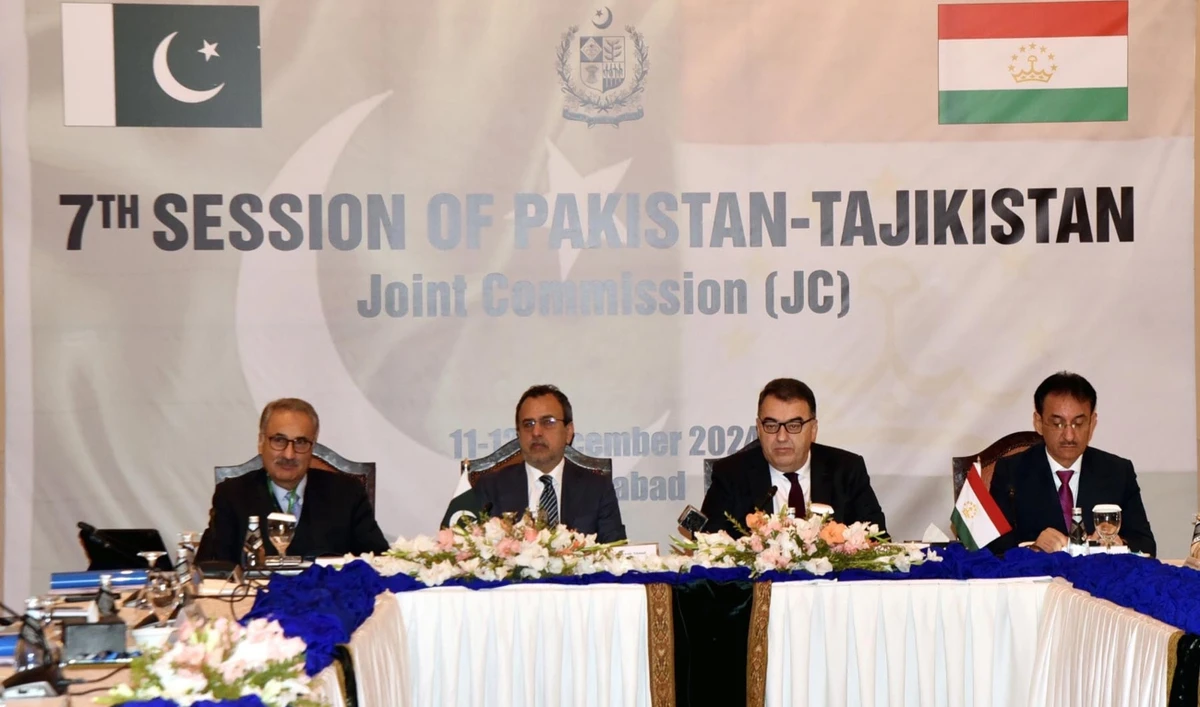
ISLAMABAD: Pakistan and Tajikistan signed two memorandums of agreement at the seventh session of the Pakistan-Tajikistan Joint Commission held in Islamabad this week, Radio Pakistan reported on Thursday.
Power Minister Sardar Awais Leghari on Wednesday announced that Islamabad and Dushanbe had agreed to set up a joint coordination committee to address transit trade challenges, as Pakistan pushes to consolidate its role as a pivotal trade and transit hub connecting the landlocked Central Asian states with the rest of the world.
In recent weeks, there has been a flurry of visits, investment talks and economic activity between officials from Pakistan and the Central Asian nations. Tajikistan is Pakistan’s closest neighbor in Central Asia with a narrow strip of 14km through the Wakhan corridor separating the two countries.
“Pakistan and Tajikistan signed two Memorandums of Understanding at the concluding meeting of the seventh Pakistan-Tajikistan Joint Commission in Islamabad,” Radio Pakistan said.
The first MoU forges a “historic partnership” between Pakistan’s northwestern province of Khyber-Pakhtunkhwa (KP) and Tajikistan’s Khatlon province, paving the way for enhanced cooperation and mutual development. A second MoU has been signed between the Pakistani and Tajik football federations.
A business-to-business (B2B) forum between the two countries will also be held in Islamabad on Dec. 13.
On Wednesday, speaking at the Joint Commission in Islamabad along with Tajikistan Energy Minister Juma Daler Shofaqir, Leghari said both nations needed to explore “new avenues of cooperation” in commercial and economic fields.
“I’m pleased to note that both sides have agreed to create a joint coordination committee on transit trade under the Tajikistan-Pakistan trade transit agreement, which will play a pivotal role in addressing operational challenges and ensuring the smooth implementation of transit trade provisions,” Leghari said.
He hoped deliberations of the joint commission would aid in preparing “concrete” recommendations to advance further growth in the fields of trade, energy, agriculture and education as well as the industrial sector.
Leghari also called for a “plan of action” to raise the current volume of trade through more trade activities and the removal of barriers.
According to data published by Tajik Customs, during 2023 (Jan-Dec), the volume of bilateral trade between Pakistan and Tajikistan stood at $52.73 million, an increase of 62.3 percent in comparison with the previous year.
“I want to emphasize the significance of extending our regional connectivity and welcome Tajikistan to avail all trade corridors from Dushanbe to Gwadar and Karachi under the Central Asian Regional Economic Cooperation program and other multi-model transnational trade corridors,” Leghari added.
He said proximity between Pakistan and Tajikistan through the Wakhan corridor presented an “excellent opportunity” to establish direct connectivity.
Leghari also spoke about the significance of the $1.2 billion Central Asia-South Asia Electricity Transmission and Trade Project (CASA-1000) project, that aims to bring 1,300 megawatts of surplus electricity from Central Asia to high-demand electricity markets in South Asia. This project involves the construction of a 1,227km-long cross-border transmission line that will connect Kyrgyzstan, Tajikistan, Afghanistan, and Pakistan
“I sincerely hope that the remaining work can be expedited to fully realize the potential of this vital energy cooperation ensuring mutual benefits in the power sector,” the Pakistani minister said.