

UK has ‘unique opportunity’ to bolster Gulf relations, forum told

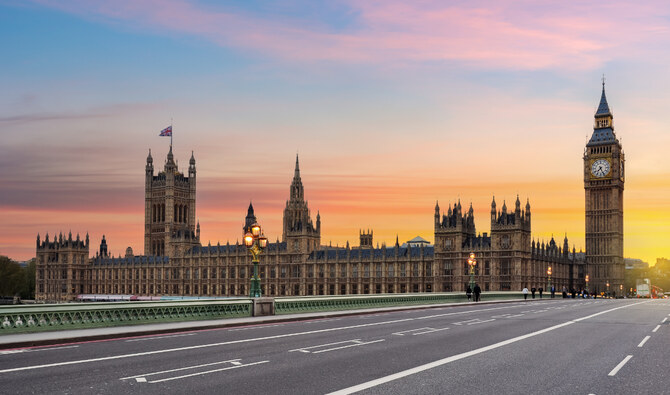
The forum on evolving dynamics between the UK and the Gulf Cooperation Council was held at the House of Lords in London on Dec. 11. (Shutterstock/File)
Short Url
Updated 12 December 2024
Follow

UK has ‘unique opportunity’ to bolster Gulf relations, forum told

  • House of Lords hosts high-level Emirati delegation
  • Former UK minister Liam Fox: ‘I think we have a unique historic opportunity … to help shape this part of the world’

LONDON: Top business leaders, researchers and politicians have called on the UK to bolster business and cultural ties with the Gulf.

The appeal came during a high-level discussion on evolving dynamics between the UK and the Gulf Cooperation Council at the House of Lords in London on Dec. 11.

An Emirati delegation led by Dr. Mohammed Al-Ali, CEO of Trends Advisory, discussed politics, counter-extremism and security within the UAE and wider Gulf.

The forum was moderated by Lady Olga Maitland, security expert and former MP, and featured comments from Al-Ali; Liam Fox, former UK defense minister; Syrian journalist Ghassan Ibrahim; former Conservative MP Daniel Kawczynski; Conservative Middle East Council Director Charlotte Leslie; and David Abrahams, former vice president of the Royal United Services Institute, among others.

Trade between the UK and the GCC has been valued at about $78 billion, according to this year’s figures. The two sides have held talks on a free trade agreement for a number of years.

Fox described Britain’s relationship with the Gulf bloc as “one of the most important trading relationships.”

He said: “I think there are reasons to be optimistic in the region. I think there are reasons to look at the building blocks that are there, to look at the quality of the leadership in the region and say, if we’ve ever had a chance to do something different, if we’ve ever had a chance to break away and not be prisoners of our history, that’s where we are now.”

But, Fox added: “History is littered with examples of when windows of opportunity opened and then closed before anyone had the willingness, the courage and the leadership to do it.

“I think we have a unique historic opportunity in maybe just the coming months, but the coming period, to help shape this part of the world, in a way that’s not impossible, and that’s the real challenge.”

Al-Ali hailed the “widespread presence” of Anglophone culture in the UAE and wider Gulf, including British educational institutions.

These “foster strong cultural ties and strengthen connections,” he added.

The Trends Advisory CEO called for the launch of a strategic council to push through the long-awaited UK-GCC free trade agreement.

Leslie hailed the Gulf’s experience in “bringing people together” in a world that is “ever more polarized.”

The UK could draw on Gulf experience developing counter-extremist organizations, she said.

Kawczynski, who took nine delegations to Riyadh during his time as an MP, singled out Saudi Arabia for particular praise.

“I’m very pleased that Keir Starmer, the prime minister, has been to Saudi Arabia this week … and I’m very pleased that parliamentarians across all political parties are starting to realize the importance of Saudi and the GCC,” he said.

The former MP added that he was “blown away” by the “sheer scale of Emirati investment” in London, and highlighted the importance of building economic interdependence between the UK and the Gulf.

Ibrahim, who heads the Global Arab Network, hailed Al-Ali’s visit as a “testament to the strength and importance of relations between the UAE and UK, as well as the rest of the GCC.”


Report highlights role of British Muslim charitable giving in supporting UK public services

Updated 05 December 2025
Follow

Report highlights role of British Muslim charitable giving in supporting UK public services

  • The study, “Building Britain: British Muslims Giving Back,” finds that donations from British Muslims are helping to bolster overstretched service

LONDON: British Muslim charitable giving is playing an increasingly significant role in supporting frontline public services across the UK, according to a new report by policy and research organization Equi.

The study, “Building Britain: British Muslims Giving Back,” finds that donations from British Muslims are helping to bolster overstretched services, including local councils, the NHS and welfare systems, at a time of growing financial pressure.

The report estimates that Muslim donors contribute around £2.2 billion ($2.9 billion) annually, making them the UK’s most generous community.

This figure is around four times the national giving average and rises to almost 10 times the average among higher earners.

According to the findings, Muslim-led charities are providing a wide range of support, including housing assistance, emergency cash grants, food provision and mental health services, easing demand on statutory services.

Equi points to evidence from 2023 showing that housing support delivered by the National Zakat Foundation helped prevent evictions that would have cost councils an estimated £28.8 million, with every £1 of charitable spending generating £73 in public sector savings.

The report also highlights a generational shift, with younger British Muslims increasingly directing their donations toward domestic causes such as homelessness, child poverty and mental health challenges.

Despite their growing impact, Muslim charities face a number of barriers, including de-banking, restrictive funding rules, securitization measures and what the report describes as limited recognition from government. Equi argues that these challenges are constraining the sector’s ability to maximize its contribution.

“British Muslim giving is not just generosity but a lifeline for public services that needs recognizing,” said Equi Managing Director Prof. Javed Khan.

“From preventing evictions to supporting mental health, these donations are saving millions for the taxpayer and strengthening communities across Britain. The evidence is clear that Muslim-led action is delivering frontline support where the state is struggling,” he added.

Equi is calling on policymakers to engage more closely with Muslim-led charities and to move beyond what it describes as symbolic recognition.

The report recommends measures such as UK-based match-funding schemes and greater faith literacy within policymaking, which it says could unlock billions of pounds in additional domestic spending while maintaining the UK’s global humanitarian commitments.

The study concluded that with greater collaboration between government and Muslim charities, charitable giving could play an even more transformative role in strengthening public services and social cohesion across the country.