Sudan largest humanitarian crisis ever recorded: IRC report

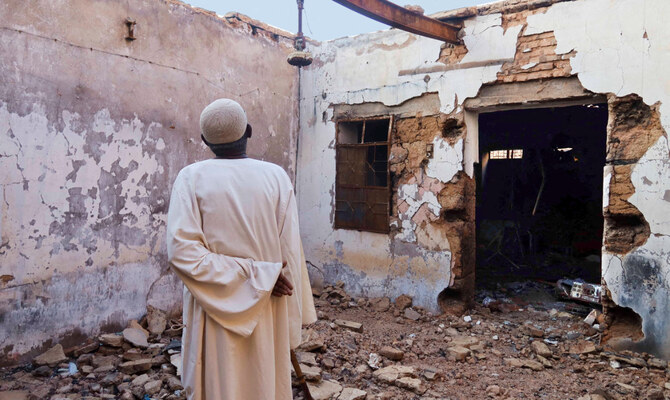
Nearly 9 million of those are displaced within Sudan, most in areas with decimated infrastructure and facing the threat of mass starvation. (AFP)
Short Url
Updated 11 December 2024
Follow

Sudan largest humanitarian crisis ever recorded: IRC report

  • Report highlights 20 countries at greatest risk of humanitarian deterioration, with Sudan ranking highest

CAIRO: Sudan has become the “biggest humanitarian crisis ever recorded” after 20 months of devastating war between rival generals, the International Rescue Committee said in a report released Wednesday.

“The country accounts for 10 percent of all people in humanitarian need, despite being home to less than 1 percent of global population,” the New York-based organization said in their 2025 Emergency Watchlist.

Since April 2023, a war between the Sudanese regular army and the paramilitary Rapid Support Forces has killed tens of thousands of people and uprooted 12 million.

Nearly 9 million of those are displaced within Sudan, most in areas with decimated infrastructure and facing the threat of mass starvation.

Across the country, nearly 26 million people — around half the population — are facing acute hunger, according to the United Nations.

Famine has already been declared in the Zamzam displacement camp in the western Darfur region, and the United Nations has said Sudan is facing the worst humanitarian crisis in recent memory.

IRC’s report highlights the 20 countries at greatest risk of humanitarian deterioration, with Sudan ranking highest on the list for the second year in a row.

They said a total of 30.4 million people were in humanitarian need across the northeast African country, making it “the largest humanitarian crisis since records began,” the IRC said.

There is no end to the war in sight, with both parties intensifying strikes on residential areas in recent weeks.

The IRC warned of total “humanitarian collapse,” as the health crisis was set to worsen and both sides continued to “choke humanitarian access.”

Around 305 million people worldwide are in need of humanitarian support, according to IRC, with 82 percent of them in watchlist areas such as the occupied Palestinian territories, Myanmar, Syria, South Sudan and Lebanon.

“It is clear that ‘the world is on fire’ is a daily reality for hundreds of millions of people,” IRC chief David Miliband said.

“The world is being cleaved into two camps: between those born in unstable conflict states, and those with a chance to make it in stable states.”


US forces withdraw from Syria’s Al-Tanf base: Syrian military sources

Updated 7 sec ago
Follow

US forces withdraw from Syria’s Al-Tanf base: Syrian military sources

  • The Americans had been moving equipment out of Al-Tanf base for the past 15 days, one source told AFP
  • Following the withdrawal from Al-Tanf, US troops are mainly now based at the Qasrak base in Hasakah

DAMASCUS: US forces have withdrawn to Jordan from Syria’s Al-Tanf base, where they had been deployed as part of the international coalition against the Daesh group, two Syrian military sources told AFP on Wednesday.
One source said “the American forces withdrew entirely from Al-Tanf base today” and decamped to another in Jordan, adding Syrian forces were being deployed to replace them.
A second source confirmed the withdrawal, adding the Americans had been moving equipment out for the past 15 days.
The second source said the US troops would “continue to coordinate with the base in Al-Tanf from Jordan.”
During the Syrian civil war and the fight against Daesh group, US forces were deployed in the country’s Kurdish-controlled northeast and at Al-Tanf, near the borders with Jordan and Iraq.
The Kurdish-led Syrian Democratic Forces (SDF) had been a major partner of the anti-Daesh coalition, and were instrumental in the group’s territorial defeat in Syria in 2019.
However, after the fall of longtime ruler Bashar Assad over a year ago, the United States has drawn closer to the new government in Damascus, recently declaring that the need for its alliance with the Kurds had largely passed.
Syria agreed to join the anti-Daesh coalition when President Ahmed Al-Sharaa visited the White House in November.
As Al-Sharaa’s authorities seek to extend their control over all of Syria, the Kurds have come under pressure to integrate their forces and de facto autonomous administration into the state, striking an agreement to do so last month after losing territory to advancing government troops.
Since then, the US has been conducting an operation to transfer around 7,000 suspected jihadists from Syria — where many were being held in detention facilities by Kurdish fighters — to neighboring Iraq.
Following the withdrawal from Al-Tanf and the government’s advances in the northeast, US troops are mainly now based at the Qasrak base in Hasakah.
Despite Daesh’s territorial defeat, the group remains active.
It was blamed for a December attack in Palmyra in which a lone gunman opened fire on American personnel, killing two US soldiers and a US civilian.
Washington later conducted retaliatory strikes on Daesh targets in Syria.