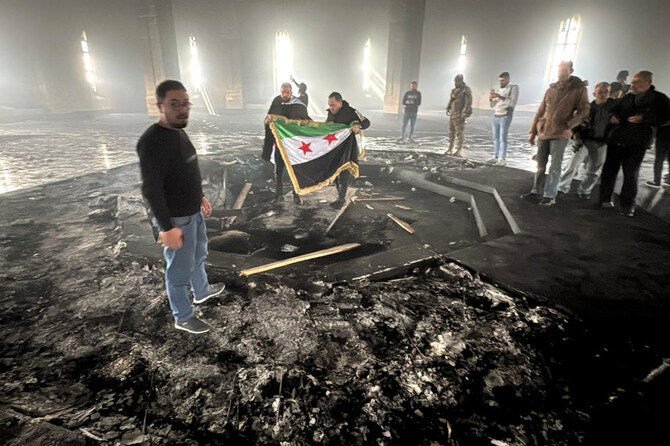
QARDAHA, Syria: The tomb of ousted Syrian president Bashar Assad’s father Hafez was torched in his hometown of Qardaha, AFP footage taken Wednesday showed, with militants in fatigues and young men watching it burn.
The Syrian Observatory for Human Rights war monitor told AFP the militants had set fire to the mausoleum, located in the Latakia heartland of Assad’s Alawite community.
AFP footage showed parts of the mausoleum ablaze and damaged, with the tomb of Hafez torched and destroyed.
The vast elevated structure atop a hill has an intricate architectural design with several arches, its exterior embellished with ornamentation etched in stone.
It also houses the tombs of other Assad family members, including Bashar’s brother Bassel, who was being groomed to inherit power before he was killed in a road accident in 1994.
On Sunday, a lightning offensive by militants seized key cities before reaching Damascus and forcing Assad to flee, ending more than 50 years of his family’s rule.


Tomb of Assad’s father set on fire in Syria hometown

https://arab.news/8uweb
Tomb of Assad’s father set on fire in Syria hometown

- Mausoleum also housed the tombs of other Assad family members


Lebanese army sets up checkpoints to implement ban on Hezbollah military activity
- Justice Minister to Arab News: State does not belong to one group over another; we are course-correcting
BEIRUT: The Lebanese army on Tuesday set up inspection checkpoints on the highway leading from Beirut to southern Lebanon, particularly in the Zahrani area toward Nabatieh and Tyre, in implementation of the government’s recent decisions to ban Hezbollah’s military activity.
The military checkpoints focused on vehicles traveling south in an unusual development as tens of thousands of residents were simultaneously fleeing in the opposite direction toward Beirut after the Israeli army issued evacuation warnings to civilians in dozens of villages south and north of the Litani River.
At the army positions, security personnel checked identification documents, searched vehicles for weapons, and questioned drivers about the purpose of their travel to the south.
The measures mark an unprecedented scene in Lebanon over the past four decades. Since the end of the civil war, Hezbollah has retained its arsenal under the banner of “resistance,” unlike other militias that disarmed under the 1989 Taif Agreement and subsequent international resolutions.
A judicial source told Arab News that the Lebanese army checkpoints are tasked with searching for those carrying weapons and launching rockets, and arresting all armed individuals, but noted that “so far no one has been arrested.”
Minister of Justice Adel Nassar told Arab News: “The government was clear in its decisions and their implementation against those who violate the law. Hezbollah is the product of 40 years of accumulation, and today we are course-correcting.”
Nassar reflected on the government’s efforts to restrict weapons to state control during the year following the Nov. 2024 ceasefire agreement between Lebanon and Israel.
“We waited for a response to the state, which is not for one group at the expense of another, but rather a guardian for all people. There were attempts to push toward engagement in the state project instead of engagement with external parties, and we have now reached this point,” he told Arab News.
Hezbollah had responded to the government’s decisions on Monday night by issuing a statement signed by MP Mohammad Raad, whose death in an Israeli strike at dawn on Monday had been rumored, describing them as “decisions against the Lebanese.”
Following its rejection of the decisions, Hezbollah launched more rockets at the Upper Galilee, claiming responsibility in statements issued under the banner of defending the south.
The militant group accused the government of “having been incapable of making decisions on war and peace and imposing them on the enemy that violates national peace and persists in its aggressive war against Lebanon and its people.”
Nassar reiterated that arrest warrants for those who launched rockets have entered into force and investigations are underway.
“There is more than one matter being pursued to identify those responsible,” refusing to disclose details.
On Tuesday, President Joseph Aoun told members of the Quintet Committee at the Presidential Palace that the decision to reserve for the Lebanese state alone the exclusive authority over war and peace, and to ban all military and unlawful security activity outside its authority, “is a sovereign and irreversible one.”
He added: “The Cabinet has tasked the army and security forces with implementing this decision across all Lebanese territory, stressing that the state alone has the sole right to decide on war and peace”.
An official source told Arab News that the president and prime minister remain in contact with world leaders and key stakeholders, urging an end to the Israeli war on Lebanon.
According to the Lebanese Presidency’s media office, French President Emmanuel Macron reaffirmed his country’s “unwavering support for Lebanon”, noting that the Cabinet’s decisions reinforce the Lebanese state’s sovereignty across its territory and affirm its sole authority over weapons.
Prime Minister Nawaf Salam received a call from Arab League Secretary-General Ahmed Aboul Gheit, who reaffirmed the League’s support for the government’s decisions.
On Tuesday, the Lebanese army redeployed from newly established positions along the Blue Line to its main bases in frontline villages, amid Israeli statements about creating a new buffer zone in southern Lebanon.
Meanwhile, UNIFIL announced the withdrawal of all civilian staff from its headquarters in Naqoura. At the same time, Israeli airstrikes intensified on Beirut’s southern suburbs and southern Lebanon, targeting what Israel claimed were meetings of Hezbollah leaders.
Lebanese Forces communications and media chief Charles Jabbour called for “a clear separation between the political and field dimensions in assessing the developments of the past 48 hours in Lebanon”.
Speaking to Arab News, he said that for the first time, the Lebanese state had taken decisions that effectively dismantled Hezbollah’s military wing, “meaning there is no longer any so-called ‘resistance’ or any weapons outside the state’s authority.”
He described the move as “historic and unprecedented”, while stressing that its implementation would take time.
Jabbour pointed out that none of the political parties or forces objected to the government’s move against Hezbollah, including the group’s closest allies. “Figures the party had supported for years remained silent and said it had no right to drag Lebanon into conflict.”
He stressed that authorities must be given sufficient time, but in return, they must swiftly implement the decisions they have taken. “I believe the Iranian project and its proxies are nearing their end”.
By contrast, Mahmoud Qamati, deputy head of Hezbollah’s political council, said the party’s military escalation against Israel stemmed from what he described as an inability to continue tolerating “the killing of our citizens, the destruction of our people’s homes, and accusations of weakness”, while the government, he claimed, continued to make “free concessions” to the enemy and pursue a policy of “strangulation”.
In a speech directed at Hezbollah’s support base in the South, he declared that “the period of patience has ended, leaving us with no choice but to return to resistance, even if that means an open war with the enemy”.
The United Nations estimated that at least 30,000 people were displaced in Lebanon over the past two days as a result of the Israeli raids, while no official figures were released by the Lebanese ministries of interior and social affairs.