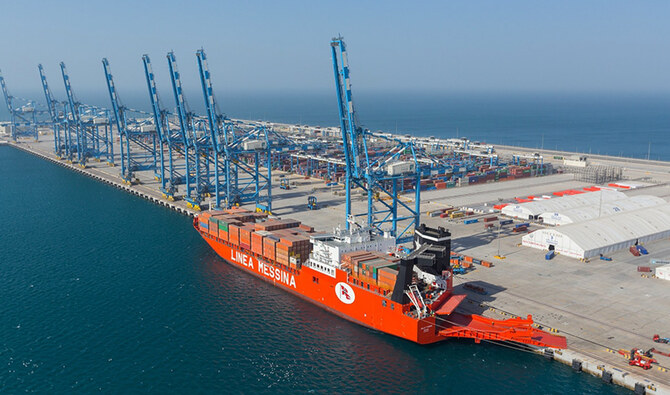
ISLAMABAD: Parliamentary Secretary for Planning, Development and Special Initiatives, Wajiha Qamar, on Wednesday informed the lower house of Pakistan’s parliament that the southwestern deep-sea port at Gwadar was “fully operational” and equipped to handle all kinds of cargo.
Gwadar is on the Arabian Sea in the southwestern province of Balochistan, a mineral-rich region plagued by a decades-long separatist insurgency. China has invested heavily in the province, including by developing Gwadar, which is key to the China-Pakistan Economic Corridor (CPEC) that also encompasses infrastructure and energy projects and is part of Chinese President Xi Jinping’s Belt and Road Initiative.
The China Overseas Port Holding Company (COPHC), which operationally handles Gwadar, plans to eventually expand the port’s capacity to up to 400 million tons of cargo per year. Long term plans for the port require a total of 100 berths to be developed by 2045. For now, Gwadar is underutilized for commercial import and export due to reasons such as distance from the marketplaces of the country, security and services availability.
Earlier this year, Prime Minister Shehbaz Sharif had ordered that 50 percent of all public sector cargo be brought to Pakistan through Gwadar. The instructions subsequently received cabinet approval in September.
“The National Assembly was informed on Wednesday that Gwadar Port is currently fully operational, equipped to handle general cargo, containers, and other operations,” Radio Pakistan reported on Wednesday.
“Responding to a question during the Question Hour, Parliamentary Secretary Planning Development and Special Initiatives Wajiha Qamar said the Port accommodates vessels of up to 50,000 DWT [deadweight tonnage] and possesses the requisite infrastructure to support bulk cargo and container handling efficiently.”
She added that multiple shipments under the Afghanistan-Pakistan Transit Trade Agreement had been successfully processed at the port.
In March this year, Pakistani security forces repulsed a gun and bomb attack by militants on a complex outside the strategic port of Gwadar, which killed all eight militants and two soldiers, officials said. In the same month, a suicide bomber killed five Chinese engineers traveling to a dam site in the country’s northwestern Khyber Pakhtunkhwa province.
Beijing has since publicly voiced concerns about the security of its workers and projects in Pakistan. Militants have also previously attacked Chinese nationals and targeted projects, viewing China as a foreign invader trying to gain control of the region’s resources.
The start of operations at a Chinese-funded airport in Gwadar was also pushed back for a security review this August after a string of deadly attacks by separatist militants in the Balochistan in which over 50 people were killed.


Gwadar port ‘fully operational,’ official tells Pakistan National Assembly
https://arab.news/2n6an
Gwadar port ‘fully operational,’ official tells Pakistan National Assembly

- China Overseas Port Holding Company plans to eventually expand port’s capacity to up to 400 million tons of cargo per year
- Gwadar underutilized for import and export due to distance from marketplaces of the country, security and services availability

Pakistan rejects Amnesty claims of Israeli spyware use, calls reports ‘disinformation’
- FO denies any link with Israel, says Pakistan has “absolutely no cooperation” on surveillance tools
- Islamabad accuses India of delaying clearance for relief aircraft bound for flood-hit Sri Lanka
ISLAMABAD: Pakistan on Friday rejected an Amnesty International report alleging the use of Israeli-made invasive spyware in the country, calling the findings speculative and misleading.
Amnesty’s investigation, published Thursday under the title Intellexa Leaks, cited the case of a Pakistan-based human rights lawyer who reported receiving a suspicious WhatsApp link in 2025. According to Amnesty International’s Security Lab, the link bore signatures consistent with Predator, a spyware product developed by Israeli manufacturer c
Foreign Office spokesperson Tahir Andrabi dismissed the suggestion that Islamabad had deployed the tool or maintained any technological cooperation with Israel.
“These are all media speculations. These are all rumor-mongering and disinformation. There is absolutely no cooperation between Pakistan and Israel on anything, let alone a spyware or these kinds of tools. So, I would reject it quite emphatically,” he said at a weekly briefing.
Andrabi also accused India of obstructing humanitarian operations, saying New Delhi delayed flight clearance for a Pakistani relief aircraft carrying aid to flood-affected Sri Lanka.
“The special aircraft carrying Pakistan’s relief goods had to wait for 48 hours, in fact more than 48 hours, around 60 hours, while the flight clearance from India was delayed,” he said.
He added that the eventual conditional flight window was too narrow to be workable.
“The partial flight clearance which eventually was given after 48 hours was operationally impractical, time-bound just for a few hours and hence not operable, severely hindering the urgent need for the relief mission for the brotherly people of Sri Lanka,” Andrabi stated.
“Humanitarian assistance is like justice, if it is delayed, it is denied.”
Responding to India’s claim that clearance was granted within four hours, he said Pakistan has documentary proof contradicting New Delhi’s version.
On a separate question about reported delays in the arrival of a Turkish delegation aimed at mediating between Islamabad and Kabul, Andrabi said Pakistan welcomed Ankara’s initiative but was unaware of the cause of postponement.
“We stand ready to receive the Turkish delegation. That delegation has not arrived as yet. And I’m not aware of any schedule. Pakistan is ready to hold negotiations, discussions,” he said, adding that the delay may be linked to coordination with the Afghan side.


