

Pakistan’s Punjab to develop ‘advanced air quality management system’ with Chinese help

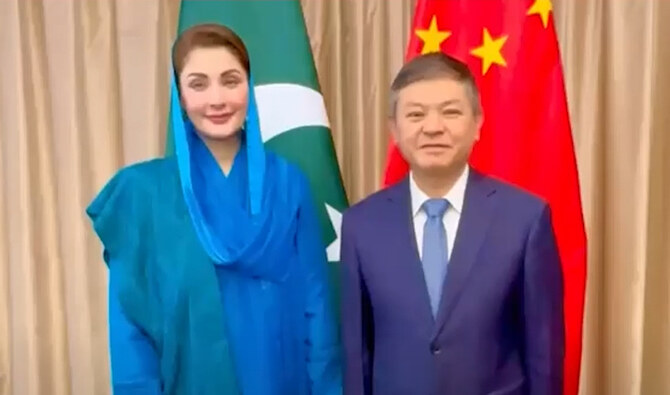
Pakistan’s Punjab Chief Minister Maryam Nawaz (left) poses for a photo with China’s Minister of Ecology and Environment, Huang Runqiu, during their meeting in Beijing on December 10, 2024. (Screengrab/X/@pmln_org)
Short Url
Updated 11 December 2024
Follow

Pakistan’s Punjab to develop ‘advanced air quality management system’ with Chinese help

  • Beijing-Punjab Clean Air joint working group set up during chief minister’s ongoing visit to China
  • Nearly two million people in Pakistan fell ill when smog choked Punjab for over two weeks last month

ISLAMABAD: Pakistan’s most populous province of Punjab will develop an advanced air quality management system with the help of China to combat an enduring smog and pollution crisis, a statement from the provincial chief minister’s office said on Wednesday. 

Smog had choked Pakistan’s eastern Punjab province for weeks last month, sickening nearly two million people and shrouding vast swathes of the province in a toxic haze. 

On Wednesday, Lahore, the capital of Punjab, was listed as the world’s sixth most polluted city by Swiss air monitor IQAir, and its PM2.5 concentration, which comprises air particles that damage lungs, was 20.5 times the World Health Organization annual guideline value. The province had closed down schools and offices for days last month, banned outdoor activities and shortened timings for restaurants, shops and markets in a bid to control smog.

“Agreement reached to develop an advanced air quality management system in Punjab with China’s collaboration,” the ruling PML-N party in Punjab said in an X post after Sharif met Chinese environment authorities. “Decision to establish the ‘Beijing-Punjab Clean Air Joint Working Group’ has been made.”

The officials also discussed wildlife conservation and plantation projects, with Sharif saying Punjab would leverage China’s expertise and experience in implementing an e-transport system in the province.

China has taken significant steps to combat its worsening air quality, declaring a “war on pollution” in 2015. Key measures include reducing coal consumption, increasing renewable energy capacity, and improving air quality monitoring systems. 

However, researchers said last month China’s emissions of carbon dioxide were on course to rise slightly this year, despite rapid progress on renewables and electric vehicles, putting a key 2025 climate target further out of reach.

China wants to cut the amount of CO2 it produces per unit of economic growth by 18 percent over the 2021-2025 period, but it fell further behind this year as a result of rising energy demand, said the Helsinki-based Center for Research on Energy and Clean Air (CREA) in its annual assessment.


Pakistan’s deputy PM says country will not send forces to Gaza to disarm Hamas

Updated 9 sec ago
Follow

Pakistan’s deputy PM says country will not send forces to Gaza to disarm Hamas

  • Ishaq Dar says Pakistan open to peacekeeping but Gaza’s internal security is Palestinian responsibility
  • Pakistan’s top religious clerics from different schools have warned against sending forces to Palestine

ISLAMABAD: Deputy Prime Minister Ishaq Dar said on Saturday Pakistan was willing to contribute to an international peacekeeping force in Gaza, though it would not deploy troops to disarm or de-weaponize Hamas.

The statement follows media reports saying Washington views Pakistan as a potentially significant contributor given its battle-hardened military and wants it to be part of International Stabilization Force (ISF), which is part of United States President Donald Trump’s 20-point framework for a Gaza peace plan.

The plan announced by Trump at the White House on September 29 was formally adopted at the Sharm El-Sheikh Peace Summit in October. Co-chaired by Trump and Egyptian President Abdel Fattah El-Sisi, the summit brought together leaders from 27 countries to sign the “Trump Declaration for Enduring Peace and Prosperity.”

Deployment of troops from Muslim-majority countries during a transitional stabilization phase is a key part of the plan before the war-ravaged Palestinian territory moves toward reconstruction and a longer-term political settlement.

“If they say that we should go and start fighting, disarm Hamas, de-weaponize them, and go and destroy the tunnels that Hamas has built until now, that is not our job,” Dar, who is also the country’s foreign minister, told reporters during a year-end briefing in Islamabad.

He emphasized there was clarity between Pakistan’s civil and military leadership over the matter.

“We have a very complete understanding on this matter that we cannot do that kind of work,” he added.

The deputy prime minister said Pakistan had been using the term “peacekeeping” and had never used the phrase “peace enforcement” while discussing the force.

“I have been very clear: Pakistan will be happy to join if the mandate is not peace enforcement and disarming and de-weaponizing Hamas.”

The government’s stance comes amid growing domestic pressure over the issue.

On Monday, a group of Pakistan’s top religious leaders, chaired by prominent scholar Mufti Taqi Usmani, warned the government against yielding to what they described as international pressure to send forces to Gaza.

In a joint statement from Karachi, the clerics — representing Deobandi, Barelvi, Ahl-e-Hadees and Shia schools of thought — said that Washington wanted Muslim countries to send their forces to Gaza to disarm Hamas.

“Several Muslim governments have already refused this, and pressure is being increased on Pakistan,” it added.

Addressing such concerns, Dar said Pakistan would not land its forces in Palestine to “fight Muslims.”

Israel has repeatedly called for the disarmament of Hamas as a precondition for any long-term settlement, and the United Nations Security Council has also endorsed the ISF framework in November.

However, Dar maintained during the media briefing the internal security of Gaza was the Palestinian responsibility.

“The Palestinian Authority, their government, it is their job, it is the job of their law enforcement agency,” he said

The deputy prime minister also highlighted Pakistan’s involvement in the “Arab Islamic Group of Eight,” including Saudi Arabia, Jordan, Egypt, the United Arab Emirates, Qatar, Turkiye and Indonesia, which has been coordinating on the crisis.

He said the efforts of these countries had brought some peace to Palestine and reduced bloodshed.

“Our declared policy is that there should be an independent two-state solution,” he continued while calling for pre-1967 borders.