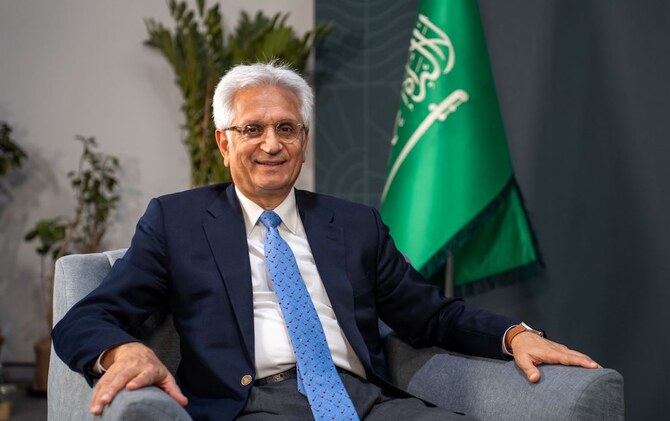

RIYADH: Saudi Arabia is playing a crucial role in guiding the Arab world to a path of sustainable development, with the Kingdom spearheading the green transition journey in the region, a top official said.
Speaking to Arab News on the sidelines of the UN’s COP16 in Riyadh, Merza Hasan, the special adviser to the chairman of the Arab Fund for Economic and Social Development, said that water scarcity is one of the most critical problems nations will face due to adverse effects of climate change.
“The Arab Fund was created by 22 Arab countries. The biggest two shareholders are Kuwait and Saudi Arabia. And Saudi, the way they look at the development now, they want to pass all this experience and the vision and whatever they learn, the different sectors which they are investing in, to scale it up to other countries, and especially with the Arab countries,” said Hasan.
He added: “I think what is happening now in Saudi Arabia, it is the biggest laboratory of development and development ideas.”
Hasan said the Kingdom should exchange its expertise in various sectors like water, electricity, and tourism, as well as infrastructure and job creation, with neighboring Arab nations.
Through the Saudi and Middle East Green Initiatives, the Kingdom has spearheaded the sustainable revolution in the wider region over the past few years.
The fourth edition of SGI, organized on the sidelines of COP16, also launched five new groundbreaking environmental projects, valued at SR225 million ($60 million).
These marked a significant step forward in Saudi Arabia’s ambitious environmental strategy, bringing the total investment in SGI initiatives to over $188 billion.
Hasan added that the Arab Fund, in the future, will be investing more to ensure water security in its member nations.
“Water is linked to many things; livelihood, prosperity, food security and manufacturing. The Arab Fund, in the coming years, is going to put a lot of resources into the water sector and addressing water challenges in the Arab region,” said Hasan.
He added: “It (water crisis) is huge, it is big. The way I can describe it, we are now in crisis. If we do not do anything and if we do not act fast, we are going to be in catastrophe.”
During the talk, Hasan revealed that the Arab Fund is giving prime preference to the green economy, and the future projects initiated by the organization will be completely sustainable.
During COP16, the Arab Coordination Group committed up to $10 billion by 2030 to address the critical challenges of land degradation, desertification, and drought.
“We are going to improve our knowledge when it comes to anything related to the environment, water, and the agricultural sector, and we want to inject green into that knowledge. We are not rich in our data, we are extremely poor when it comes to the data related to many things that are related to the environment,” said Hasan.
He also revealed that the fund is currently creating an Arab Development Data portal, where Saudi Arabia is also playing a pivotal role.
“We are working with all the statistical units to improve the capacity when it comes to the data and data related to the environment and green economy. We are also linking it to the many of these intellectual reports which are available, which nobody tapped into,” added Hasan.
He said that the fund is also using advanced technologies such as artificial intelligence to collect and leverage data to ensure a sustainable future.