

Arab Fund to launch observatory to address water scarcity

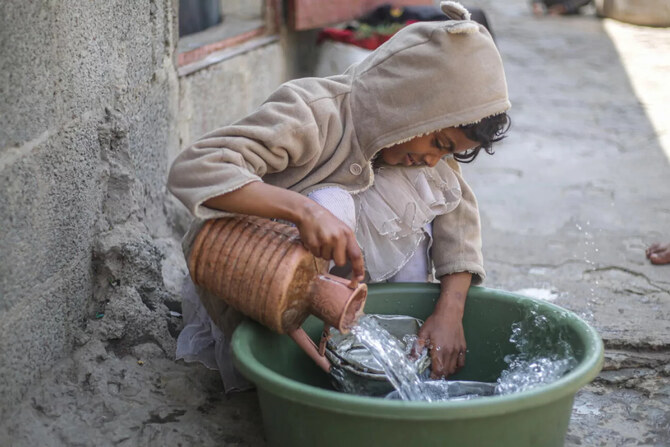
The observatory will provide vital data and insights to stakeholders, helping them make informed decisions to address the growing challenges of water scarcity. File
Short Url
Updated 11 December 2024
Follow

Arab Fund to launch observatory to address water scarcity

  • Observatory will foster collaboration and attract investments to solve the region's urgent water management challenges
  • Fund reaffirmed its commitment to enhancing regional water and food security

RIYADH: The Arab Fund for Economic and Social Development is set to launch a new Water Observatory aimed at boosting investments in sustainable water solutions across the region.

Announced at the 16th session of the UN Convention to Combat Desertification’s Conference of the Parties in Riyadh, this initiative is designed to improve data collection and accessibility on water-related projects.

The observatory will provide vital data and insights to stakeholders, helping them make informed decisions to address the growing challenges of water scarcity.

The initiative is aligned with the Arab Fund’s ongoing commitment to combat water scarcity, a critical issue in a region where 12 countries face severe water shortages, each with less than 500 cubic meters of water per capita annually.

“Addressing water scarcity requires billions in investments, but these resources must be strategically allocated to create meaningful, long-term impact,” said Merza Hasan, senior adviser to the chairman of the Arab Fund for Economic and Social Development.

“By collaborating with regional and global partners from the public and private sectors, as well as financial institutions, we can address overconsumption and ensure water sustainability for future generations.”

The fund’s statement emphasized that the observatory will foster collaboration and attract investments to solve the region's urgent water management challenges.

At COP16, the fund reaffirmed its commitment to enhancing regional water and food security, noting its support for the Riyadh Green Initiative. This is part of a broader $10 billion pledge by the Arab Coordination Group to promote sustainable development in the region.

In addition, the fund hosted two events. One focused on advancing water management policies, exploring innovative financing mechanisms, and fostering international partnerships. The other brought together private sector leaders to share strategies and experiences on successful water-related investments, emphasizing the essential role the private sector plays in addressing water scarcity.

Moreover, the Arab Fund held high-level bilateral meetings with ACG member states, senior government officials, and representatives from regional and global development organizations, including UN agencies. These discussions aimed to explore potential partnerships and co-financing opportunities to advance the Sustainable Development Goals across the Arab region.

To date, the Arab Fund has financed 671 projects totaling 10.72 billion Kuwaiti dinars ($34.87 billion), benefiting 22 countries.


Saudi Arabia’s economy expands by 4.8% in Q3: GASTAT 

Updated 7 sec ago
Follow

Saudi Arabia’s economy expands by 4.8% in Q3: GASTAT 

RIYADH: Saudi Arabia’s gross domestic product expanded by 4.8 percent in the third quarter of this year compared to the same period in 2024, driven by growth in both oil and non-hydrocarbon sectors, official data showed. 

According to estimates by the General Authority for Statistics, oil activities in the Kingdom advanced by 8.3 percent year on year in the third quarter, while the non-oil sector recorded a growth rate of 4.3 percent during the same period. 

Government activities also expanded by 1.4 percent compared to the same quarter of the previous year. 

The strong performance underscores progress under the Kingdom’s Vision 2030 strategy, which aims to diversify the economy and reduce reliance on crude revenues. 

“The main driver of growth in real GDP was non-oil activities, which contributed 2.4 percentage points. Oil activities contributed 2 percentage points. Net taxes on products and government activities contributed 0.2 percentage points each,” said GASTAT. 

All economic activities recorded positive annual growth. Petroleum refining achieved the highest rate in the third quarter, rising 11.9 percent year on year, followed by crude petroleum and natural gas activities at 7.3 percent, and electricity, gas and water activities at 6.4 percent. 

On a seasonally adjusted basis, Saudi Arabia’s GDP expanded by 1.4 percent in the third quarter compared to the previous three months. 

Oil activities grew by 3.3 percent quarter on quarter, while government activities and non-oil activities advanced by 1 percent and 0.6 percent, respectively. 

Regarding the trade balance, exports increased 18.4 percent year on year in the third quarter and 7.5 percent quarter on quarter. 

Imports rose by 4.3 percent compared to the same period last year, although inbound shipments were down 1.2 percent from the previous quarter. 

Earlier this month, the World Bank upgraded its 2025 economic growth forecast for Saudi Arabia to 3.8 percent, up from its earlier estimate of 3.2 percent, citing renewed momentum in both oil and non-oil sectors. 

In October, the International Monetary Fund also raised its economic growth forecast for the Kingdom to 4 percent for both 2025 and 2026.