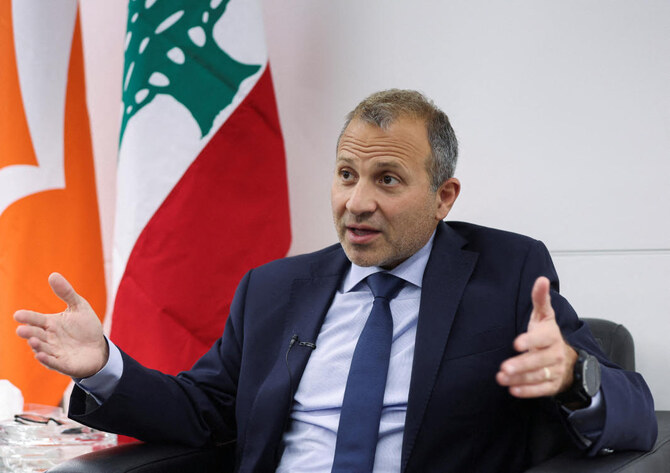
PARIS: Iran-backed Hezbollah needs to focus on domestic issues in Lebanon and not the wider region, senior Lebanese Maronite politician Gebran Bassil said on Tuesday, adding that he was against the head of the army running for the presidency.
A year of fighting between Hezbollah and Israel, which culminated in a tentative ceasefire brokered by the United States and France in November, saw more than 4,000 killed, thousands displaced and the powerful Shiite group considerably weakened militarily with many of its leaders dead.
“It’s a process whereby Hezbollah accepts that they are part of the Lebanese state and are not parallel to the state,” Bassil, a Maronite Christian, who is one of Lebanon’s most influential politicians, told Reuters in an interview in Paris.
“We don’t want their end. We want them to be partners in the Lebanese nation, equal to us in abiding by the rules and preserving the sovereignty of Lebanon. We agree with them on defending Lebanon and supporting the Palestinian cause, but politically and diplomatically, not militarily.”
Bassil, who said the group should distance itself from the Iran-aligned “Axis of Resistance,” is head of the Free Patriotic Movement (FPM), a Christian party founded by former President Michel Aoun, his father-in-law, that has been aligned with Hezbollah.
He was sanctioned by the United States in 2020 for alleged corruption and material support to Hezbollah. He denies the accusations.
He was in Paris meeting French officials. He declined to say whether he met Donald Trump’s regional envoy and fellow Maronite Massad Boulos, who accompanied the US president-elect to France last weekend.
Since the truce, Paris has increased efforts to discuss with the myriad key actors in Lebanon over how to break a political impasse after two years without a president or permanent government.
The presidential post is reserved for Christians, but part of the standoff reflects rivalries among the community as well as crucial political and religious balances in the country.
Authorities finally announced that the parliament would meet on Jan. 9 to elect a new president.
Bassil, who has enough lawmakers to block a Maronite candidate, said he was against the candidacy of Joseph Aoun, the head of the army, who diplomats say both the United States and France consider as a serious candidate.
He said Aoun’s appointment would be against the constitution and that he did not have consensus among all the Lebanese factions.
“We are against him because we don’t see him as being fit for the presidency,” Bassil said. “We need candidates who can bring the Lebanese together,” he said declining to name one.


![]()

Hezbollah must focus on Lebanon not wider region, senior politician Bassil says
Short Url
https://arab.news/533vv
Hezbollah must focus on Lebanon not wider region, senior politician Bassil says
- Parliament meets on Jan. 9 to decide on president
- Hezbollah weakened after war with Israel


Latest updates


© 2026 SAUDI RESEARCH & PUBLISHING COMPANY, All Rights Reserved And subject to Terms of Use Agreement.