


RIYADH: Misk Art Week is underway in the Kingdom’s capital with workshops, markets, and showcases curated around the theme of art and technology.
As the country accelerates to new horizons, 20 local and international participants have revealed their perspectives of Riyadh and its ever-changing nature at the “Seeing Riyadh” exhibition.
Saudi photographer Meshari Al-Dosari’s work preserves the beauty of the city and its architectural heritage. Among the photographs are scenes of old neighborhood houses with distinctive motifs and vintage cars parked at the forefront, hinting to the viewer that life still exists in these worn-out homes.

Faisal Bin Zarah platforms the iconic Al-Faisaliah and Al-Mamlakah towers in his “Moonlight Symphony” and “Aligned.” (AN photo)
Al-Dosari said: “Houses nowadays look like closed-up boxes. They don’t have the same soul. That was an era that wasn’t really documented and it’s disappearing now.
“A lot of houses are being destroyed because they’re dilapidated or need renovation, so their owners build new houses and that era disappears.”
Italian artist Armando Perna was part of Misk Art Institute’s Masaha residency last year, in which he mapped Riyadh’s evolving character and its liminality. In “Seeing Riyadh,” his work focuses on the outskirts of the city. His photographs show simple prayer buildings that are often found on travel routes.

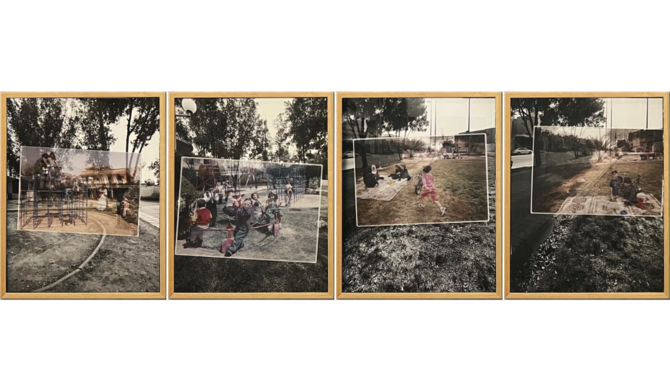
Dalal Almutairi dissects the nostalgic essences of childhood memories left behind in revisited spaces in “The Red Slide." (AN photo)
As an international artist he is fascinated by life in the desert that alludes to the old way of Saudi living that is different from the culture in cities.
He told Arab News: “In this kind of emptiness, you find these markers, which also give an identity to these places. They work in relation to the landscape.”
Part of his work also features caravans he photographed in a town north of Riyadh, which were used at the time for nomads. He added: “On the left side, there’s the modern structures with the modern caravans and on the right, these are the very old (mosques).”

The unique exhibition space, which used to be an auditorium, is lined with works that capture both the historic and contemporary marks and nuances of the changing city. (AN photo)
The exhibition space, which used to be an auditorium, is lined with works that capture both the historic and contemporary marks and nuances of the changing city.
Dalal Al-Mutairi dissects the nostalgic essences of childhood memories left behind in revisited spaces in “The Red Slide,” while Faisal Bin Zarah platforms the iconic Al-Faisaliah and Al-Mamlakah towers in his “Moonlight Symphony” and “Aligned.”
Saudi photographer Sarah Al-Ansary focuses on documenting Riyadh through its people, architecture, and culture.

As an international artist, Armando Perna was fascinated by the life in the desert that alludes to the old way of Saudi living that’s different from the culture in cities. (AN photo)
The emerging artist often visits old neighborhoods in the city, and told Arab News: “It feels amazing to capture buildings and elements that have been there for decades.”
On display are two sets of photos. One features photographs of handwritten shop signs, located in two different neighborhoods. Each sign highlights an amenity in that neighborhood, like the “neighborhood tailor” and “technical plumbing.”
She said: “What really drew me to the signs was how they were written by hand rather than being printed, which is the more common method used today. Both signs left me wondering how long they had been there.”

Saudi photographer Meshari Aldosari’s work preserves the beauty of the city. Old neighborhood houses with unique architectural motifs are framed with vintage cars parked at the forefront, letting us know that life still exists in these worn-out homes. (AN photo)
The second set of photos are of Shola Shopping Center, which opened in the 1980s but has since shut down. The artist was drawn to the bright colors and design of the building.
Al-Ansary said: “Being a part of Misk Art Week 2024 has been a wonderful opportunity to meet like-minded photographers and artists. I also loved seeing people resonate with the photos and having memories of the areas that I photographed.
“I’m very grateful to Misk Art Institute for valuing photography as an art form and giving me the opportunity to exhibit my work.”
Other participants include Hajar Ali, Latifa Al-Bokhari, Mohammed Al-Jubran, Sara Saad, and Tamara Hamad.
“Seeing Riyadh” is on view at Misk Art Week until Dec. 10.



