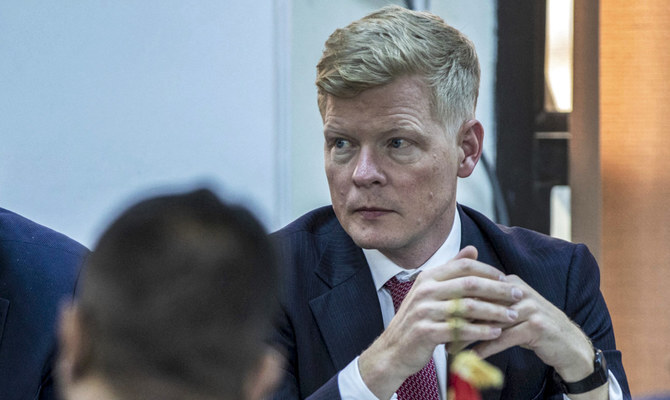
MANAMA: Yemen’s warring parties and beleaguered people cannot wait indefinitely for a roadmap to peace before the country slips back to war, the UN special envoy told AFP.
Hans Grundberg insisted it was “still possible” to solve the conflict in impoverished Yemen, where Iran-backed Houthi militants control much of the country.
But any chance of implementing a roadmap has effectively been put on hold by escalating regional crises sparked by the war in Gaza.
Although preparatory discussions are continuing with all sides, “obviously... it cannot stay like this forever,” Grundberg said in an interview at the Manama Dialogue conference in Bahrain.
“At a certain point, there is an expected delivery that the parties want to see happen. And if that doesn’t take place, you risk losing the necessary momentum that you have, and that danger is clear.”
He added: “There are belligerent voices in the region. What I’m saying is, don’t go down that road — it’s possible to settle this conflict.”
Yemen has been at war since March 2015, when a Saudi-led coalition began a campaign to dislodge the Houthis who had seized control of Yemen’s capital, Sanaa, months earlier.
A UN-brokered ceasefire in April 2022 calmed fighting and in December last year, even after the Israel-Hamas war had started, the warring parties committed to a peace process.
But US and British strikes on Houthi targets in January, after the militants began attacking shipping on the vital Red Sea trade route, “complicated the mediation space tremendously.”
“On the basis of that, we have not been able to take the step forward from the commitments that were agreed to in 2023 to the assigned roadmap,” Grundberg said.
The UN envoy said it’s not “possible to move forward with the roadmap right now, because I don’t think that the implementation of that roadmap would be possible.”
But he added: “I still believe that the foundation for a roadmap in Yemen is there because the conflict between Yemenis is solvable.
“However, the complicating factor now is the regional destabilization, where Yemen has become an integral part through the attacks in the Red Sea.”
Grundberg said the roadmap is “not a magic wand” for Yemen, which has been plunged into one of the world’s worst humanitarian crises with two-thirds of the population dependent on aid.
The roadmap is intended as a structure for implementing humanitarian and economic commitments, and steps toward a permanent ceasefire and political process, over a nominal period of three years.
“So here I think the responsibility that lies on our side is to ensure that this momentum is upheld and that the parties understand the necessity to... trust in the fact that this is possible to achieve,” Grundberg said.
“If not, the consequences are known. If you slip back into a violent confrontation internally, I think the consequences of that are pretty well known and I don’t think that they would be in favor of anyone.”
He added: “I would guess that the Yemeni people should be impatient as a whole. I think that they have been waiting for peace for far too long.
“Everyone wants this to come to an end.”


Yemen can’t wait ‘forever’ for peace roadmap, UN envoy says
https://arab.news/6rdnn
Yemen can’t wait ‘forever’ for peace roadmap, UN envoy says

- Any chance of implementing a roadmap has effectively been put on hold by escalating regional crises sparked by the war in Gaza
- Although preparatory discussions are continuing with all sides, “obviously... it cannot stay like this forever,” Grundberg said


Palestine, Egypt officials discuss Gaza safety, security
- Talks also on strategies for stability in Israeli-ravaged Occupied Territories
LONDON: Hussein Al-Sheikh, deputy president of the Palestinian Authority, discussed security and diplomatic issues during separate meetings in Cairo with Egypt’s Foreign Minister Badr Abdel Ati and Hassan Rashad, director of the Egyptian General Intelligence Service.
Al-Sheikh briefed Egyptian officials on the latest developments regarding the Occupied Territories, in the presence of Maj. Gen. Majed Faraj, head of the Palestinian General Intelligence Service.
The discussion on Sunday also focused on strategies for achieving stability and security for the Palestinian people, and progressing to the second phase of US President Donald Trump’s plan for Gaza, as reported by the Wafa news agency.
Officials aim to improve coordination and consultation to tackle the challenges facing the Israeli-ravaged Palestine and the wider region.
Al-Sheikh might become Palestine’s president in the event of a power vacuum in the Palestinian Authority, currently led by 90-year-old Mahmoud Abbas.


