

‘Hell on earth’: Bangladeshi evacuees recount Israeli attacks on Lebanon

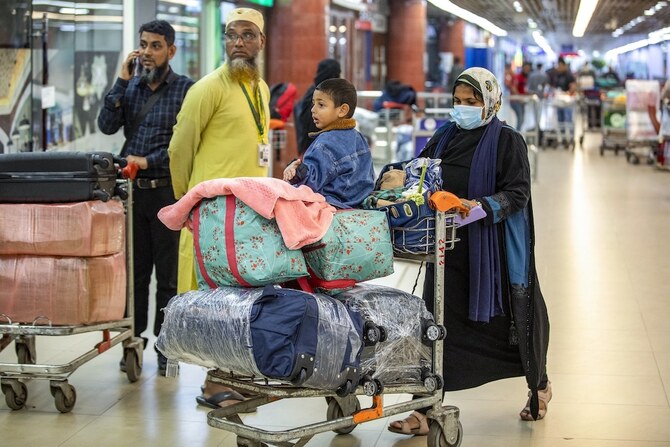
A Bangladeshi national carries luggage upon her arrival from Lebanon at the Hazrat Shahjalal International Airport in Dhaka on Oct. 21, 2024. (AFP)
Short Url
Updated 26 October 2024
Follow

‘Hell on earth’: Bangladeshi evacuees recount Israeli attacks on Lebanon

  • Up to 100,000 Bangladeshi nationals live and work in Lebanon
  • So far around 120 have been repatriated

DHAKA: As she fled Israeli airstrikes on Lebanon, Morium Begum was not sure she would ever see her family again.

The Bangladeshi mother of two was working as a housekeeper in the southern city of Nabatieh, which came under Israeli fire in late September.

“There were huge explosions everywhere and continuous bombing around me,” Begum told Arab News. “The situation had become so bad that it was no longer possible to stay there.”

She joined a group of other Bangladeshis heading to Saida, 30km away, where the Bangladeshi embassy and local NGOs are providing shelter to around 300 Bangladeshi migrant workers, according to Begum.

Begum was one of around 120 Bangladeshi nationals to have been evacuated from Lebanon in the past few days. After working abroad for 14 years, she has returned home with nothing.

“The situation was very, very dangerous. I didn’t even get the chance to bring any clothes with me,” she said. “I’m not sure if the house I lived in is still standing ... I left all my belongings in that house. I am returning home empty-handed. Still, I am grateful to Allah for being able to return.”

The death toll from Israel’s attacks on Lebanon since the beginning of October stands at more than 2,600, the Lebanese Health Ministry said on Friday. More than 12,200 people have been injured in air and ground raids, many of which have targeted civilian and medical infrastructure.

Shila Khatun, who worked as a domestic helper in the same area as Begum and also sought shelter in Saida, said the house she worked in has now been destroyed. “I would have been dead if I stayed there for two or three days more,” she added.

But staying at the shelter in Saida was no guarantee of safety. On the day she arrived, Khatun said, a bomb fell just 100 meters away.

“It was like hell on earth,” she said. “For a few minutes I couldn’t see or hear anything. Words can’t describe the horror. At one point, I lost all hope.”

There are between 70,000 and 100,000 Bangladeshi nationals living in Lebanon, many unofficially. The Ministry of Foreign Affairs says the process of their repatriation has been complicated not only by airport closures but also by lack of proper documentation.

Mohammad Uzzal, who was working at a restaurant in Nabatieh, was fortunate that his employer found him after he and the rest of the staff — along with many local residents — decided to leave and seek shelter in Saida.

“Many of us — Bangladeshi, Lebanese, and other nationals — rushed to a safer location,” Uzzal said. “I couldn’t bring any money with me. My passport was with my employer. Later on, when I reached the shelter, my employer brought my passport, and he also gave me some money. Fortunately, all of my wages got cleared by the employer. I feel lucky.”

Like Begum and Khatun, Uzzal was also evacuated last week.

“I have two small children. Every moment, I prayed to Allah to grant me a few days more on this earth to look after my children,” he said. “To me, this is like a second life.”


Ugandan opposition turns national flag into protest symbol

Updated 4 sec ago
Follow

Ugandan opposition turns national flag into protest symbol

KAMPALA: Hundreds screamed with excitement as Uganda’s opposition leader passed by a recent rally, with the crowd waving a sea of national flags — a dangerously politicized symbol in the run-up to this week’s election.
Analysts say it is almost a foregone conclusion that President Yoweri Museveni, 81, will win a seventh term in Thursday’s vote, given his near-total control over the state apparatus in the east African country.
But his opponent, 43-year-old Robert Kyagulanyi, better known as Bobi Wine, has framed the election as a protest vote and cannily turned the national flag into a symbol of resistance.
Police last month warned against using the flag “casually and inappropriately.”
Wine’s supporters have faced frequent intimidation by the security forces during the campaign, according to the United Nations Human Rights Office and other observers.
But the flag is “the only weapon we have,” said woodworker Conrad Olwenyi, 31, at a Wine rally this week.
“We cannot fight the security, because they have a gun. We only have the flag,” he said. But “if they shoot you when you have the flag, they are shooting the country.”

- ‘Reclaiming patriotism’ -

Uganda’s flag — created when the country achieved independence from Britain in 1962 — has stripes of black to represent Africa, yellow for its sunshine, and red to represent African brotherhood, with a grey crowned crane overlaid.
In the 2021 elections, Wine’s National Unity Platform (NUP) adopted red berets as a symbol, but the government ruled that was illegal since they were part of the military uniform, and used that ruling to justify raids on the party’s offices.
The flag is a clever alternative and a way of “reclaiming patriotism,” said Uganda expert Kristof Titeca.
“It’s kind of taken the government by surprise, and so that’s why they started this clampdown,” he told AFP.
Like many countries in east Africa, there are laws governing how the national flag may be used, though these were rarely enforced in Uganda in the past.
“It shows the panic,” prominent cartoonist Jimmy Spire Ssentongo told AFP.
“I don’t think they are threatened by misuse of the flag. They are threatened by the visibility of the support toward NUP,” said Ssentongo, adding that as Museveni ages and nears 40 years in power, “the space for freedom of expression also shrinks.”
“Everyone has a right to use the national flag, but it depends on in what context they’re using it for. I believe the opposition is politicizing it,” said Israel Kyarisiima, a national youth co-ordinator for Museveni’s National Resistance Movement party.
Security services have repeatedly been accused by Wine’s supporters of targeting those carrying the flag at rallies, with the leader urging followers in his Christmas address to “come to the defense of anyone assaulted for carrying the flag.”
And the threats from police have not stopped Wine’s supporters brandishing the flag at rallies.
“Now we’ve got something that can really show our unity as Ugandans, and they are trying to make it criminal,” said one attendee this week, Ruth Excellent Mirembe, 25, waving a flag.
Trying to stop its use is “oppression in the highest form,” she told AFP. “This represents us as Ugandans.”