
ACCRA: Joseph Antwi knows what he wants as a young person in Ghana casting his vote for the first time on Saturday when the West African nation elects its next president.
What he is not sure of, though, is whether the election’s outcome would improve the worst cost-of-living crisis in a generation in Ghana, one of the region’s economic powerhouses which has struggled in recent years with high public debt, a weakened local currency and high inflation.
“I want to vote to kick out the current government because they have not been kind to young people,” said Antwi, a trader in the capital of Accra, accusing the outgoing government of President Nana Addo Akufo-Addo of breaking its electoral promises since it was first elected eight years ago.
But the options for a candidate that will bring change are limited, he said, echoing the concerns of some of the 18.7 million people registered to vote for both president and members of parliament.
Ghana’s presidential elections have historically been two-horse races. This time is no different.
Although 12 candidates are running to become Ghana’s next president, it is seen as a tight race between Vice President Mahamudu Bawumia of the ruling New Patriotic Party government that has struggled to resolve the economic crisis, and immediate past President John Mahama, the leader of the main opposition National Democratic Congress.
In their final campaign rallies on Thursday, both candidates made a last push to pitch their political parties as the answer to Ghana’s economic woes.
Bawumia, a former deputy governor of the central bank, promised to build on the outgoing administration’s efforts and stabilize the economy. “I know what I want to do from day one in the presidency,” Bawumia, 61, told cheering supporters in Accra.
Mahama, on the other hand, restated his promise to “reset” the country on various fronts. “We need to reset our democracy, governance, economy, finances, agriculture, infrastructure, environment, health sector, and all that we hold dear as a people,” the 65-year-old former president said.
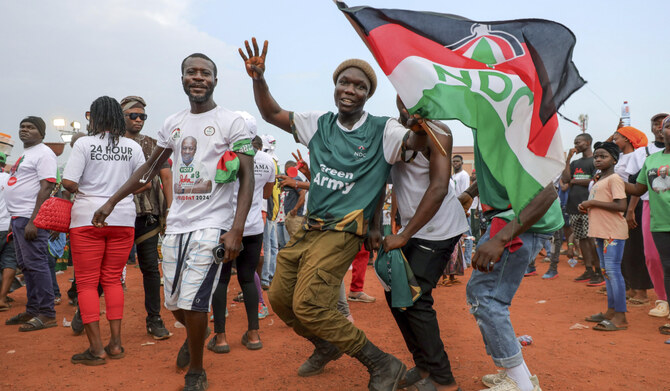
Across the city, the election mood has been high-spirited with political rallies, while election jingles and songs blast from public speakers.
In addition to the economic hardship, illegal gold mining — known locally as galamsey — has also been a major source of concern, triggering protests in recent weeks.
Ghana is Africa’s top gold producer and the world’s sixth largest, but illegal gold mining, which pollutes rivers and the environment, has spiked as people become more desperate for a better life.
Voters will be looking at whoever will promise to solve the problem of unemployment and hardship, said Lord Mawuko-Yevugah, a professor of political economy at the Ghana Institute of Management and Public Administration.
Ghana’s opposition parties have also alleged plans by the election commission to rig the vote in favor of the ruling party, although without providing any evidence. The claims raised fears for a country seen as a beacon of democratic values at a time when democracy in West Africa is threatened by coups.
“We view transparency, responsiveness, and inclusiveness as critical to ensuring, credible and fair processes,” said Jean Mensa, head of the Ghanaian electoral commission. “And we have demonstrated these three elements in all aspects of our work.”