

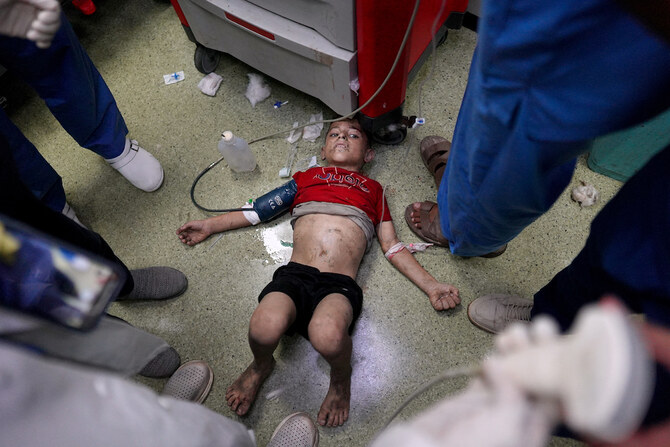

DEIR AL-BALAH: The 12-year-old Palestinian boy was lying in a hospital bed in central Gaza, wracked with leukemia, malnourished, and whimpering in pain despite the morphine doctors were giving him, when Rosalia Bollen, a UNICEF official, said she saw him in late October.
Islam Al-Rayahen’s family had asked Israeli authorities six times over the past months for permission to evacuate him from Gaza for a desperately needed stem cell transplant, Bollen said.
She said the request was refused six times for unexplained security reasons.
Islam died three days after she saw him, Bollen said.
Thousands of patients in Gaza are waiting for Israeli permission for urgently needed medical evacuation from Gaza for treatment of war wounds or chronic diseases they cannot get after the destruction of much of the territory’s health care system by Israel’s 15-month military campaign.
HIGHLIGHTS
• WHO says 14,000 patients of all ages need medical evacuation from Gaza.
• The territory’s Health Ministry puts the number higher, at 22,000, including 7,000 patients in extreme need who could die soon without treatment.
Among them are at least 2,500 children who UNICEF says must be transported immediately.
“They cannot afford to wait. These children will die. They are dying in waiting, and I find it striking that the world is letting that happen,” Bollen said.
The Israeli military often takes months to respond to medical evacuation requests, and the number of evacuations has plunged in recent months. In some cases, the military rejects either the patient or, in the case of children, the caregivers accompanying them on vague security grounds or with no explanation.
The Israeli decisions appear to be “arbitrary and are not made on criteria nor logic,” said Moeen Mahmood, the Jordan country director for Doctors Without Borders.
COGAT, the Israeli military agency in charge of humanitarian affairs for Palestinians, said in a statement that it “makes every effort to approve the departure of children and their families for medical treatments, subject to a security check.”
It did not respond when asked for details about Islam’s case.
A military official said Israel’s internal intelligence service reviews whether the patient or their escort has what he called “a connection to terrorism.”
If one is found, they are refused.
Osaid Shaheen, who is nearly 2, now faces having his eyes removed after Israel rejected his evacuation for treatment of cancer in his retinas.
The toddler was diagnosed with cancer in April after his mother, Sondos Abu Libda, noticed his left eyelid was droopy.
The World Health Organization requested his evacuation through the Rafah border crossing in southern Gaza, but the crossing was shut down in May when Israeli troops took it over in an offensive, Abu Libda said.
WHO applied again, this time for Osaid to leave through the Kerem Shalom crossing into Israel, now the only route for evacuees to travel. During the long wait, the cancer spread to the child’s other eye and reached stage 4.
Abu Libda was told Osaid was rejected on security grounds in November, and there was no further explanation.
She was stunned, she said. “I did not expect that a child could get a security rejection.”
Doctors have given the boy three doses of chemotherapy. But with supplies short in Gaza, they’re struggling to get more. If they can’t, they will have to remove Osaid’s eyes, or cancer will spread to other parts of his body, Abu Libda said.
“He’s just a child. How will he live his life without seeing? How will he play? How will he see his future, and how will his life turn out?” Abu Libda asked, standing outside the house where her family is sheltering in the Beni Suheil district of southern Gaza.
Nearby, little Osaid — who so far still has his sight — toddled around in the rubble of a building destroyed by Israeli forces, smiling as he played with chunks of debris.
When asked about his case, COGAT did not reply.
WHO says 14,000 patients of all ages need medical evacuation from Gaza.
The territory’s Health Ministry puts the number higher, at 22,000, including 7,000 patients in extreme need who could die soon without treatment, according to Mohammed Abu Salmeya, a ministry official in charge of evacuation referrals.
Since the war began on Oct. 7, 2023, 5,230 patients have been evacuated, said Margaret Harris, a WHO spokesperson.
Since May, when the Rafah crossing shut down, the rate has slowed, with only 342 patients evacuated, she said, an average of less than two a day. Before the war, when Israeli permission was also necessary, around 100 patients a day were transferred out of Gaza, according to WHO.
More than 44,500 Palestinians have been killed and more than 105,000 wounded by Israel’s bombardment and ground offensives, launched in retaliation for Hamas’ Oct. 7, 2023, attack on southern Israel.
The casualty toll, by Gaza’s Health Ministry, does not distinguish combatants from civilians — but more than half are women and children.
Gaza’s health system has been decimated, with only 17 of the territory’s original 36 hospitals functioning — and those only partially.
They struggle with the waves of war wounded on top of patients with other conditions.
Carrying out specialized surgeries or treatments in Gaza is difficult or impossible, with equipment destroyed, some specialist doctors killed or arrested, and medical supplies limited.
Gaza’s only dedicated cancer hospital was seized by Israeli troops early in the war, heavily damaged, and has been shut down.
Doctors without Borders said in August it sought to evacuate 32 children along with their caregivers, but only six were allowed to leave. In November, it applied for eight others, including a 2-year-old with leg amputations, but Israeli authorities blocked evacuation, it said
The military official said five of the eight requests in November were approved, but the caregivers trying to travel with the children were rejected on security grounds.
The official said Doctors Without Borders would have to resubmit the requests with alternate escorts.
The official didn’t say why the other three children weren’t approved.
The rejected caregivers were the children’s mothers and grandmothers, said Mahmoud, the Doctor’s Without Borders official, who said no explanation was given for the security concern.
Children long waiting for permission face dire consequences if they don’t get treatment.
Nima Al-Askari said doctors told her that 4-year-old Qusay could become paralyzed if her son doesn’t get surgery in the next two or three months for a heart defect that constricts his aorta.
“Should I wait until my son becomes paralyzed?” Al-Askari said.
“Everyone is telling me to wait until he gets evacuated. ... This is my only son. I can’t see him in a wheelchair.”
Asma Saed said she has been waiting for three months to hear whether her 2-year-old son, Al-Hassan, can travel for treatment for kidney failure. In the meantime, they are living in a squalid tent camp in Khan Younis, with little clean water or food.
She said her son doesn’t sleep, screaming all night.
“I wish I could see him like any child in the world who can move, walk, and play,” she said.
“He’s a child. He can’t express his pain.”


