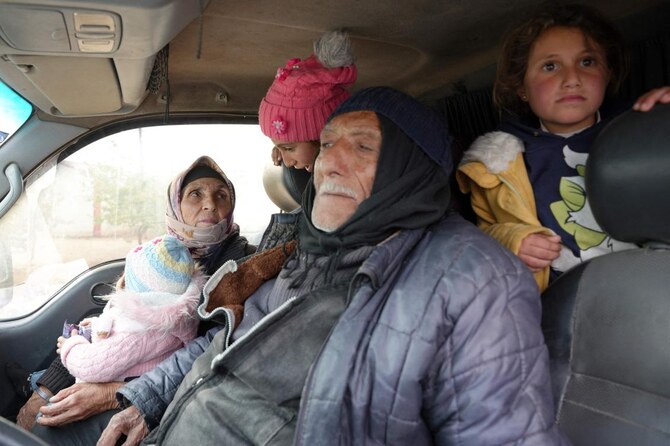
GENEVA: The escalation in fighting in Syria has displaced around 280,000 people in just over a week, the United Nations said on Friday, warning that numbers could swell to 1.5 million.
“The figure we have in front of us is 280,000 people since November 27,” Samer AbdelJaber, head of emergency coordination at the UN’s World Food Programme (WFP), told reporters in Geneva.
“That does not include the figure of people who fled from Lebanon during the recent escalations” in fighting there, he added.
The mass displacement has happened since militants led by Islamist group Hayat Tahrir Al-Sham (HTS) launched their lightning offensive a little more than a week ago.
That occurred just as a tenuous ceasefire in neighboring Lebanon took hold between Israel and Syrian President Bashar Assad’s ally Hezbollah, following two months of full-blown war that drove hundreds of thousands to flee into Syria.
WFP warned that the fresh mass-displacement inside Syria, more than 13 years after the country’s civil war erupted, was “adding to years of suffering.”
AbdelJaber said the WFP and other humanitarian agencies were “trying to reach the communities wherever their needs are,” and that they were working “to secure safe routes so that we can be able to move the aid and the assistance to the communities that are in need.”
He also stressed the urgent need for more funding to ensure humanitarians are “ready for any scenario basically in terms of displacements that could evolve in the coming days or months.”
AbdelJaber cautioned that “if the situation continues evolving (at the current) pace, we’re expecting collectively around 1.5 million people that will be displaced and will be requiring our support.”

UN says Syria fighting has displaced 280,000 so far
https://arab.news/55fwn
UN says Syria fighting has displaced 280,000 so far
- UN’s Samer AbdelJaber warns that numbers could swell to 1.5 million
- ‘That does not include the figure of people who fled from Lebanon during the recent escalations’
Iran FM criticizes Israel for ‘doctrine of domination’
- Doctrine allows Israel to expand its military arsenal while pressuring other countries in the region to disarm
- His remarks came a day after renewed nuclear talks with Washington in Oman
DOHA: Iran’s Foreign Minister Abbas Araghchi on Saturday criticized what he said was a “doctrine of domination” that allows Israel to expand its military arsenal while pressuring other countries in the region to disarm.
His remarks came a day after renewed nuclear talks with Washington, with previous talks collapsing when Israel launched an unprecedented bombing campaign against Iran last June that triggered a 12-day war.
Araghchi was speaking at the Al Jazeera Forum conference in Qatar but made no reference to Friday’s talks with the United States.
“Israel’s expansionist project requires that neighboring countries be weakened: militarily, technologically, economically and socially,” Araghchi said.
“Under this project Israel is free to expand its military arsenal without limits ... Yet other countries are demanded to disarm. Others are pressured to reduce defensive capacity. Others are punished for scientific progress,” he added.
“This is a doctrine of domination.”
During the 12-day war Israel targeted senior Iranian military officials, nuclear scientists and sites as well as residential areas, with the US later launching its own attacks on key nuclear facilities.
Iran responded at the time with drone and missile attacks on Israel, as well as by targeting the largest US military base in the Middle East, located in Qatar.
On Friday, Araghchi led the Iranian delegation in indirect nuclear talks with US Middle East envoy Steve Witkoff in Muscat.
The top Iranian diplomat later described the atmosphere as having been “very positive,” while US President Donald Trump said the talks were “very good,” with both sides agreeing to proceed with further negotiations.
The talks followed threats from Washington and its recent deployment of an aircraft carrier group to the region following Iran’s deadly crackdown on anti-government protests last month.
The United States has sought to address Iran’s ballistic missile program and its support for militant groups in the region — issues which Israel has pushed to include in the talks, according to media reports.
Tehran has repeatedly rejected expanding the scope of negotiations beyond the nuclear issue.


