

Modi’s party says US State Department targeting India

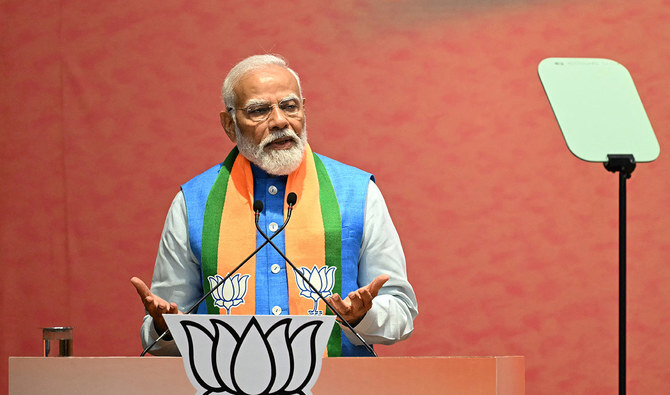
India’s Prime Minister Narendra Modi addresses an event of Bharatiya Janata Party’s (BJP), in New Delhi on April 14, 2024. (AFP/File)
Short Url
Updated 06 December 2024
Follow

Modi’s party says US State Department targeting India

  • New Delhi and Washington have forged a strong relationship in last two decades
  • Both have vowed to further strengthen ties despite some differences and irritants

NEW DELHI: Indian Prime Minister Narendra Modi’s Bharatiya Janata Party (BJP) has accused the State Department and “deep state” elements in the US of trying to destabilize India in conjunction with a group of investigative journalists and opposition leader Rahul Gandhi.
The accusation comes as a surprise as New Delhi and Washington have forged a strong relationship in the last two decades and both have vowed to further strengthen ties despite some differences and irritants.
Gandhi’s Congress party used the Organized Crime and Corruption Reporting Project (OCCRP)’s articles that “singularly focused” on the Adani Group and its alleged closeness to the government to undermine Modi, the ruling party said on Thursday.
Group chair Gautam Adani and seven others were indicted last month in the US for being part of a $265 billion scheme to bribe Indian officials — allegations the group has termed “baseless.”
OCCRP’s articles have also accused state-sponsored hackers in India of using Israeli-made Pegasus spyware to target government critics.
The government has previously denied both allegations.
The BJP has previously accused Gandhi, the OCCRP and 92-year-old billionaire financier-philanthropist George Soros of attacking Modi.
On Thursday, it cited a French media report that said that OCCRP was funded by the US Agency for International Development and “other deep state figures” like Soros.
“The Deep State had a clear objective to destabilize India by targeting Prime Minister Modi,” the BJP said in a series of messages on X.

“It has always been the US State Department behind this agenda...OCCRP has served as a media tool for carrying out a deep state agenda,” it said.
Sambit Patra, a BJP national spokesperson and lawmaker, repeated the accusations at an official media briefing by the party on Thursday.
“A French investigative media group...has revealed that... 50 percent of OCCRP’s funding comes directly from the US State Department,” Patra said. “OCCRP has served as a media tool for carrying out a deep state agenda.”
The State Department, US AID, Soros and the Congress party did not immediately respond to requests for comment. The Indian foreign ministry also did not respond to a request for comment on the ruling party’s accusation against the State Department.
OCCRP said in a statement it was an independent media outlet and not associated with any political party.
“The US government, while providing some funding to OCCRP, has no say in our editorial processes and no control over our reporting,” it said.
The government has lately been facing heat over the US indictment of Gautam Adani, who opposition leaders say Modi has always protected, and the country’s parliament was suspended multiple times last week as opposition lawmakers demanded a discussion on the issue.
Modi’s BJP and Adani have denied the accusations.


Ukraine’s Zelensky: We have backed US peace proposals to get a deal done

Updated 13 February 2026
Follow

Ukraine’s Zelensky: We have backed US peace proposals to get a deal done

  • “The tactic we chose is for the Americans not to think that we want to continue the war,” Zelensky ‌told The Atlantic

Ukrainian President Volodymyr Zelensky said Kyiv ‌had sought to back US peace proposals to end the war with Russia as President Donald Trump seeks to resolve the conflict before ​November mid-term elections.
Zelensky, in an interview published by The Atlantic on Thursday, said Kyiv was willing to hold both a presidential election and a referendum on a deal, but would not settle for an accord that was detrimental to Ukraine’s interests.
“The tactic we chose is for the Americans not to think that we want to continue the war,” Zelensky ‌told the ‌US-based publication. “That’s why we started supporting their ​proposals in ‌any ⁠format ​that speeds ⁠things along.”
He said Ukraine was “not afraid of anything. Are we ready for elections? We’re ready. Are we ready for a referendum? We’re ready.”
Zelensky has sought to build good relations with Washington since an Oval Office meeting in February 2025 descended into a shouting match with Trump and US Vice President JD ⁠Vance.
But he said he had rejected a ‌proposal, reported this week by the ‌Financial Times, to announce the votes ​on February 24, the fourth ‌anniversary of Russia’s invasion. A ceasefire and proposed US security ‌guarantees against a future invasion had not yet been settled, he said.
“No one is clinging to power,” The Atlantic quoted him as saying. “I am ready for elections. But for that we need security, guarantees ‌of security, a ceasefire.”
And he added: “I don’t think we should put a bad deal ⁠up for a ⁠referendum.”
Russian President Vladimir Putin has said Zelensky is not a legitimate negotiating partner because he has not faced election since coming to power in 2019.
Zelensky has said in recent weeks that a document on security guarantees for Ukraine is all but ready to be signed.
But, in his remarks, he acknowledged that details remained unresolved, including whether the US would be willing to shoot down incoming missiles over Ukraine if Russia were to violate the peace.
“This hasn’t been fixed ​yet,” Zelensky said. “We have raised ​it, and we will continue to raise these questions...We need all of this to be written out.”