Bereaved Gazans clear charred remains after deadly strike on camp

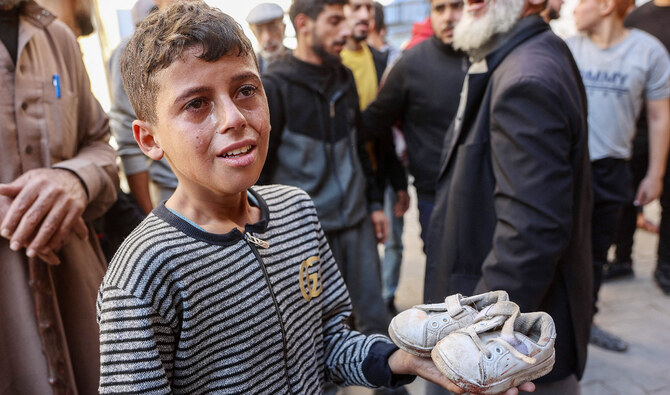
A boy holds the shoes of a toddler who was killed from shrapnel following an Israeli strike at Al-Ahli Arab Hospital in Gaza City. (AFP)
Short Url
Updated 05 December 2024
Follow

Bereaved Gazans clear charred remains after deadly strike on camp

KHAN YOUNIS: Palestinians in the southern Gaza Strip worked on Thursday to clear bent metal sheets and charred personal belongings from tents incinerated by an Israeli airstrike on a displacement camp.

Gaza’s Civil Defense agency said that the strike on the tents in the Al-Mawasi area — designated a humanitarian zone by the Israeli army — killed 21 and injured 40, “most of them children, women and the elderly.”

Agency spokesman Mahmoud Bassal said that at least five children were among the dead, most of whose bodies were left completely burnt by fires caused by the bombing.

“We heard a huge explosion, so we rushed to the place. I saw fire and smoke in the area of the displaced people’s tents. There was chaos everywhere,” said Mahmoud Shurrab, 39, who lives in his home in Al-Mawasi.

“The bodies were burned, limbs were everywhere, and there was a huge fire in dozens of tents,” said Shurrab, who lost four family members in the strike.

AFP could not independently verify Shurrab’s allegations but saw the large fire caused by the bombings Wednesday night.

On Thursday, an AFP journalist saw a large crater several meters deep in the sandy ground caused by the bomb’s impact, as well as piles of bent metal sheets that had been used for makeshift shelters.

Men carried a body away from the rubble wrapped in blankets used as a shroud.

The Israeli army said that the strike targeted “senior Hamas terrorists who were involved in terrorist activities” in Al-Mawasi.

Eyewitnesses told AFP journalists on the ground that about 50 tents for the displaced were burned in fires caused by the strike.

“A missile explosion shook the area, and a mass of flames and fire set the area alight,” Ahmad Al-Siqali, a displaced man in Khan Younis, said as he stood surrounded by the remains of the shelters that previously housed displaced families.

“Seconds later, the remains of the martyrs, women and children, who were safe in their tents, were scattered ... in the streets and on top of the tents,” Siqali added.

Ezz El-Din Abu Subha, a civil defense agency paramedic who was dispatched to the site, said that after the first Israeli strike, “we were helping the injured and helping the citizens and also retrieving the bodies, and the place was targeted again.”

“The place is full of tents for the displaced, sheltering people from all areas, most of them from different families displaced from Rafah, and each family has a tent,” he added.

Al-Mawasi is a coastal area in Khan Younis that Israeli forces unilaterally declared a humanitarian zone in the early days of the war, urging displaced Palestinians to move there.

As the nearly 14-month-long war has dragged on and almost all of Gaza’s 2.4 million inhabitants have been displaced, tents and makeshift shelters have covered the sandy area.

The area has repeatedly been hit by Israeli forces, including in significant deadly strikes in September and July.

The Oct. 7, 2023, attack sparked the war in Gaza.

Israel’s retaliatory military campaign in Gaza has resulted in at least 44,580 deaths, mostly civilians, according to data from the territory’s Health Ministry, which the UN considers reliable.


UN humanitarian chief’s fresh funding call as Sudan crisis passes 1,000 days amid famine, mass displacement

Updated 6 sec ago
Follow

UN humanitarian chief’s fresh funding call as Sudan crisis passes 1,000 days amid famine, mass displacement

  • ‘Today we are signaling that the international community will work together to bring this suffering to an end,’ Tom Fletcher tells fundraising event in Washington
  • Sudan is a central pillar of the UN’s global humanitarian plan for 2026, which aims to save 87m lives worldwide, he adds

NEW YORK CITY: The UN on Tuesday launched a renewed appeal for funding and the political backing to address what it described as the catastrophic humanitarian crisis in Sudan, which has now been locked in civil war for more than 1,000 days.

Speaking at a fundraising event for Sudan in Washington, organized by the US Institute for Peace, the UN under-secretary-general for humanitarian affairs, Tom Fletcher, said the scale of the suffering in Sudan had reached intolerable levels marked by famine, mass displacement and widespread sexual violence against women and girls.

“The horrific humanitarian crisis in Sudan has endured more than 1,000 days — too long,” he said. “Too many days of famine, of brutal atrocities, of lives uprooted and destroyed.”

The global community was now united in its desire to halt the suffering and ensure life-saving aid reaches those most in need, Fletcher said.

“Today we are signaling that the international community will work together to bring this suffering to an end,” he added.

Sudan is a central pillar of the UN’s global humanitarian plan for 2026, which aims to save 87 million lives worldwide, Fletcher explained as he thanked donors, including the US, the EU and the UAE, for stepping forward.

“Sudan is the most important component of that plan,” he said, noting that humanitarian operations there have been chronically underfunded and plagued by danger. “We have lost hundreds of colleagues in Sudan, colleagues of incredible courage.”

The UN plans to provide food, medicine, water and sanitation services to more than 14 million people across Sudan this year, as well as protection for vulnerable groups, Fletcher said.

He stressed that funding alone would not be sufficient, however, and called for stronger measures to protect civilians and aid workers, secure humanitarian access and support a temporary truce between the warring factions.

“The money is not enough,” he said. “We need the air assets, the security, the medical support for our teams, and the mediation work that has to underpin the access.”

The UN will work, through the Sudan Humanitarian Initiative, with the so-called “Quad” group of international partners (the US, Egypt, Saudi Arabia and the UAE) and others to identify priority areas for urgent action and remove obstacles to the delivery of aid, Fletcher said.

He added that the UN seeks visible progress toward a humanitarian truce in Sudan within the next few weeks, and called for those guilty of any violations in the country to be held accountable.

“We have set a target date of the beginning of Ramadan to make visible progress on this work,” Fletcher said. Ramadan is expected to begin on or around Feb. 17 this year.

Quoting UN Secretary-General Antonio Guterres, he added that the urgency of ending the conflict was growing as the third anniversary of its outbreak on April 15, 2023, approaches.

“The guns must fall silent and a path to peace must be charted,” Fletcher said, adding that the UN fully supports efforts to secure a humanitarian truce and rapidly scale up aid across Sudan.

“Today, we’re saying, ‘Enough.’ Let today be the signal that the world is uniting in solidarity for practical impact.”