

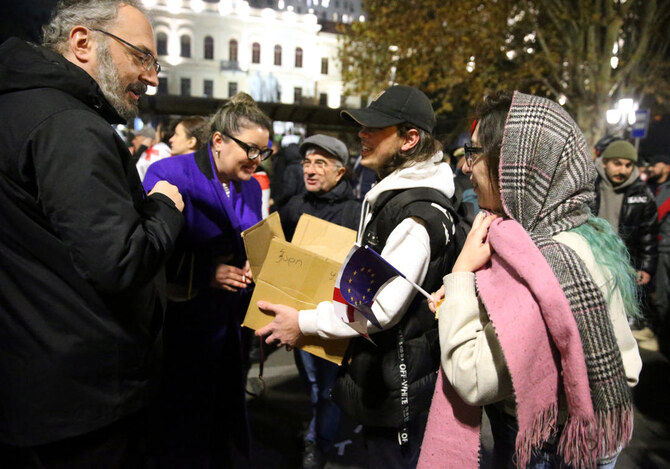

TBILISI: Almost every night since pro-EU protests erupted in Georgia last week, young husband-and-wife duo Mamuka Matkava and Gogona Parkaia have been working flat out to feed their fellow demonstrators.
Each night the couple, one a musician and the other an artist, spend three to four hours cooking dozens of mchadi, a traditional cornbread native to their home region of Mingrelia in western Georgia, in their small flat in a quiet residential neighborhood of the capital Tbilisi.
Adding to each piece a slice of salty Georgian sulguni cheese, they dish out the snacks to protesters gathered on Tbilisi’s central Rustaveli Avenue, the epicenter of the protests. Many protesters stay out until morning amid lengthy standoffs with riot police armed with water cannon and tear gas.
The South Caucasus country of 3.7 million has been gripped by crisis since the Georgian Dream party, returned to power in an October election the opposition says was tainted by fraud, said last week it was halting European Union accession talks until 2028, abruptly freezing a long-standing national goal of EU membership that is written into Georgia’s constitution.
Georgian Dream says the protests represent an attempt to stage a violent revolution by pro-EU opposition parties.
Like many young Georgians, Gogona sees the question of EU membership as existential for her country, which gained independence at the Soviet Union’s break-up in 1991, but has under Georgian Dream deepened ties with Russia, which continues to support two breakaway Georgian regions.
“The most important thing is that we need to avoid becoming part of Russia,” she said.
“We need a friend who can protect us from the power of Russia, you know? Because we are a very small country, and by ourselves, we cannot do anything.”
For Gogona, who runs a YouTube channel with husband Mamuka, there is an added responsibility. She is pregnant, and says that helping feed protesters allows her to take a stand without risking her unborn child at protests that often turn violent, and at which over 300 people have been detained.
“I don’t just feel responsible for myself right now. I feel responsible for my child,” she said.
GENERATION GAP
Younger Georgians have been numerous at pro-EU rallies that have flared up periodically since the spring, when Georgian Dream introduced a law on “foreign agents” that domestic and foreign critics say is draconian and Russian-inspired.
In contrast to their elders, few younger Georgians have visited Russia, or speak its language, having grown up in a period when Moscow imposed a stringent visa regime on Georgians that was only lifted last year.
Born and raised in a country where EU and Georgian flags fly together outside government buildings, and enjoying visa-free travel to the EU’s Schengen Zone, Georgia’s Generation Z tend toward pro-Western views.
They see the current protests as a seminal moment in the history of Georgia, which was ruled from Russia for around 200 years, and fought and lost a brief war with its huge neighbor in 2008.
Twenty-year-old politics student Nini came to Wednesday night’s protest with classmates from one of Tbilisi’s private universities, most of which have suspended studies amid mass student walk-outs.
Like many rally-goers, she carried a gas mask slung around her neck in case of a police crackdown.
She said: “As a student, and as a Georgian, just a citizen, I feel like it’s my obligation to stand with my people, with my fellow Georgians when there is such a critical situation in our country.”
Nini said that her peers, who grew up online and often speak fluent English, took their pro-Western cues from their parents’ and grandparents’ bitter experiences of Georgia’s turbulent history since independence.
“We don’t want to go back into the past. We’re not going back.”
For expectant mother Gogona, her unborn child only adds to the significance of the current moment.
“We don’t want our children to have to protest in their life. We want them to have freedom and the opportunity to choose their own way,” she said.
“We just want them to be in a free country, you know?”


