

Pakistan army calls for action against ‘political elements’ using ‘fake news for vested interests’

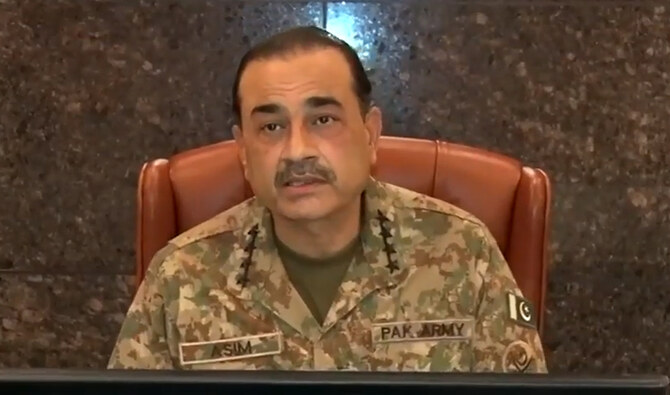
In this screengrab, taken from a handout video released by Pakistan’s Inter-Service Public Relations (ISPR), Army Chief General Asim Munir speaks during the 84th Formation Commanders Conference at the General Headquarters in Rawalpindi on December 5, 2024. (Photo courtesy: ISPR)
Short Url
Updated 05 December 2024
Follow

Pakistan army calls for action against ‘political elements’ using ‘fake news for vested interests’

  • Military’s statement comes after pro-Imran Khan supporters stormed Islamabad last month, demanding his release from prison
  • Khan’s PTI party says at least 20 of its supporters were killed in raid to disperse protesters while the government says four troops died

ISLAMABAD: A meeting of top commanders of the Pakistan army chaired by Chief of Army Staff General Syed Asim Munir on Thursday called on the government to pass laws to check “unfettered and unethical use” of freedom of expression, saying those spreading “fake news for vested political interests” needed to be brought to justice.

The military’s statement comes as the government has vowed legal action against thousands of supporters of jailed ex-premier Imran Khan who stormed Islamabad last month, demanding his release from prison. The government says protesters killed four security officers in clashes while Khan’s Pakistan Tehreek-e-Insaf party says at least 12 of its supporters died and “hundreds” were injured as security agencies used live ammunition rounds to disperse protesters, which authorities deny. 

Party leaders have described the raid on the protest site as a “massacre,” with social media platforms awash with pictures and video footage that the government has called “fake propaganda” by PTI followers. The government also says there were no civilian casualties. The army was deployed by the government during the raid to disperse protesters, but authorities say only police and paramilitary troops participated while the military acted as a “third line of defense.”

In the aftermath of the protests, the coalition government of Prime Minister Shehbaz Sharif formed two task forces: one to identify and take legal action against rioters and another to track and bring to justice suspects behind what the government describes as a “malicious campaign” to spread “concocted, baseless and inciting” online news, images and video content against the state and security forces.
 
In a statement released after the Corps Commanders conference on Thursday evening, the army said the forum had “noted with concern the malicious propaganda done in the aftermath of the lawful deployment of the Army in the capital to secure key government buildings and provide safe & secure environment for the valued visiting delegations.”

“This pre-planned coordinated and premeditated propaganda reflects continuity of a sinister design by certain political elements as an attempt to drive a wedge between the public & Armed Forces and institutions of Pakistan,” the statement said in what was a clear reference to the PTI party. “This futile attempt, fueled and abetted by external players, will never be successful.”

The army called on the government to promulgate and implement laws and regulations to check “unfettered and unethical use of freedom of expression to spew venom, lies and sow the seeds of polarization.”

“Those spreading fake news for vested political / financial interests need to be identified and brought to justice,” the statement added. “Forum resolved that Army remains committed to serving the nation & public and guard against all external and internal threats without any bias and political affiliation, and any attempt to pitch innocent people against each other and use of violence as an instrument for vested gains can never be tolerated.”

Khan, who remains a popular figure in Pakistan despite being in prison and facing several court cases, has led a campaign of unprecedented defiance against the Sharif coalition and the all-powerful military, which he accused of being behind his ouster from office in 2022. The army denies it interferes in politics.


Pakistan’s ‘Air Punjab’ faces scrutiny over Gulfstream jet purchase

Updated 6 sec ago
Follow

Pakistan’s ‘Air Punjab’ faces scrutiny over Gulfstream jet purchase

  • Punjab government calls luxury jet part of planned airline awaiting regulatory approval
  • Aviation experts question the viability of the 17-seat aircraft for commercial operations

ISLAMABAD: Aviation experts and an official on Saturday questioned the commercial viability of the move as the Punjab government said it had acquired a Gulfstream luxury aircraft as part of “Air Punjab,” an upcoming airline registered with the Securities and Exchange Commission of Pakistan (SECP) but yet to secure key regulatory approvals.

The development comes months after the federal government moved ahead with the privatization of Pakistan International Airlines (PIA), citing its inability to sustainably run the debt-ridden national carrier.

Air Punjab (Private) Limited was incorporated with the SECP on July 24, 2025, under registration number 0302317. The concept was first introduced by Punjab Chief Minister Maryam Nawaz in April 2025, with plans to launch operations within a year using leased aircraft. The provincial cabinet subsequently approved the airline’s establishment. However, an official told Arab News that the project remains at a preliminary stage.

“They have not got their license yet,” the official in the aviation department told Arab News on condition of anonymity, adding the airline still has to go through processes to be able to start operations.

The aircraft in question, a Gulfstream G500, registration N144S, arrived in Lahore from North America in December 2025 and began local flight operations on February 6, 2026. Online flight records show the jet was used at least 15 times between February 9 and February 18 for short trips to cities including Lahore, Rawalpindi, Sialkot, Dera Ghazi Khan and Faisalabad, with flight durations ranging from 14 to 37 minutes. It frequently used the call sign “Punjab 2.”

Responding to criticism that the aircraft had been inducted for the Punjab chief minister, the provincial information minister Azma Bukhari on Friday defended the purchase.

“For our ‘Air Punjab,’ we are buying various aircraft and some we will take on lease,” she said. “This means we have to build a fleet which will have all kinds of planes, and this is a part of that same link. Right now, as soon as the matters on this are finalized, I will definitely tell you.”

The aviation official said the aircraft was a 17-seater and couldn’t be used for commercial flights.

“The smallest aircraft used for commercial operations now is the ATR, which has around 48 [ATR 42-500] to 70 [ATR 72-500] seats. How can an airline be operated with a Gulfstream jet that is configured for VIP travel and has previously been used for executive flights? It is not commercially viable,” he said.

Speaking about the technical aspects, Afsar Malik, an independent aviation expert, said the provincial minister had probably been mistaken when she said the aircraft was for the upcoming airline.

“The Gulfstream is state aircraft and state aircraft cannot be used for commercial purpose,” he said. “Secondly, it’s not commercially viable. If Punjab information minister has said it, it would either be a slip of the tongue or ignorance.”

The planned launch of the provincial carrier comes as Pakistan’s aviation sector tries to recover from its deepest crisis in decades. The industry’s decline was interrupted in late 2025 by the federal government’s sale of the debt-ridden national carrier, Pakistan International Airlines (PIA), to a private consortium after the state could not sustain losses exceeding 800 billion rupees ($2.8 billion).

The private sector has proven equally volatile. Regulators recently suspended the license of Serene Air after its entire five-aircraft fleet was deemed “unserviceable,” leaving it with zero operational capacity.

“Twelve airlines have shut down since the sector’s inception,” said aviation consultant Irshad Ghani, noting that Serene Air joined a long list of failed carriers including Shaheen Air and Bhoja Air.

High capital requirements and rising airfares have hollowed out the domestic market, leaving ventures like Air Punjab facing immense skepticism in an industry Ghani describes as “fragile.”

Ghani, who heads an aviation consultancy firm, said PIA had operated 19-seater ATR turboprop aircraft in the past, particularly to serve smaller airports such as Sargodha where larger jets could not land. However, he drew a distinction between turboprops designed for commercial routes and executive jets.

“As far as the Gulfstream jet is concerned, it has been operated as a chartered aircraft, and it can also be used for charter operations by an airline. However, that would typically be the case for a well-established or large airline,” Ghani said.

He questioned the broader logic of the project.

“The question arises: when the federal government has just sold the national airline, acknowledging that the government could not successfully run it, how logical is it for a provincial government to operate its own airline?” he asked.

Ghani said he doubted it will be run successfully.

“If Punjab had the capacity to operate a public airline, why didn’t it consider purchasing PIA instead,” he wondered.

Minister Bukhari did not respond to Arab News queries regarding the Gulfstream and Air Punjab.