SEOUL: South Korea’s main opposition party on Wednesday urged President Yoon Suk Yeol to resign immediately or face impeachment, hours after Yoon ended short-lived martial law that prompted troops to encircle parliament before lawmakers voted to lift it.
Yoon didn’t make any immediate public response to the opposition’s demand. But his office said senior presidential advisers and secretaries for Yoon offered to resign collectively and the president also put off his official Wednesday morning schedule.
In the capital, tourists and residents walked around, traffic and construction were heard, and other than crowds of police holding shields, it seemed like a normal sunny, cold December morning.
On Tuesday night, Yoon abruptly imposed the emergency martial law, vowing to eliminate “anti-state” forces after he struggled to push forward his agenda in the opposition-dominated parliament. But his martial law was effective for only about six hours, as the National Assembly voted to overrule the president. The declaration was formally lifted around 4:30 a.m. during a Cabinet meeting.
The liberal opposition Democratic Party, which holds a majority in the 300-seat parliament, said Wednesday that its lawmakers decided to call on Yoon to quit immediately or they would take steps to impeach him.
“President Yoon Suk Yeol’s martial law declaration was a clear violation of the constitution. It didn’t abide by any requirements to declare it,” the Democratic Party said in a statement. “His martial law declaration was originally invalid and a grave violation of the constitution. It was a grave act of rebellion and provides perfect grounds for his impeachment.”
Impeaching him would require support from two-thirds of the parliament, or 200 of its 300 members. The Democratic Party and other small opposition parties together have 192 seats. But when the parliament rejected Yoon’s martial law declaration in a 190-0 vote, 18 lawmakers from Yoon’s ruling People Power Party cast ballots supporting the rejection, according to National Assembly officials.
If Yoon is impeached, he’ll be stripped of his constitutional powers until the Constitutional Court can rule on his fate. Prime Minister Han Duck-soo, the No. 2 position in the South Korean government, would take over his presidential responsibilities.
Yoon’s martial law declaration, the first of its kind in more than 40 years, harkened to South Korea’s past military-backed governments when authorities occasionally proclaimed martial law and other decrees that allowed them to station combat soldiers, tanks and armored vehicles on streets or at public places like schools to prevent anti-government demonstrations. Such scenes of military intervention had not been seen since South Korea achieved a genuine democracy in the late 1980s until Tuesday night.
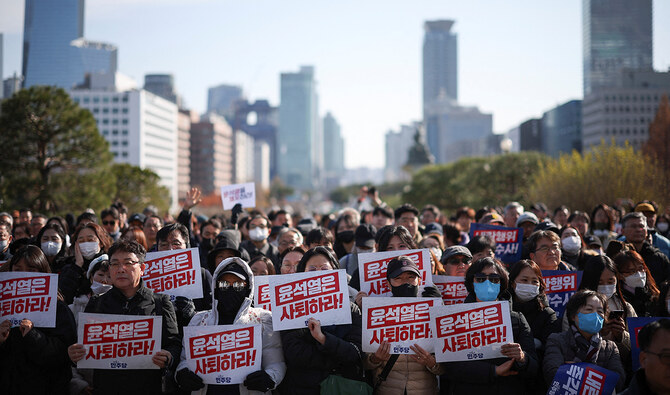
After Yoon’s declaration, troops carrying full battle gear, including assault rifles, tried to keep protesters away from the National Assembly as military Blackhawk helicopters flew overhead and landed nearby. One soldier pointed his assault rifle at a woman who was among protesters outside the building demanding that the martial law be lifted.
It wasn’t clear how the 190 lawmakers were able to enter a parliamentary hall to vote down Yoon’s martial law decree. Some reportedly climbed over walls, and while troops and police officers blocked some from entering they didn’t aggressively restrain or use force against others.
No major violence has been reported. The troops and police personnel were later seen leaving the ground of the National Assembly after the parliamentary vote to lift the martial law. National Assembly Speaker Woo Won Shik said: “Even with our unfortunate memories of military coups, our citizens have surely observed the events of today and saw the maturity of our military.”
Ruling People Power Party Han Dong-hun demanded that Yoon explain his decision and fire Defense Minister Kim Yong Hyun, who he said recommended the martial law decree to Yoon. The Defense Ministry has not commented.
Under South Korea’s constitution, the president can declare martial law during “wartime, war-like situations or other comparable national emergency states” that require the use of military force to restrict the freedom of press, assembly and other rights to maintain order. Many observers question whether South Korea is currently in such a state.
The constitution also states that the president must oblige when the National Assembly demands the lifting of martial law with a majority vote.
In Washington, the White House said the US was “seriously concerned” by the events in Seoul. A spokesperson for the National Security Council said President Joe Biden’s administration was not notified in advance of the martial law announcement and was in contact with the South Korean government.
Pentagon spokesman Maj. Gen. Pat Ryder said there was no effect on the more than 27,000 US service members based in South Korea.
In Seoul, the streets seemed busy like a normal day. Tourist Stephen Rowan, from Brisbane, Australia, who was touring Gyeongbokgung Palace, said he was not concerned at all.
“But then again, I don’t understand too much about the political status in Korea,” he said. “But I hear they are now calling for the current president’s resignation, so ... apparently there’s going to be a lot of demonstrations. ... I would have been concerned if martial law had stayed enforced.”
Yoon’s government and ruling party have been embroiled in an impasse with the Democratic Party over next year’s budget bill and a Democratic Party-led attempt to to impeach three top prosecutors.
During his televised announcement, Yoon also described the opposition as “shameless pro-North Korean anti-state forces who are plundering the freedom and happiness of our citizens.” He did not elaborate. North Korea has no immediate comments.
Natalia Slavney, research analyst at the Stimson Center’s 38 North website that focuses on Korean affairs, said Yoon’s imposition of martial law was “a serious backslide of democracy” that followed a “worrying trend of abuse” since he took office in 2022.
South Korea “has a robust history of political pluralism and is no stranger to mass protests and swift impeachments,” Slavney said, citing the example of former President Park Geun-hye, who was ousted from office and imprisoned for bribery and other crimes in 2017. She was later pardoned.


![]()

South Korean President Yoon is urged to resign or face impeachment over martial law
Short Url
https://arab.news/r4y48
South Korean President Yoon is urged to resign or face impeachment over martial law
- On Tuesday night, Yoon abruptly imposed emergency martial law
- The National Assembly voted to overrule the president within six hours
Latest updates


© 2026 SAUDI RESEARCH & PUBLISHING COMPANY, All Rights Reserved And subject to Terms of Use Agreement.