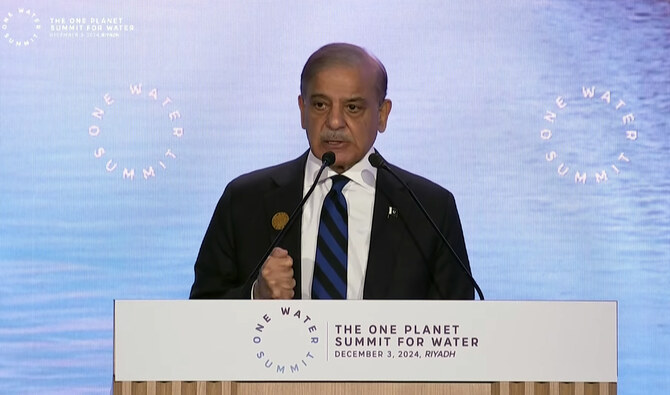
ISLAMABAD: Prime Minister Shehbaz Sharif on Tuesday called for transfer of technology, financing and international cooperation to ensure sustainable management of water for all as he addressed the One Water Summit in Riyadh, Saudi Arabia.
The summit, a joint initiative of Saudi Arabia, France, Kazakhstan and the World Bank, aimed for high-level political commitments to promote global cooperation and a coherent international approach toward water resource management.
Addressing the summit, Sharif said water was lifeblood of the planet, which transcended political boundaries, connected nations and fostered shared ecosystem, which was why his country attached great importance to transboundary cooperation.
“At the global level, I would submit for your kind consideration a number of steps to overcome water-related challenges. First, we need international cooperation and collaboration to ensure availability, sustainable management of water and sanitation for all,” he told attendees at the summit.
“Second, exchange of knowledge and expertise as well as transfer of technologies on innovative water management must be prioritized. Third, adequate funding for climate-resilient infrastructure and overcoming financing gap remains critical for climate-vulnerable countries.”
He appreciated the Kingdom of Saudi Arabia, France, Kazakhstan and the World Bank for the initiative, saying the world required “strong political will and global leadership to overcome the water crisis.”
“We must also focus on framework for transparency, data-sharing and regional cooperation to avoid conflicts and promote water-sharing,” the Pakistan premier said.
“We must invest in skills development, research and institutional strengthening to tackle water challenges at national and global levels.”
Sharif detailed steps taken by his government to ensure water security and climate-resilience, saying Pakistan was proud of joining this initiative and looked forward to providing all possible support in achieving its goals.
“As leaders, policymakers and custodians of the future, it is our duty to ensure that these rivers, lakes and aquifers that have nourished civilizations for centuries must not be reduced to tales of the past,” he added.
The One Water Summit is being held on Dec. 3-4 on the margins of the next high-level session of the COP16 of the United Nations Convention to Combat Desertification (UNCCD). It aims to contribute to ongoing United Nations discussions and processes to enhance global water governance, accelerate action on SDG6 on water and sanitation, and build on the momentum of the UN Water Conference in 2023.
The summit aims to scale up projects by stimulating partnerships between states, international organizations, local authorities, development and private banks, businesses, philanthropies, scientific experts, NGOs and civil society, in line with previous One Planet Summits, according to the forum’s website.
The forum will also act as an incubator for solutions in preparation for the next UN Water Conference in 2026, and integrate its agenda into the other existing water processes and initiatives such as the World Water Forum, the Dushanbe Conference and the World Water Week.

Pakistan PM calls for global cooperation for sustainable water management at Riyadh forum
https://arab.news/wrczd
Pakistan PM calls for global cooperation for sustainable water management at Riyadh forum
- The One Water Summit, a joint initiative of Saudi Arabia, France, Kazakhstan and World Bank, aims to stimulate global partnerships for water resource management
- PM Shehbaz Sharif says it is their duty as leaders to ensure that water resources that have nourished civilizations for centuries must not be reduced to tales of past
Ex-Pakistan spy chief’s conviction signals tougher days ahead for Imran Khan — analysts
- Ex-ISI director-general sentenced to 14 years for political interference, misuse of authority
- Hameed also investigated over his alleged role in May 9, 2023 nationwide unrest
ISLAMABAD: The recent conviction of former Pakistan spy chief Lt. General Faiz Hameed signals tougher days ahead for former Prime Minister Imran Khan and his political party, Pakistan Tehreek-e-Insaf (PTI), political and security analysts said Friday.
A military court on Thursday sentenced Hameed to 14 years of rigorous imprisonment after finding him guilty of engaging in political activities, violating the Official Secrets Act and misusing authority and government resources.
One of the most influential officers of his generation, Hameed served as director-general of Pakistan’s powerful Inter-Services Intelligence agency ISI from 2019 to 2021. He was widely seen as close to former prime minister Khan, who has been jailed since August 2023 on corruption charges that he says are politically motivated.
Dr. Ayesha Siddiqa, a security analyst who has written extensively on military affairs, told Arab News that, “Further punishments could be imposed on Faiz Hameed and Imran Khan.”
“They may face stricter measures,” she added.
Senator Faisal Vawda, a former federal minister, believes ex-spy chief Hameed would provide evidence against Khan in cases linked to the May 2023 unrest.
“Fourteen years’ imprisonment … this is the beginning … Hamid in his trial is giving evidence and testimony against Khan sahab/jadoogar and others in connection with May 9 events,” Vawda wrote on X on Dec. 11, 2025.
Dr. Siddiqa further adds that a recent press conference by Pakistan’s military spokesperson, in which he lashed out at Khan, suggested that a “further tightening of the PTI” would follow in the days ahead.
On Dec. 5, 2025, Pakistan’s military spokesperson, Lt. Gen. Ahmed Sharif Chaudhry, accused Khan of spreading an “anti-army” narrative, saying his rhetoric had moved beyond normal politics and posed a “national security threat.”
Hammed is accused of instigating attacks on government and military installations during nationwide unrest on May 9, 2023.
Protests erupted across Pakistan on May 9, 2023, following Khan’s arrest, with demonstrators from his party and supporters damaging military and government property. Khan and his political party PTI deny they instructed supporters to resort to violence.
Pakistan’s military said in August 2023 that it was separately examining Hameed’s alleged role in “fomenting vested political agitation and instability in cahoots with political elements.”
Minister for Parliamentary Affairs Tariq Fazal Chaudhry told reporters at a press conference Friday that the conviction would have “far-reaching political consequences” in the days ahead.
“This verdict ensures that no one will dare in future to repeat such political engineering or such unconstitutional abuse of authority,” Chaudhry said.
He added that Hameed’s conviction had reinforced public trust in the military’s accountability process.
PTI’s Secretary Information Sheikh Waqas told Arab News that Hameed’s conviction was “an internal matter of the military institution.”
“If and when the detailed verdict is made public and contains any reference, only then can a comment be considered,” he said.
Dr. Siddiqa, however, questioned the impartiality of the verdict, saying it did not reflect a “broader pattern” of reform within the military.
“Corruption has occurred before, political involvement has taken place and occasional punishments have been meted out,” she said. “This is not the first punishment, nor does it indicate a pattern.”
She added, “The answer is no — this is selective justice.”
Journalist and political analyst Muneeb Farooq said the verdict was significant and “no joke,” adding that the current military leadership is “inexplicably hard and strict in every way.”
“It’s a move to punish the evil,” he said. “That’s how the current military leadership sees it.”
Lahore-based political analyst Salman Ghani said Hameed’s conviction is alarming for “corrupt elements” and those who once wielded influence in Pakistan.
However, he questioned why accountability had not extended to then-army chief General Qamar Javed Bajwa, who has also been accused by the ruling Pakistan Muslim League-Nawaz party, along with Hameed, of engineering the ouster of former Prime Minister Nawaz Sharif.
“Did he not have the support and approval of the army chief of the time for the actions he carried out?” Ghani asked.


