


RIYADH: Forced migration due to land degradation is a global challenge that needs to be tackled, according to Saudi Arabia’s climate envoy.
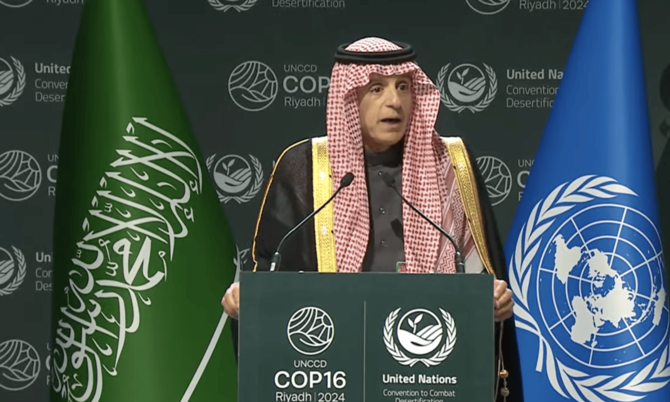
Taking center stage at COP16 in Riyadh, Adel Al-Jubeir described the phenomenon as a driving force behind security crises, highlighting food, air quality, and biodiversity as areas of concern.
Addressing delegates, Al-Jubeir painted a stark picture of the cascading impacts of degraded land, calling for unified global action to halt the alarming trend.
“Land degradation impacts every single human being,” he said, linking the loss of productive land to the displacement of millions and the destabilization of entire regions. “When people cannot grow food, they migrate. This migration often leads to tension and conflict in the receiving areas, creating a cycle of dislocation and violence.”
The figures are sobering, with 100 million hectares of land lost annually — an area the size of Egypt — while the global population continues to rise, intensifying pressure on diminishing resources.
Al-Jubeir emphasized that addressing land degradation is a matter of environmental urgency and a cornerstone of global security. “This is an issue that touches every aspect of our lives — food security, national security, migration, air quality, and biodiversity,” he said, urging nations to collaborate on solutions to reverse degradation and restore the Earth’s ability to absorb carbon.
The discussion was further elevated by Ibrahim Thiaw, executive secretary of the UN Convention to Combat Desertification, whose address highlighted the profound human toll of land degradation.
“People do not migrate because they want to; they do so because they have no choice,” he said, he described how the loss of fertile land compels millions to flee their homes.
Thiaw drew a direct line between environmental degradation and global displacement trends, citing data showing that up to 7 billion people could be affected by droughts by 2050. He linked 40 percent of interstate conflicts to disputes over natural resources, underscoring the link between environmental collapse and geopolitical instability.
His solution was clear and direct: land restoration. “Investing in land restoration is investing in keeping people safe at home,” Thiaw said, adding: “It is about giving them the dignity to produce food, educate their children, and live securely without being forced to migrate.”
He called on global leaders to prioritize sustainable agricultural practices and ecological restoration, noting that these investments could break the cycles of forced migration and conflict.
The intersection of environmental sustainability, migration, and security presented at COP16 has underscored the need for urgent, united action.
With Saudi Arabia championing this agenda on the global stage, and as negotiations proceed over the course of the next two weeks, the focus now shifts to translating bold commitments into tangible outcomes that safeguard communities and ecosystems worldwide.


