

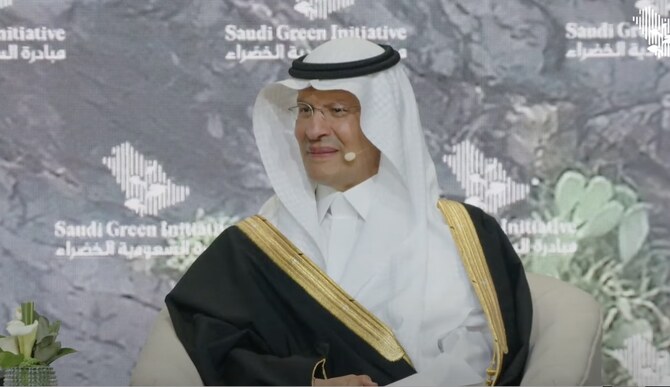

RIYADH: Saudi Arabia is the only country profiting from the global energy transition due to its sound economic approach, feasibility studies, and solid partnerships, according to the Kingdom’s energy minister.
Speaking at the opening of the fourth edition of the Saudi Green Initiative Forum in Riyadh, which runs from Dec. 3-4, Prince Abdulaziz bin Salman emphasized that Saudi Arabia is uniquely positioned to benefit from its shift toward a sustainable energy economy, particularly in comparison to other nations.
The Kingdom boasts the second-lowest methane intensity among major oil and gas producers. It also ranks second globally in terms of crude oil carbon intensity and plans to tender 20 gigawatts of renewable capacity in 2024 — a target exceeded only by China and the US.
“We are the only country on planet Earth that is making money out of the transition. Why? Because we are honest about our transition, we don’t do things without going through economics, without feasibility studies, without even choosing solid partners,” the minister explained.
“Total is a good example. They are working with us on petrochemicals, on gas stations, on renewables,” he added.
Prince Abdulaziz further noted that part of the Kingdom’s transition strategy involves replacing one million barrels of oil per day with gas and renewable energy — a significant milestone.
He stressed that energy security should not be compromised in the transition. “By the way, you would not be able to secure the other two, which are affordability and sustainability. The reality check is that the three things have to go hand in hand, and you should not compromise, and compromising one of the things will lead you to forfeit the other two, especially energy security,” he said.
On the Kingdom’s Vision 2030, the minister expressed confidence in long-term plans, stating: “I know for certain that there will be a 2040, there will be a 2050 because it works. People are on their doors; people are held accountable. People want to deliver because they see that whatever they were they’re delivering is impacting their daily life, is improving their lot.”
He continued: “We have a lot to show, and we want to make sure that aside from our commitments, with its own durations, we want to put this event, especially this Saudi Green Initiative, to make sure that people can continue seeing us progress our progress here in this country in a voluntary way because we are self-assured that every year we shall expose the world to new achievements, new targets, new approaches, and we are not shy from gathering people to see it.”
During the first day of the event, the Ministry of Energy signed 10 agreements and memorandums of understanding with various companies.
One of the key agreements focuses on deploying a carbon capture and utilization hub in Yanbu Industrial City, in collaboration with the Royal Commission for Jubail and Yanbu. The Ministry also signed a deal with King Abdullah University of Science and Technology on cryogenic carbon capture and another with the King Abdullah Petroleum Studies and Research Center and Climeworks for a direct air capture feasibility study.
Other MoUs included partnerships with Academy 32 to support the Regional Collaboration Initiative for Emissions Reduction, and with JEDCO and Tarshid to enhance energy efficiency efforts. Additionally, the Ministry inked agreements with SAL and Tarshid for a detailed facility study, and with Lindea and the Middle East Green Initiative to develop clean cooking solutions.
A funding agreement for the Clean Cooking Initiative was also announced in collaboration with Sipchem and the Middle East Green Initiative, as well as a similar deal focused on air products.
The Ministry of Energy also revealed plans to implement carbon-cured concrete in NEOM, in partnership with Abdullah Abdin, CarbonCure, and Gulf Cryo.
During the event, the Ministry of Energy and the Ministry of Economy and Planning also announced the winners of the Carbon Capture and Utilization Challenge.
In fifth place was Gasgene for converting carbon to ethanol and acetone chemicals, biofuels, and animal proteins. Dioxycle secured fourth place for converting carbon to ethylene used for plastics, chemicals, rubber vinyl, and medical applications.
In third place was Carbon to Stone for converting carbon to carbonate users for construction materials. D-CRBN won second place for converting carbon to chemicals, fuels, organic acids, and polymers.
Up Catalyst came in first place for converting carbon to battery-grade graphite and nanomaterials.
Commenting on the winners, Fasial Al-Ibrahim, the Saudi minister of economy and planning, said: “The winners today embody the spirit of innovation and ingenuity that is proving invaluable in our pursuit of a more sustainable world.”
He added: “When it comes to the solutions that we’ve seen, we’re looking forward to implementing them on the ground.”
Al-Ibrahim went on to stress how there’s no better place in the world for bold thinkers to collaborate, act, innovate, and solve the world’s greatest challenges than in Saudi Arabia.
“We recognize that the climate crisis knows no borders, and neither should our solutions. We must scale solutions without borders. Decarbonizing the industry, energy, and power sectors, which depend on carbon management, will go a long way to fully build a sustainable and climate-resilient economy, and that is why this challenge matters,” he said.
This year’s edition of the Saudi Green Initiative Forum, held during COP16, aims to tackle pressing global environmental challenges, such as land rehabilitation, carbon reduction innovations, and sustainable financing. It will also explore the role of natural solutions in helping communities adapt to climate change, while emphasizing efforts to preserve the Kingdom’s rich biodiversity, according to an official statement.


