ISLAMABAD: Prime Minister Shehbaz Sharif on Tuesday vowed legal action against “rioters” involved in anti-government protests led by ex-premier Imran Khan’s Pakistan Tehreek-e-Insaf (PTI) last month, as the party decried a state-backed crackdown against its supporters.
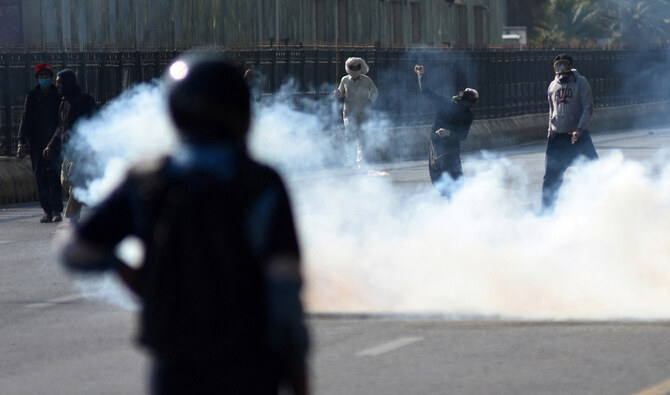
Thousands of supporters of the PTI stormed Islamabad last month, demanding Khan’s release from prison. The government said protesters killed four security officers in clashes, while the PTI says 12 supporters had died and, without immediately providing evidence, that hundreds had suffered gunshot wounds during chaotic scenes overnight in the heart of Islamabad as police dispersed marchers who had broken through security barricades. The PTI also says thousands have been arrested and social media platforms have been awash for days with pictures and video footage that the government has called “fake propaganda,” insisting there were no civilian casualties.
In the aftermath of the protests, Sharif formed two task forces: one to identify and take legal action against rioters and another to track and bring to justice suspects behind what the government describes as a “malicious campaign” to spread “concocted, baseless and inciting” online news, images and video content against the state and security forces.
On Tuesday, Sharif chaired a meeting of the task force formed to investigate and take legal action against rioters involved in the PTI sit-in.
“Those who violated the law during the sit-ins, damaged government property and injured and martyred the officials of the law enforcement agencies should be punished as per the law,” Sharif was quoted as saying in a statement released by his office.
“The process of identifying the rioters present at the scene of the incident is also being completed quickly … After identification, all the rioters will be presented in the courts, briefing.”
The PM said weapons, cartridges, shells and other evidence left by PTI protesters had been collected from the scene and would be sent for forensics.
The PTI has denounced the two task forces created by the government, saying they were meant to target the party and its supporters.
“The task force is just another sham committee to basically violate all human rights of PTI workers and leaders,” Khan’s close aide and PTI spokesperson Sayed Zulfikar Abbas Bukhari told Arab News, speaking about the second body formed to investigate anti-state online campaigns allegedly launched by PTI followers.
“It is further an attempt to increase scrutiny and torture of PTI workers, using the recent massacre as an excuse to try to eliminate the party.”
The Islamabad police chief has said authorities arrested nearly 1,000 supporters of Khan who were involved in last month’s protests. Speaking to reporters last Wednesday, Ali Rizvi denied that live ammunition had been used during the operation, which he said police had conducted alongside paramilitary forces. He said weapons, including automatic rifles and tear gas guns, were seized from the protest site where thousands had gathered. The site was cleared in a matter of hours.
Khan has been in prison since August 2023 and faces a slew of legal cases he says are politically motivated to keep him away from public office.


![]()

Pakistan PM vows legal action against ‘rioters’ involved in pro-Imran Khan protests
Short Url
https://arab.news/5nvzb
Pakistan PM vows legal action against ‘rioters’ involved in pro-Imran Khan protests
- Last week, Sharif formed two task forces, one to identify and punish rioters and another against those behind anti-state online campaigns
- Khan’s PTI has denounced the two task forces created by the government, saying they are meant to specifically target the party, supporters
Latest updates


© 2026 SAUDI RESEARCH & PUBLISHING COMPANY, All Rights Reserved And subject to Terms of Use Agreement.