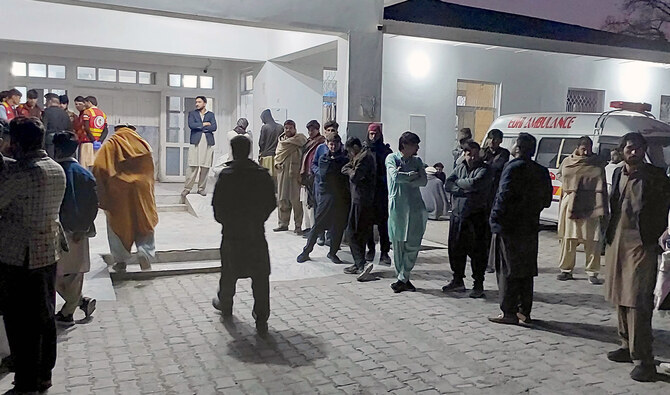
PESHAWAR: The death toll from sectarian clashes in northwest Pakistan has risen to 133, the provincial government said Monday, as tribal elders failed to ensure a truce between the feuding Sunni and Shiite Muslim communities.
Pakistan is a Sunni-majority country, but Kurram in Khyber Pakhtunkhwa province, near the border with Afghanistan, has a large Shiite population and the communities have clashed for decades.
At least “133 precious lives have been lost, and 177 people injured” in sporadic clashes since November 21, said a statement issued after a provincial cabinet meeting.
A tribal jirga, or council of elders, had been formed to ensure a truce that had remained elusive so far, it said.
“Bunkers set up by armed groups in Kurram will be dismantled and heavy weaponry ... will be confiscated,” the statement added.
The latest fighting broke out last Thursday when two separate convoys of Shiite Muslims traveling under police escort were ambushed, killing more than 40.
Since then days of fighting with light and heavy weapons have brought the region to a standstill, with major roads closed and mobile phone services cut as the death toll surged.
Anfal Hussain, who owns a pharmacy in Parachinar area, said “2024 has been extremely tough for Kurram” with dozens killed in clashes.
“I’ve been running this pharmacy for 11 years, but during the recent clashes the highway has been practically closed since October. This has caused significant shortages of food supplies and medicines,” Hussain, 36, told AFP.
“Many major illnesses cannot be treated in Parachinar’s hospitals, but they remain helpless due to the road closures,” he added.
A senior security official in the provincial capital Peshawar, speaking on condition of anonymity, on Friday told AFP that officials with the help of tribal elders were “close to achieving a truce,” after two earlier deals had failed to stymie the fighting.
“There are only two villages now where the sporadic firing is still taking place,” he said.
Police have regularly struggled to control violence in Kurram, which was part of the semi-autonomous Federally Administered Tribal Areas until it was merged with Khyber Pakhtunkhwa in 2018.
The Human Rights Commission of Pakistan said 79 people had been killed in the region between July and October in sectarian clashes.
The feuding is generally rekindled by disputes over land in the rugged mountainous region, and fueled by underlying tensions between communities from different sects.


![]()

Pakistan sectarian clashes toll reaches 133 since Nov. 21 — provincial government
Short Url
https://arab.news/yqwep
Pakistan sectarian clashes toll reaches 133 since Nov. 21 — provincial government
- A tribal jirga, or council of elders, had been formed to ensure a truce that has remained elusive so far
- Government says bunkers set up by armed groups to be dismantled and heavy weaponry confiscated
Latest updates


© 2026 SAUDI RESEARCH & PUBLISHING COMPANY, All Rights Reserved And subject to Terms of Use Agreement.