Pakistan says 7 of 34 MoUs recently signed with Riyadh actualized into deals worth $560 million

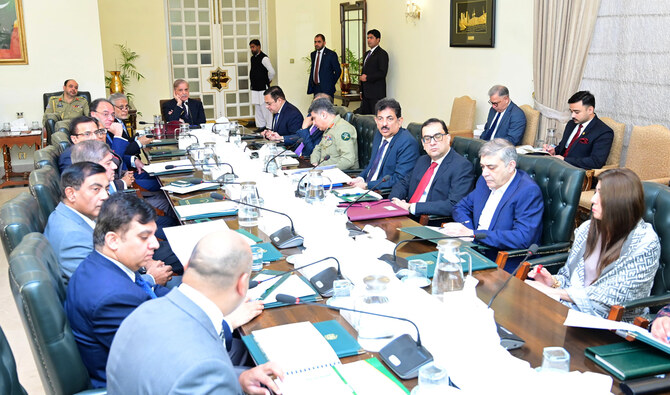
Pakistan Prime Minister Shehbaz Sharif chairs a review meeting regarding Saudi investments in the country, in Islamabad on December 2, 2024. (Photo courtesy: PMO)
Short Url
Updated 02 December 2024
Follow

Pakistan says 7 of 34 MoUs recently signed with Riyadh actualized into deals worth $560 million

  • 34 MoUs worth $2.8 billion were signed between Pakistani and Saudi business in October
  • Pakistan has pushed in recent weeks to strengthen trade, investment ties with friendly nations

ISLAMABAD: Seven out of 34 memorandums of understanding (MoUs) signed with Saudi Arabia earlier this year have been actualized into agreements worth $560 million, Pakistani Prime Minister Shehbaz Sharif’s office said on Monday. 
The announcement came after Sharif was briefed on progress made on 34 MoUs worth $2.8 billion signed between Pakistani and Saudi business in October. Pakistan and Saudi Arabia have a significant trade relationship, with Pakistan exporting mainly agricultural products and Saudi Arabia exporting mainly petroleum products.
“In a short period of time, 34 investment memorandums of understanding were signed between the two countries, out of which 7 have been given the form of agreements worth $560 million,” Sharif’s office said in a statement after he chaired a meeting to review progress on investment between Pakistan and Saudi Arabia.
“Prime Minister expressed satisfaction over the progress of various ongoing projects between the two countries,” the statement added, as the PM was briefed on discussions held at the second meeting of the Pakistan-Saudi Arabia Joint Task Force in November and informed about cooperation in various sectors. 
Pakistan has pushed in recent months to strengthen trade and investment ties with friendly nations, particularly the Kingdom, which has promised a $5 billion investment package that cash-strapped Pakistan desperately needs to shore up foreign reserves and fight a chronic balance of payment crisis.
Pakistanis are the second-largest expatriate community in the Kingdom, with over 2.5 million living and working in Saudi Arabia, the top source of remittances for the South Asian nation.


China backs Pakistan in fight against militancy after deadly Balochistan attacks

Updated 03 February 2026
Follow

China backs Pakistan in fight against militancy after deadly Balochistan attacks

  • China is a major ally and investor in Pakistan and has pledged over $65 billion in major infrastructure projects, including in Balochistan
  • Chinese Foreign Ministry spokesperson Lin Jian says ‘we mourn for lives lost, and our hearts go out to injured and those who lost loved ones’

ISLAMABAD: China condemns the recent attacks that killed more than 200 people in Pakistan’s southwestern Balochistan province, a Chinese foreign ministry spokesperson said on Tuesday, reaffirming Beijing’s support for Pakistan in its fight against militancy.

The Baloch Liberation Army (BLA) group launched coordinated attacks in several cities across Balochistan on Saturday, killing 33 civilians and 17 security personnel. Officials said 117 militants were killed in skirmishes and follow-up operations.

Balochistan, which borders Iran and Afghanistan, is the site of a decades-long insurgency waged by Baloch separatist groups who often attack security forces, foreigners and non-local Pakistanis and kidnap government officials.

China is a major ally and investor in Pakistan and has pledged over $65 billion in investment in road, infrastructure and development projects under the China-Pakistan Economic Corridor (CPEC).

“China strongly condemns the [Balochistan] attacks... We mourn for the lives lost, and our hearts go out to the injured and those who lost their loved ones,” Chinese Foreign Ministry spokesperson Lin Jian said at a press briefing on Tuesday.

“China firmly opposes any form of terrorism and will as always firmly support Pakistan in combating terrorism, maintaining solidarity and social stability, and protecting the safety of the people.”

Chinese nationals working in Pakistan have often been targeted by militants, particularly in the southwestern Balochistan province, where China is developing a deep seaport that is touted as the crown jewel of CPEC.

Interior Minister Mohsin Naqvi said last week the attacks, claimed by the separatist Baloch Liberation Army (BLA), were planned from India. New Delhi rejected the allegation as “baseless,” saying Islamabad was attempting to deflect attention from its internal challenges.

Balochistan is home to vast reserves of minerals and hydrocarbons. Separatist militant groups such as the BLA blame Islamabad for exploiting Balochistan’s natural resources and denying locals a share in them. The military and civilian government reject these allegations and say they are investing in the province’s development.