Thailand, Malaysia brace for fresh wave of floods as water levels ease

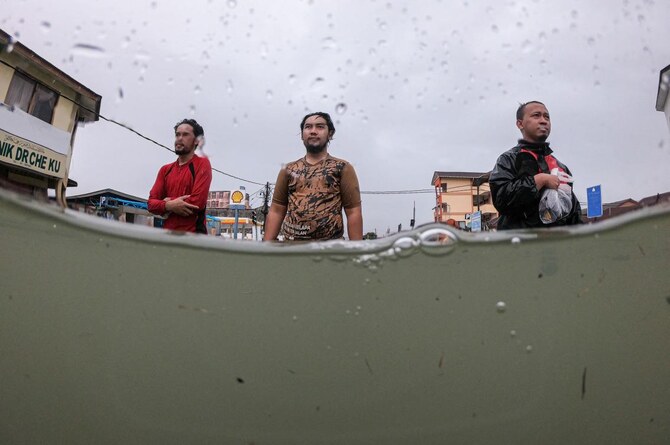
People wade through a flooded street during heavy rain in Pasir Puteh, in Malaysia’s Kelantan state on Nov. 30, 2024. Kelantan was expected to face a fresh deluge from Dec. 4. (AFP)
Short Url
Updated 02 December 2024
Follow

Thailand, Malaysia brace for fresh wave of floods as water levels ease

  • More than half a million households in the neighboring countries have been hit by torrential rain and flooding

KUALA LUMPUR/BANGKOK: Malaysia and Thailand are facing a second wave of heavy rain and potential flooding this week, authorities said on Monday, even as some displaced residents were able to return home and the worst floods in decades began receding in some areas.
Since last week, 27 people have died and more than half a million households in the neighboring Southeast Asian countries have been hit by torrential rain and flooding that authorities say have been the most severe in decades.
The immediate situation has improved in some areas and water levels have eased, according to government data on Monday.
In Malaysia, the number of people in evacuation shelters dropped to around 128,000 people, from 152,000 on Sunday, the disaster management agency’s website showed.
The northeastern state of Kelantan, which has been the worst hit, was expected to face a fresh deluge from Dec. 4, the chief minister’s office said in a Facebook post on Sunday.
“Although floodwater trends show a slight decrease, (the chief minister) stressed that vigilance measures must remain at the highest level,” the post said.
Meanwhile, in southern Thailand, 434,000 households remain affected, the country’s interior ministry said in a statement on Monday, down by about 100,000 from the weekend.
The government has provided food and supplies for those in the flood-hit areas, the ministry said, adding water levels in seven provinces were decreasing.
Thailand’s Meteorological Department said people in the country’s lower south should beware of heavy to very heavy rains and possible flash flooding and overflows, especially along foothills near waterways and lowlands, between Dec. 3-5.


Philippines struggles to evacuate nationals from Middle East as attacks escalate across region

Philippine President Ferdinand Marcos Jr. leads a Special Cabinet Meeting to discuss the situation in the Middle East.
Updated 03 March 2026
Follow

Philippines struggles to evacuate nationals from Middle East as attacks escalate across region

  • Over 1,400 Philippine nationals in Middle East have requested for repatriation
  • Filipinos are told to shelter in place, follow host government’s advice on situation

MANILA: The Philippines is in talks to evacuate its nationals from across the Middle East, President Ferdinand Marcos Jr. said on Tuesday, as an increasing number of Filipinos are seeking to leave amid growing destruction from US-Israeli strikes on Iran and Tehran’s counterstrikes against US bases in Gulf countries.

More than 2.4 million Filipinos live and work in the Middle East, where tensions have been high since Saturday, after coordinated US-Israel strikes killed Iran’s Supreme Leader Ali Khamenei and senior Iranian officials.

Tehran responded by targeting US military bases in Gulf countries, and violence has been widening across the region. 

Evacuating Philippine nationals across the region is not yet possible, Marcos said, as countries closed their airspace, leading to airport shutdowns and the cancellation of thousands of flights throughout the Middle East.

“For now, we are depending on the advice that will be given to us by the local authorities in the place where our nationals — where our people — are,” Marcos told reporters in Manila on Tuesday.

The Philippine government has received requests for repatriation from more than 1,400 Filipino nationals in various Middle Eastern countries, including 872 from the UAE and almost 300 from Israel. Similar requests have also been made by Filipinos in Iran, Bahrain and Jordan.

“Right now, the most dangerous area for our people right now would be Israel as attacks there are continuous,” Marcos said.

“The problem now is that no planes are flying and airports are being hit. That’s why the situation is very fluid, our assessment is that it may be too dangerous to mount flights.

“Even if we could charter an aircraft, we cannot do anything because number one, the airports are closed. They are all no-fly zones.”

As the Philippine government prepares for multiple scenarios, officials have secured buses and other vehicles for possible evacuation by land.

Filipinos in “danger areas” have been moved to a safer place, Marcos said, citing the targeting of Saudi Arabia’s Ras Tanura oil refinery by Iranian drones on Monday morning.

“But essentially our advice to them is shelter in place and follow the host government’s advice … For now it’s extremely difficult to enter or exit the region because the only aircraft flying are fighter jets and drones, and missiles.

“That’s why it is not a place that you would want to put in a civilian aircraft to take out our nationals,” he said.

“But again, as I said, the situation is changing by the minute, by the hour. We just have to be in very good and close contact with the local authorities.”