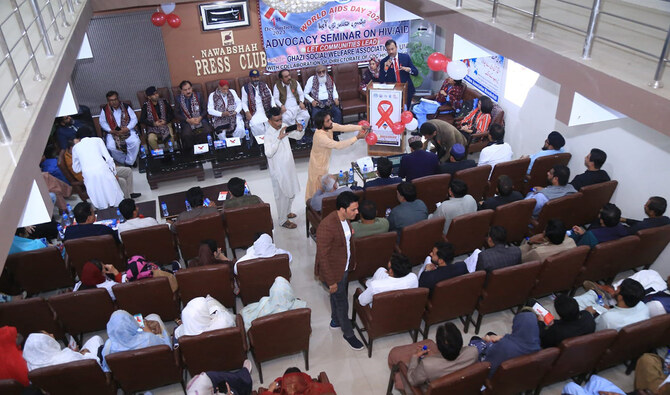
ISLAMABAD: Pakistan’s Prime Minister Shehbaz Sharif called for strengthening health systems throughout the country and for sustainable interventions as the international community marks World AIDS Day today, Sunday.
Every year on Dec. 1, the international community marks World AIDS Day to unite people in the fight against HIV and AIDS. The day is marked to show strength and solidarity against Human Immunodeficiency Virus (HIV) and acquired immunodeficiency syndrome (AIDS), and to remember the lives lost to the disease.
HIV attacks and destroys the infection-fighting CD4 cells (CD4 T lymphocyte) of the immune system while AIDS is its most advanced form. People with HIV who are not on medication and do not have consistent control of their HIV can transmit it through sexual intercourse, sharing of needles, pregnancy and breastfeeding. If HIV is controlled, the risk of transmission is close to zero.
“By working together, we will continue to strengthen our health systems and expand access to essential services for our citizens,” Sharif said in a statement.
The Pakistani premier noted that HIV/AIDS remains a global health challenge and a significant socio-economic issue that threatens livelihoods, disrupts families and deepens inequalities.
“Despite our collective efforts, the HIV epidemic in Pakistan continues to grow, underscoring the need for bold, innovative, and sustainable interventions,” Sharif noted. “It is only through the strategy rooted in equality and inclusion that we can halt the spread of HIV.”
According to the World Health Organization (WHO), 88.4 million people have been infected with the HIV virus since the beginning of the epidemic and about 42.3 million people have died of HIV in total.
Globally, 39.9 million people were living with HIV at the end of 2023. An estimated 0.6 percent of adults aged 15–49 years worldwide are living with HIV, although the burden of the epidemic continues to vary considerably between countries and regions.


![]()

Pakistan calls for sustainable interventions, strengthening health systems on World AIDS Day
Short Url
https://arab.news/9852q
Pakistan calls for sustainable interventions, strengthening health systems on World AIDS Day
- Around 88.4 million people in total have been affected HIV worldwide, says World Health Organization
- Pakistan PM Shehbaz Sharif resolves to expand access to essential health care services to all Pakistani citizens
Latest updates


© 2026 SAUDI RESEARCH & PUBLISHING COMPANY, All Rights Reserved And subject to Terms of Use Agreement.