ISLAMABAD: Pakistan’s Ministry of Religious Affairs said on Friday that 38,000 Hajj applications had been received in the first 10 days of the submission period, 11,000 more than during the same period last year.
The surge comes as Pakistan prepares to send 179,210 pilgrims for the annual Islamic pilgrimage in 2025, under a quota evenly divided between government and private Hajj schemes.
“By the tenth day, 38,000 Hajj applications have been received,” a ministry said in a statement, adding that designated banks would continue accepting applications over the weekend. The final deadline for submissions is Dec. 3.
Pilgrims under the regular Hajj scheme can secure their booking with an initial payment of Rs200,000 ($719), according to the statement.
Pakistan has steadily improved facilities for pilgrims in recent years.
One key initiative is the Makkah Route Initiative, which streamlines immigration processes by enabling pilgrims to complete formalities at their departure airports.
Initially tested in Islamabad in 2019, the program was later expanded to Karachi, benefitting tens of thousands of travelers.
Efforts have also included the launch of a mobile application, Pak Hajj 2025, to provide pilgrims with essential updates, flight details and navigation assistance in Saudi Arabia.
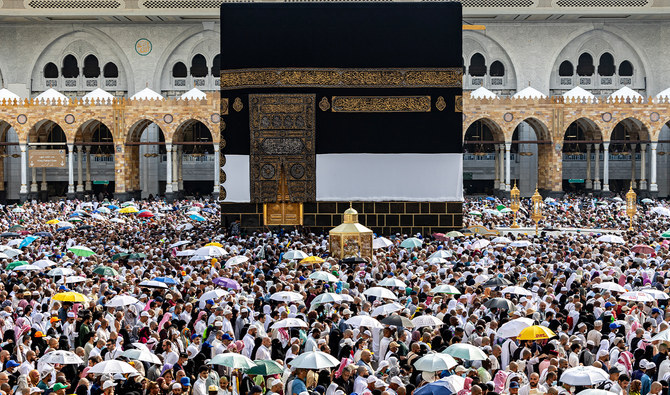
Hajj, one of the five pillars of Islam, attracts millions of Muslims annually to Makkah, with Pakistan consistently being among the largest contributors of pilgrims.

Pakistan receives 38,000 Hajj applications in 10 days
https://arab.news/b5mfh
Pakistan receives 38,000 Hajj applications in 10 days
- Total number of applications received so far is 11,000 more than during the corresponding period last year
- Pakistan has a Hajj quota of 179,210, evenly split between the government and private tour operators
World Bank president in Pakistan to discuss development projects, policy issues
- Pakistan, World Bank are currently gearing up to implement a 10-year partnership framework to grant $20 billion loans to the cash-strapped nation
- World Bank President Ajay Banga will hold meetings with Pakistan Prime Minister Shehbaz Sharif and other senior officials during the high-level visit
ISLAMABAD: World Bank President Ajay Banga has arrived in Pakistan to hold talks with senior government officials on development projects and key policy issues, Pakistani state media reported on Sunday, as Islamabad seeks multilateral support to stabilize economy and accelerate growth.
The visit comes at a time when Pakistan and the World Bank are gearing up to implement a 10-year Country Partnership Framework (CPF) to grant $20 billion in loans to the cash-strapped nation.
The World Bank’s lending for Pakistan, due to start this year, will focus on education quality, child stunting, climate resilience, energy efficiency, inclusive development and private investment.
"World Bank President Ajay Banga arrives in Pakistan for a high-level visit," the state-run Pakistan TV Digital reported on Sunday. "During his stay, he will meet Prime Minister Shehbaz Sharif and other senior officials to discuss economic reforms, development projects, and key policy issues."
Pakistan, which nearly defaulted on its foreign debt obligations in 2023, is currently making efforts to stabilize its economy under a $7 billion International Monetary Fund (IMF) program.
Besides efforts to boost trade and foreign investment, Islamabad has been seeking support from multilateral financial institutions to ensure economic recovery.
“This partnership fosters a unified and focused vision for your county around six outcomes with clear, tangible and ambitious 10-year targets,” Martin Raiser, the World Bank vice president for South Asia, had said at the launch of the CPF in Jan. last year.
“We hope that the CPF will serve as an anchor for this engagement to keep us on the right track. Partnerships will equally be critical. More resources will be needed to have the impact at the scale that we wish to achieve and this will require close collaboration with all the development partners.”
In Dec., the World Bank said it had approved $700 million in financing for Pakistan under a multi-year initiative aimed at supporting the country's macroeconomic stability and service delivery.
It followed a $47.9 million World Bank grant in August last year to improve primary education in Pakistan's most populous Punjab province.


