Lebanon MPs seek end to leadership vacuum with January presidency vote

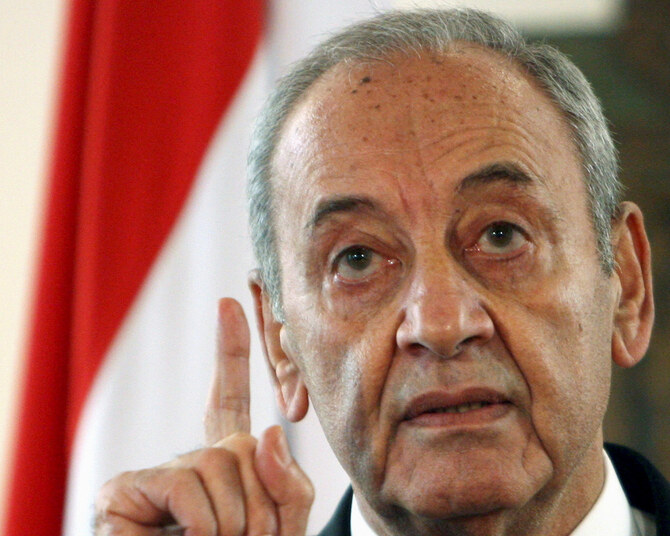
Lebanon’s parliament will hold a session in January to elect a new president, according to speaker Nabih Berri. (Reuters)
Short Url
Updated 28 November 2024
Follow

Lebanon MPs seek end to leadership vacuum with January presidency vote

  • “Speaker Nabih Berri called a parliament session to elect a president of the republic on January 9,” the NNA reported
  • Lebanon has been without a president since Michel Aoun’s term ended in October 2022

BEIRUT: Lebanon’s parliament will meet on January 9 to elect a new president, seeking to end more than two years without a head of state, official media reported Thursday, a day after an Israel-Hezbollah ceasefire began.
The official National News Agency also reported that parliament on Thursday extended the mandate of army chief Joseph Aoun, himself floated as a potential presidential contender.
“Speaker Nabih Berri called a parliament session to elect a president of the republic on January 9,” the NNA reported.
Lebanon has been without a president since Michel Aoun’s term ended in October 2022, with neither of the two main blocs — the Iran-backed Hezbollah and its opponents — having the majority required to elect one, and unable to reach a consensus.
The NNA also said Thursday that “parliament approved the extension of the mandate of General Joseph Aoun for one year.”
Lawmakers had already extended his term last year, as he had been set to retire on January 10, 2024.
Part of Thursday’s parliament session was attended by French special envoy Jean-Yves Le Drian, who arrived a day earlier for talks with senior Lebanese officials.
A statement from speaker Berri’s office said he and Le Drian on Thursday “discussed the general situation, political developments and the presidential issue.”
A French diplomat told AFP on condition of anonymity to discuss sensitive matters that Le Drian came to Lebanon to “relaunch the issue of the presidency and the need for reforms.”
By convention, the presidency goes to a Maronite Christian, the premiership is reserved for a Sunni Muslim and the post of parliamentary speaker goes to a Shiite Muslim.
On Wednesday after the ceasefire between Israel and Iran-backed Hezbollah came into effect, Lebanese Prime Minister Najib Mikati said: “I hope this will be a new page for Lebanon. I hope the coming days will lead to the election of a president.”
Berri, who led ceasefire talks on behalf of ally Hezbollah, also called Wednesday for the country to “quickly elect a president.”
Hezbollah chief Naim Qassem said in a speech earlier this month that after the war, Hezbollah would “bring an effective contribution to the election of a president.”


Gulf countries offer support to Yemen’s legitimate government, Saudi security

Updated 5 sec ago
Follow

Gulf countries offer support to Yemen’s legitimate government, Saudi security

  • Qatar, Kuwait say their security is based on the security of Saudi Arabia and the GCC
  • Bahrain said it had confidence in the leadership of Saudi Arabia and the UAE to contain differences

LONDON: Gulf and Arab countries on Tuesday offered support to the internationally recognized government in Yemen after the UAE withdrew its forces from the country.

The statements were issued after the military coalition supporting Yemen’s government carried out airstrikes on a shipment of weapons and vehicles destined for southern separatist forces.

The shipment arrived in the port of Mukalla on board two vessels from Fujairah in the UAE.

The Emirates was asked by Rashad Al-Alimi, head of Yemen’s presidential council, to withdraw its troops from Yemen within 24 hours.

Saudi Arabia said the separatists, operating under the Southern Transitional Council and supported by the UAE, posed a direct threat to the Kingdom’s national security and regional stability by recently seizing territory in the  governorates of Hadramaut and Al-Mahra.

Qatar said it was following the developments “with keen interest.”

A foreign ministry statement said Doha fully supported the legitimate Yemeni government and stressed the importance of preserving Yemen's unity and  safeguarding the interests of the Yemeni people.

It added that the security of Saudi Arabia and the security of the member states of the Gulf Cooperation Council (GCC) “constitute an inseparable part of the security of the State of Qatar, reflecting the deep-rooted fraternal ties and shared destiny that unite the GCC states.”

The ministry commended the statements issued by Saudi Arabia and the UAE “which reflect a commitment to prioritizing the interests of the region.”

Kuwait also offered “unwavering support” for Yemen’s government and said the security of Saudi Arabia and GCC is the basis of its own national security.

Its foreign ministry praised the “responsible approach” taken by both Saudi Arabia and the UAE.

Bahrain, the current GCC chair, said it had confidence in the leadership of Saudi Arabia and the UAE “and their ability to contain any differences in viewpoints within the framework of a unified Gulf.”

The foreign ministry statement offered “unequivocal” support toward regional and international initiatives and efforts aimed at reaching a comprehensive and lasting political solution in Yemen.

Egypt said it had full confidence in Saudi Arabia and the UAE “to handle the current developments in Yemen with wisdom.”

Cairo will continue efforts toward a comprehensive political settlement for Yemen, the statement said.