

Norway, World Wide Fund for Nature square off in court over deep sea mining

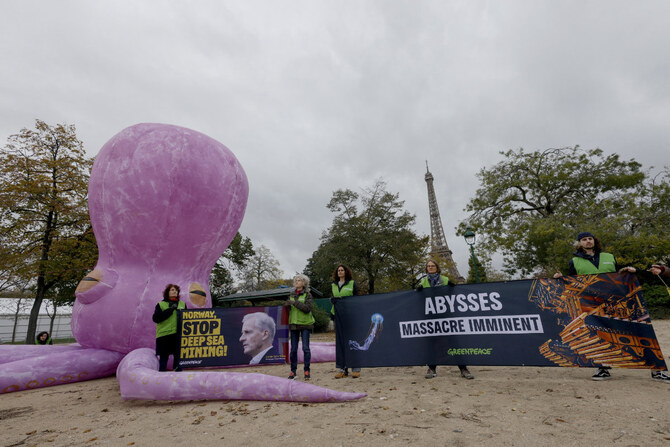
Greenpeace activists stand next to a giant Octopus as they demonstrate in front of the Eiffel Tower against the Prime Minister of Norway Jonas Gahr Store's wish to authorize deep sea mining in the Arctic, as he attends the Paris Peace Forum, in Paris on November 10, 2023. (AFP)
Short Url
Updated 28 November 2024
Follow

Norway, World Wide Fund for Nature square off in court over deep sea mining

  • Norway could become one of the first countries to authorize seabed mining, arguing the importance of not relying on China for minerals essential for renewable technology
  • WWF-Norway is also calling on the Norwegian government to stop giving public support to mining companies for the exploration phase and to allocate these funds to independent research institutions

OSLO: The World Wide Fund for Nature’s (WWF) Norwegian chapter will have its day in court Thursday, after it sued Norway for opening up its seabed to mining before performing sufficient impact studies.
Already Western Europe’s largest oil and gas producer, Norway could become one of the first countries to authorize seabed mining, arguing the importance of not relying on China for minerals essential for renewable technology.
While deep-sea mining is contentious due to its potential impact on vulnerable marine ecosystems, Norway’s parliament in January formally gave its green light to open up parts of its seabed to exploration.
“We believe the government is violating Norwegian law by now opening up for a new and potentially destructive industry without adequately assessing the consequences,” Karoline Andaur, CEO of WWF-Norway, said in a statement.
Norway “must halt the rushed process, must actively support a national and global moratorium — a temporary ban on seabed mining until there is sufficient knowledge,” Andaur said in an online meeting earlier in November.
With their lawsuit, WWF-Norway is also calling on the Norwegian government to stop giving public support to mining companies for the exploration phase and to allocate these funds to independent research institutions.
That would help “to close the many knowledge gaps about marine life,” Andaur said.
The trial will run until December 5.

On April 12, Norway’s Ministry of Energy announced that it was opening up an area of the Norwegian Sea and Greenland Sea to exploration, with the aim of awarding the first licenses in the first half of 2025.
Within the area, which is the size of the United Kingdom, it has designated locations covering 38 percent of the area suitable for exploration for a first licensing round.
“Before any exploitation can begin, it has to be shown that the proposed exploitation can take place in a sustainable and responsible manner,” Astrid Bergmal, state secretary at the energy ministry, told AFP in an email.
The first projects will also have to be approved by parliament, Bergmal added.
“The first phase will consist of mapping and exploration, which has little environmental impact,” she said.
But critics see this stage as a first step toward exploitation.
According to several NGOs, opening up the seabed poses an additional threat to an ecosystem that is little-known and has already been weakened by global warming.
Possible dangers include the destruction of marine habitats and organisms, noise and light pollution, as well as the risk of chemical leaks from machines and species being displaced.
Norwegian authorities meanwhile stress that by allowing the prospecting they want to fill in the gaps in knowledge.
In early 2023, the Norwegian Offshore Directorate published a report concluding that “substantial resources are in place on the seabed” including minerals such as copper, zinc and cobalt.


Bangladesh halts controversial relocation of Rohingya refugees to remote island

Updated 29 December 2025
Follow

Bangladesh halts controversial relocation of Rohingya refugees to remote island

  • Administration of ousted PM Sheikh Hasina spent about $350m on the project
  • Rohingya refuse to move to island and 10,000 have fled, top refugee official says

DHAKA: When Bangladesh launched a multi-million-dollar project to relocate Rohingya refugees to a remote island, it promised a better life. Five years on, the controversial plan has stalled, as authorities find it is unsustainable and refugees flee back to overcrowded mainland camps.

The Bhasan Char island emerged naturally from river sediments some 20 years ago. It lies in the Bay of Bengal, over 60 km from Bangladesh’s mainland.

Never inhabited, the 40 sq. km area was developed to accommodate 100,000 Rohingya refugees from the cramped camps of the coastal Cox’s Bazar district.

Relocation to the island started in early December 2020, despite protests from the UN and humanitarian organizations, which warned that it was vulnerable to cyclones and flooding, and that its isolation restricted access to emergency services.

Over 1,600 people were then moved to Bhasan Char by the Bangladesh Navy, followed by another 1,800 the same month. During 25 such transfers, more than 38,000 refugees were resettled on the island by October 2024.

The relocation project was spearheaded by the government of former Prime Minister Sheikh Hasina, who was ousted last year. The new administration has since suspended it indefinitely.

“The Bangladesh government will not conduct any further relocation of the Rohingya to Bhasan Char island. The main reason is that the country’s present government considers the project not viable,” Mizanur Rahman, refugee relief and repatriation commissioner in Cox’s Bazar, told Arab News on Sunday.

The government’s decision was prompted by data from UN agencies, which showed that operations on Bhasan Char involved 30 percent higher costs compared with the mainland camps in Cox’s Bazar, Rahman said.

“On the other hand, the Rohingya are not voluntarily coming forward for relocation to the island. Many of those previously relocated have fled ... Around 29,000 are currently living on the island, while about 10,000 have returned to Cox’s Bazar on their own.”

A mostly Muslim ethnic minority, the Rohingya have lived for centuries in Myanmar’s western Rakhine state but were stripped of their citizenship in the 1980s and have faced systemic persecution ever since.

In 2017 alone, some 750,000 of them crossed to neighboring Bangladesh, fleeing a deadly crackdown by Myanmar’s military. Today, about 1.3 million of them shelter in 33 camps in the coastal Cox’s Bazar district, making it the world’s largest refugee settlement.

Bhasan Char, where the Bangladeshi government spent an estimated $350 million to construct concrete residential buildings, cyclone shelters, roads, freshwater systems, and other infrastructure, offered better living conditions than the squalid camps.

But there was no regular transport service to the island, its inhabitants were not allowed to travel freely, and livelihood opportunities were few and dependent on aid coming from the mainland.

Rahman said: “Considering all aspects, we can say that Rohingya relocation to Bhasan Char is currently halted. Following the fall of Sheikh Hasina’s regime, only one batch of Rohingya was relocated to the island.

“The relocation was conducted with government funding, but the government is no longer allowing any funds for this purpose.”

“The Bangladeshi government has spent around $350 million on it from its own funds ... It seems the project has not turned out to be successful.”