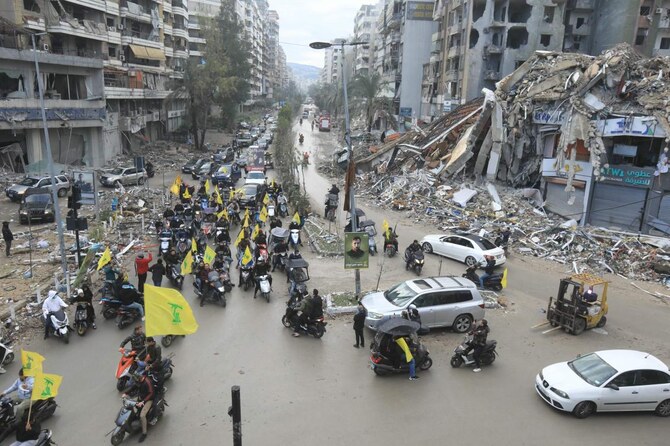
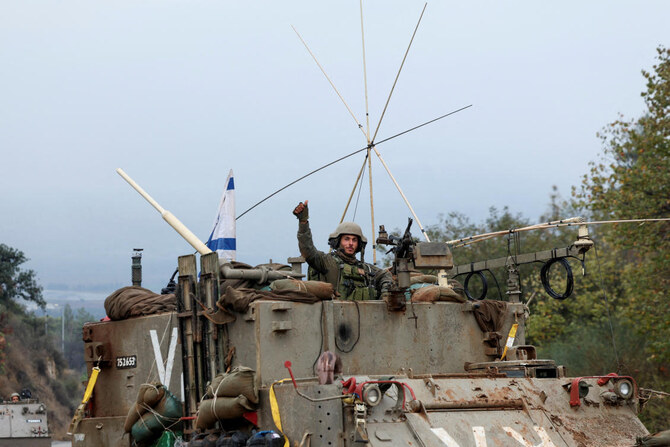
BEIRUT: A ceasefire between Israel and Lebanese armed group Hezbollah held on Wednesday after the two sides struck a deal brokered by the US and France, a rare feat of diplomacy in the Middle East wracked by two wars and several proxy conflicts for over a year.
The agreement ended the deadliest confrontation between Israel and the Iran-backed militant group in years but Israel is still fighting its other arch foe the Palestinian militant group Hamas in the Gaza Strip.
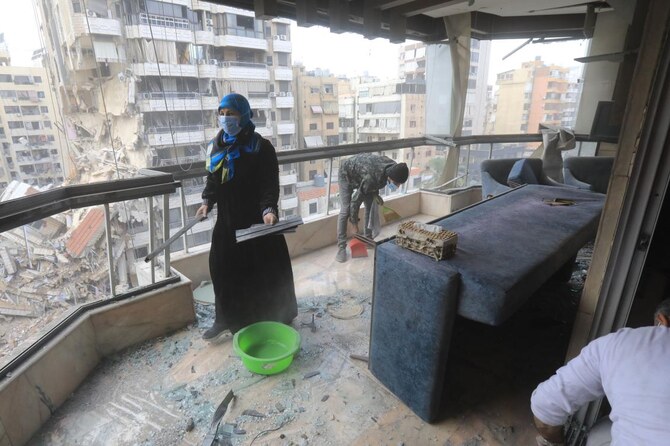
Lebanon’s army, tasked with ensuring the ceasefire lasts, said it was preparing to deploy to the south of the country, a region Israel heavily bombarded in its battle against Hezbollah, along with eastern cities and towns and the armed group’s stronghold in the southern suburbs of Beirut.
Cars and vans piled high with mattresses, suitcases and even furniture streamed through the heavily-bombed southern port city of Tyre, heading south. Fighting had escalated drastically over the past two months, forcing hundreds of thousands of Lebanese from their homes.
Israel’s military said on Wednesday its forces were still on Lebanese territory and urged residents of southern Lebanese villages who had been ordered to evacuate in recent months to delay returning home until further notice from the Israeli military. Israeli troops have pushed around 6 km (4 miles) into Lebanon in a series of ground incursions launched in September.
Israel said it identified Hezbollah operatives returning to areas near the border and had opened fire to prevent them from coming closer. There were no immediate signs that the incident would undermine the ceasefire.
The agreement, which promises to end a conflict across the Israeli-Lebanese border that has killed thousands of people since it was ignited by the Gaza war last year, is a major achievement for the US in the waning days of President Joe Biden’s administration.
Diplomatic efforts will now turn to shattered Gaza, where Israel has vowed to destroy Hamas, which led the Oct. 7, 2023, attacks on Israeli communities.
Israel has said its military aim in Lebanon had been to ensure the safe return of about 60,000 Israelis who fled from their communities along the northern border when Hezbollah started firing rockets at them in support of Hamas in Gaza.
In Lebanon, some cars flew national flags, others honked, and one woman could be seen flashing the victory sign with her fingers as people started to return to homes they had fled.
Many of the villages the people were likely returning to have been destroyed.
Hussam Arrout, a father of four said he was itching to return to his home.
“The Israelis haven’t withdrawn in full, they’re still on the edge. So we decided to wait until the army announces that we can go in. Then we’ll turn the cars on immediately and go to the village,” he said.
Announcing the ceasefire, Biden spoke at the White House on Tuesday shortly after Israel’s security cabinet approved the agreement in a 10-1 vote.
“This is designed to be a permanent cessation of hostilities,” Biden said. “What is left of Hezbollah and other terrorist organizations will not be allowed to threaten the security of Israel again.”
Israel will gradually withdraw its forces over 60 days as Lebanon’s army takes control of territory near its border with Israel to ensure that Hezbollah does not rebuild its infrastructure there after a costly war, Biden said.
He said his administration was also pushing for an elusive ceasefire in Gaza.
Hamas official Sami Abu Zuhri told Reuters that the group “appreciates” Lebanon’s right to reach an agreement which protects its people, and hopes for a deal to end the Gaza war.
National security adviser Jake Sullivan said the US would start its renewed push for a Gaza ceasefire on Wednesday.
But without a similar agreement yet in Gaza, many residents said they felt abandoned.
“We hope that all Arab and Western countries, and all people with merciful hearts and consciences...implement a truce here because we are tired,” said displaced Gazan Malak Abu Laila.
Egypt and Qatar, which along with the United States have tried unsuccessfully to mediate a ceasefire in Gaza, welcomed the Lebanon truce. Qatar’s foreign ministry said on Wednesday it hoped it would lead to a similar agreement to end the Gaza war.
Iran, which backs Hezbollah and Hamas as well as the Houthis that have attacked Israel from Yemen, said it also welcomed the ceasefire.
Israel has dealt a series of blows to Hezbollah, notably the assassination of its veteran leader Hassan Nasrallah.
The Israeli military said on Wednesday Israeli forces fired at several vehicles with suspects to prevent them from reaching a no-go zone in Lebanese territory and the suspects moved away.
Defense Minister Israel Katz said he instructed the military to “act firmly and without compromise” should it happen again.
Hezbollah lawmaker Hassan Fadlallah said that the militant Lebanese group would retain the right to defend itself if Israel attacked.
The ceasefire would give the Israeli army an opportunity to rest and replenish supplies, and isolate Hamas, said Prime Minister Benjamin Netanyahu.
“We have pushed them (Hezbollah) decades back. We eliminated Nasrallah, the axis of the axis. We have taken out the organization’s top leadership, we have destroyed most of their rockets and missiles,” he said.

Israel-Hezbollah ceasefire holds in first hours, Lebanese civilians start to return home
Short Url
https://arab.news/nxvww
Israel-Hezbollah ceasefire holds in first hours, Lebanese civilians start to return home
- Families return to their homes in the most heavily bombed ares of Lebanon
- Lebanon’s army says it was preparing to deploy to the south of the country as part of ceasefire agreement
MSF says conditions for Gaza medics ‘as hard as it’s ever been’ despite truce
DOHA: Conditions for medics and patients in Gaza are as severe as ever despite a nearly two-month truce in the territory, the president of medical charity Doctors Without Borders (MSF) said in an AFP interview.
Israel and Palestinian militant group Hamas agreed in October to a US-backed truce deal for Gaza which stipulated an influx of aid to the territory devastated by two years of war and in the grip of a humanitarian crisis.
“It’s as hard as it’s ever been,” Javid Abdelmoneim said of conditions for medical staff operating in Gaza’s hospitals, speaking on the sidelines of the annual Doha Forum on diplomacy on Sunday.
“While we’re able to continue doing operations, deliveries, wound care, you’re using protocols or materials and drugs that are inferior, that are not the standard. So you’ve got substandard care being delivered,” he explained.
Abdelmoneim, who worked as a doctor in Gaza in 2024, said the ongoing truce was only a “ceasefire of sorts” with “still several to dozens of Palestinians being killed every day by Israel.”
Despite the truce, 376 Palestinians have been killed in Gaza, according to local health authorities, as well as three Israeli soldiers.
“We’re seeing the injured patients in the emergency rooms in which we work throughout the strip,” he added.
Aid agencies are pushing for more access for humanitarian convoys to enter Gaza while Israel has resisted calls to allow aid through the Rafah crossing from Egypt.
Aid ‘weaponized’
The MSF president said that since the truce began, aid “hasn’t come in to the level that’s necessary.”
“There isn’t a substantial change and it is being weaponized... So as far as we’re concerned that is an ongoing feature of the genocide. It’s being used as a chip and that’s something that should not happen with humanitarian aid,” Abdelmoneim said.
In 2024, MSF said its medical teams had witnessed evidence on the ground in Gaza and concluded that genocide was taking place.
Israel’s foreign ministry rejected the report saying at the time that it was “fabricated.”
Abdelmoneim said both the lack of supplies and the destruction of hospitals in the Palestinian territory — still not offset by the provision so far of field hospitals — meant care remained inadequate.
“Those two things together mean increased infection rates, increased stays and greater risk of complications. So it is a substandard level of care that you’re able to deliver,” he said.
The MSF president also sounded the alarm over the safety of medical staff in Sudan where at the end of October the paramilitary Rapid Support Forces (RSF) seized the North Darfur capital of El-Fasher, the army’s last stronghold in the western region.
The paramilitaries’ final advance after a bitter 18-month siege was followed by reports of widespread atrocities.
“One feature that has been consistent, no matter where you are in Sudan, no matter who controls the territory, are attacks on health care and blockages to supply movements and provision of health care,” Abdelmoneim said.
’Freedom, protection access’
The World Health Organization said at the end of October that it had received reports that more than 460 patients and their companions had been shot dead at a maternity hospital in El-Fasher during its capture by the RSF and of six health workers being abducted.
On Thursday, an RSF drone attack on the army-held town of Kalogi in Sudan’s South Kordofan state hit a children’s nursery and a hospital, killing dozens of civilians including children, a local official told AFP.
“Both sides need to allow humanitarian and medical workers freedom, protection and access to the population, and that includes supplies,” said Abdelmoneim, who also worked as a doctor in Omdurman in Sudan in February.
The MSF president said the charity’s medical teams receiving displaced people in Sudan and neighboring Chad were encountering “harrowing tales of sexual violence, tales of ethnically targeted violence, extortion” as well of “evidence that really does point to famine-like conditions.”
In Tawila, a town now sheltering more than 650,000 people fleeing El-Fasher and nearby Zamzam camp, also under RSF control, Abdelmoneim said the MSF had been told by survivors “that family members are detained and never seen again.”
“So our question is, what has happened to that population?” he said.
The medical charity was backing calls by the UN Human Rights Council for an enquiry into the reported violations.
“We would encourage all member states to support that, an independent investigation inside El-Fasher,” Abdelmoneim said.
Israel and Palestinian militant group Hamas agreed in October to a US-backed truce deal for Gaza which stipulated an influx of aid to the territory devastated by two years of war and in the grip of a humanitarian crisis.
“It’s as hard as it’s ever been,” Javid Abdelmoneim said of conditions for medical staff operating in Gaza’s hospitals, speaking on the sidelines of the annual Doha Forum on diplomacy on Sunday.
“While we’re able to continue doing operations, deliveries, wound care, you’re using protocols or materials and drugs that are inferior, that are not the standard. So you’ve got substandard care being delivered,” he explained.
Abdelmoneim, who worked as a doctor in Gaza in 2024, said the ongoing truce was only a “ceasefire of sorts” with “still several to dozens of Palestinians being killed every day by Israel.”
Despite the truce, 376 Palestinians have been killed in Gaza, according to local health authorities, as well as three Israeli soldiers.
“We’re seeing the injured patients in the emergency rooms in which we work throughout the strip,” he added.
Aid agencies are pushing for more access for humanitarian convoys to enter Gaza while Israel has resisted calls to allow aid through the Rafah crossing from Egypt.
Aid ‘weaponized’
The MSF president said that since the truce began, aid “hasn’t come in to the level that’s necessary.”
“There isn’t a substantial change and it is being weaponized... So as far as we’re concerned that is an ongoing feature of the genocide. It’s being used as a chip and that’s something that should not happen with humanitarian aid,” Abdelmoneim said.
In 2024, MSF said its medical teams had witnessed evidence on the ground in Gaza and concluded that genocide was taking place.
Israel’s foreign ministry rejected the report saying at the time that it was “fabricated.”
Abdelmoneim said both the lack of supplies and the destruction of hospitals in the Palestinian territory — still not offset by the provision so far of field hospitals — meant care remained inadequate.
“Those two things together mean increased infection rates, increased stays and greater risk of complications. So it is a substandard level of care that you’re able to deliver,” he said.
The MSF president also sounded the alarm over the safety of medical staff in Sudan where at the end of October the paramilitary Rapid Support Forces (RSF) seized the North Darfur capital of El-Fasher, the army’s last stronghold in the western region.
The paramilitaries’ final advance after a bitter 18-month siege was followed by reports of widespread atrocities.
“One feature that has been consistent, no matter where you are in Sudan, no matter who controls the territory, are attacks on health care and blockages to supply movements and provision of health care,” Abdelmoneim said.
’Freedom, protection access’
The World Health Organization said at the end of October that it had received reports that more than 460 patients and their companions had been shot dead at a maternity hospital in El-Fasher during its capture by the RSF and of six health workers being abducted.
On Thursday, an RSF drone attack on the army-held town of Kalogi in Sudan’s South Kordofan state hit a children’s nursery and a hospital, killing dozens of civilians including children, a local official told AFP.
“Both sides need to allow humanitarian and medical workers freedom, protection and access to the population, and that includes supplies,” said Abdelmoneim, who also worked as a doctor in Omdurman in Sudan in February.
The MSF president said the charity’s medical teams receiving displaced people in Sudan and neighboring Chad were encountering “harrowing tales of sexual violence, tales of ethnically targeted violence, extortion” as well of “evidence that really does point to famine-like conditions.”
In Tawila, a town now sheltering more than 650,000 people fleeing El-Fasher and nearby Zamzam camp, also under RSF control, Abdelmoneim said the MSF had been told by survivors “that family members are detained and never seen again.”
“So our question is, what has happened to that population?” he said.
The medical charity was backing calls by the UN Human Rights Council for an enquiry into the reported violations.
“We would encourage all member states to support that, an independent investigation inside El-Fasher,” Abdelmoneim said.
© 2025 SAUDI RESEARCH & PUBLISHING COMPANY, All Rights Reserved And subject to Terms of Use Agreement.