

Why is Pakistan’s former PM Imran Khan in jail?

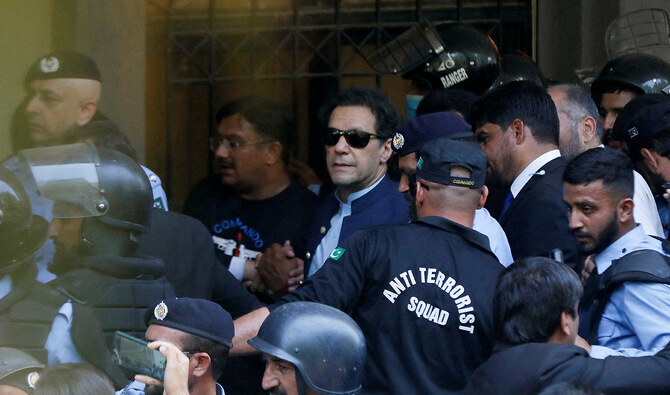
Security officers escort Pakistan’s former Prime Minister Imran Khan, as he appeared in Islamabad High Court, Islamabad, Pakistan May 12, 2023. (REUTERS/File)
Short Url
Updated 27 November 2024
Follow

Why is Pakistan’s former PM Imran Khan in jail?

  • Khan first arrested in May 2023 over allegations he received a land bribe through a trust created when he was in office 
  • Khan, now in jail since August 2023, also faces charges of terrorism and is accused of revealing state secrets 

ISLAMABAD: Pakistan’s capital Islamabad was gripped by violence on Tuesday as protesters demanding the release of former Prime Minister Imran Khan clashed with security forces near the parliament.

Here is a look at some of the allegations against the 72-year-old cricketer-turned-politician — named in dozens of cases since he left office in 2022 — that have kept him behind bars for more than a year.

GRAFT ALLEGATIONS

Khan was first arrested in May 2023 in relation to allegations that his wife, Bushra Bibi, and he received land worth up to 7 billion rupees ($25 million) as a bribe through a trust created in 2018, while he still held office.
His Pakistan Tehreek-e-Insaf (PTI) party has maintained the land was donated for charitable purposes.
Khan was released on bail after three days in prison, during which his supporters attacked and set fire to military and other state installations, with eight people killed in the violence.

ABETTING VIOLENCE

Khan is facing anti-terrorism charges in connection with the violence that followed his arrest in May last year, and in relation to which several of his supporters have already been sentenced.
PTI said in July that authorities had issued fresh arrest warrants for him in three different cases related to the clashes.

STATE SECRETS

Khan was accused of making public a classified cable sent to Islamabad by Pakistan’s ambassador in Washington in 2022, while he still held office.
He was acquitted in the case in June.

UNLAWFUL MARRIAGE

Khan and his wife were accused of breaking Islamic law by failing to observe the mandated waiting period between Bibi’s divorce from her previous husband and their marriage in 2018 .


Return of millions of Afghans from Pakistan and Iran pushes Afghanistan to the brink, UN warns

Updated 14 February 2026
Follow

Return of millions of Afghans from Pakistan and Iran pushes Afghanistan to the brink, UN warns

  • Afghan authorities provide care packages for those returning that include food aid, cash, a telephone SIM card and transportation
  • But the returns have strained resources in a country struggling with a weak economy, severe drought and two devastating earthquakes

GENEVA: The return of millions of Afghans from neighboring Pakistan and Iran is pushing Afghanistan to the brink, the U.N. refugee agency said on Friday, describing an unprecedented scale of returns.

A total of 5.4 million people have returned to Afghanistan since October 2023, mostly from the two neighboring countries, UNHCR’s Afghanistan representative Arafat Jamal said, speaking to a U.N. briefing in Geneva via video link from Kabul, the Afghan capital.

“This is massive, and the speed and scale of these returns has pushed Afghanistan nearly to the brink,” Jamal said.

Pakistan launched a sweeping crackdown in Oct. 2023 to expel migrants without documents, urging those in the country to leave of their own accord to avoid arrest and forcible deportation and forcibly expelling others. Iran also began a crackdown on migrants at around the same time.

Since then, millions have streamed across the border into Afghanistan, including people who were born in Pakistan decades ago and had built lives and created businesses there.

Last year alone, 2.9 million people returned to Afghanistan, Jamal said, noting it was “the largest number of returns that we have witnessed to any single country.”

Afghanistan’s Taliban rulers have criticized the mass expulsions.

Afghanistan was already struggling with a dire humanitarian situation and a poor human rights record, particularly relating to women and girls, and the massive influx of people amounting to 12% of the population has put the country under severe strain, Jamal said.

Already in just the month and a half since the start of this year, about 150,000 people had returned to Afghanistan, he added.

Afghan authorities provide care packages for those returning that include some food aid, cash, a telephone SIM card and transportation to parts of the country where they might have family. But the returns have strained resources in a country that was already struggling to cope with a weak economy and the effects of a severe drought and two devastating earthquakes.

In November, the U.N. development program said nine out of 10 families in areas of Afghanistan with high rates of return were resorting to what are known as negative coping mechanisms — either skipping meals, falling into debt or selling their belongings to survive.

“We are deeply concerned about the sustainability of these returns,” Jamal said, noting that while 5% of those who return say they will leave Afghanistan again, more than 10% say they know of someone who has already left.

“These decisions, I would underscore, to undertake dangerous journeys, are not driven by a lack of a desire to remain in the country, on the contrary, but the reality that many are unable to rebuild their viable and dignified lives,” he said.