

NEOM giga-project a ‘generational investment,’ Saudi minister says

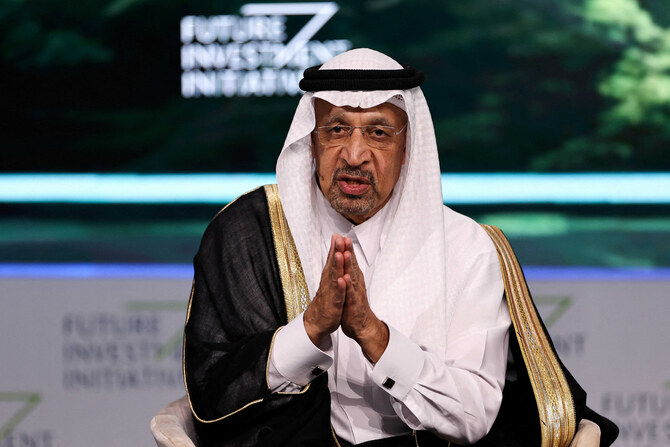
Saudi Arabia's Minister of Investment, Khalid-al-Falih. Reuters/File
Short Url
Updated 27 November 2024
Follow

NEOM giga-project a ‘generational investment,’ Saudi minister says

  • Foreign investors starting to come to NEOM, minister says
  • On recent departure of NEOM’s CEO, minister says there is a time to pass baton
  • Risk-return ‘very fair’ for outside investors, Al-Falih says

RIYADH: Saudi Arabia’s NEOM gigaproject, a futuristic region being built in the desert, is a “generational investment” with a long timeline, the country’s investment minister told Reuters on Monday, adding that foreign investment will pick up pace.

“NEOM was not meant to be a two-year investable opportunity. If anybody expected NEOM to be foreign investment in two, three or five years, then they have gotten (it) wrong — it’s a generational investment,” Minister Khalid Al-Falih said on the sidelines of the World Investment Conference in Riyadh.

“The flywheel is starting and it will gain speed as we go forward, as some of the foundational assets come to the market,” he said.

The world’s top oil exporter has poured hundreds of billions of dollars into development projects through the Kingdom’s $925 billion sovereign fund, the Public Investment Fund, as it undergoes an economic agenda dubbed Vision 2030 to cut dependence on fossil fuels.

NEOM, a Red Sea urban and industrial development nearly the size of Belgium that is meant to eventually house 9 million people, is central to Vision 2030.

NEOM announced this month its long-time chief executive, Nadhmi Al-Nasr, had stepped down, without giving further details.

Asked what effect the departure would have on investors, the minister said the executive had done “a respectable job” but that “there is a time for everybody to pass on the baton.”

Asked if PIF will continue to do much of the spending on NEOM until more foreign funds come in, Al-Falih said it was not binary.

“I think foreign investors are starting to come to NEOM, they’re starting to channel capital. Some of the projects that the PIF will be doing will be financed through global capital pools, through some alternative and private capital. That’s taking place as we speak,” he said.

“So I urge you not to look at NEOM as being 100 percent PIF and then suddenly there will be a cliff and it will go private.”

Saudi Arabia, which is racing to attract $100 billion in annual foreign direct investment by the turn of the decade — reaching about a quarter of that in 2023 — has recently seen more co-investment deals between state entities and foreign investors.

“It’s always been the intent,” Al-Falih said of foreign inflows alongside state funds.

He noted that foreign investors were at times “still looking, still examining, still sometimes questioning,” but that now there was confidence in the profitability of investment opportunities and that “the risk-return trade-offs are very, very fair and positive to them.” 


Closing Bell: Saudi equities continue 4-day upward trend 

Updated 14 January 2026
Follow

Closing Bell: Saudi equities continue 4-day upward trend 

RIYADH: Saudi equities closed higher on Wednesday, with the Tadawul All Share Index rising 51.52 points, or 0.47 percent, to finish at 10,945.15. 

Trading activity was robust, with 373.9 million shares exchanged and total turnover reaching SR6.81 billion. 

The MT30 Index also ended the session in positive territory, advancing 11.93 points, or 0.82 percent, to 1,472.82, while the Nomu Parallel Market Index declined 116.82 points, or 0.49 percent, to 23,551.47, reflecting continued volatility in the parallel market.

The main market saw 90 gainers against 171 decliners, indicating selective buying. 

On the upside, Al Kathiri Holding Co. led gainers, closing at SR2.18, up SR0.12, or 5.83 percent. Wafrah for Industry and Development Co. advanced to SR23, gaining SR0.99, or 4.5 percent, while Al Ramz Real Estate Co. rose 4.35 percent to close at SR60.

SABIC Agri-Nutrients Co. added 4.21 percent to SR118.70, and Al Jouf Agricultural Development Co. climbed 4.12 percent to SR45. 

Meanwhile, losses were led by Saudi Industrial Export Co., which fell 9.73 percent to SR2.69. United Cooperative Assurance Co. declined 5.08 percent to SR3.74, while Thimar Development Holding Co. dropped 4.54 percent to SR35.30.  

Abdullah Saad Mohammed Abo Moati for Bookstores Co. retreated 4.15 percent to SR48.50, and Gulf Union Alahlia Cooperative Insurance Co. slipped 3.96 percent to SR10.44. 

On the announcement front, Saudi National Bank announced its intention to issue US dollar-denominated Additional Tier 1 capital notes under its existing international capital programe, with the final size and terms to be determined subject to market conditions and regulatory approvals.  

The planned issuance aims to strengthen Tier 1 capital and support the bank’s broader financial and strategic objectives.  

The stock closed at SR42.70, gaining SR0.70, or 1.67 percent, reflecting positive investor reaction to the capital management move. 

Separately, Almasane Alkobra Mining Co. said its board approved the establishment of a wholly owned simplified joint stock company to provide drilling, exploration and related support services, with a share capital of SR100 million and headquarters in Najran, subject to regulatory approvals.  

The new subsidiary aligns with the company’s strategy to enhance operational efficiency and expand its role in the Kingdom’s mining sector.

Shares of Almasane Alkobra Mining closed at SR98.70, up SR0.30, or 0.3 percent, by the end of the session.