

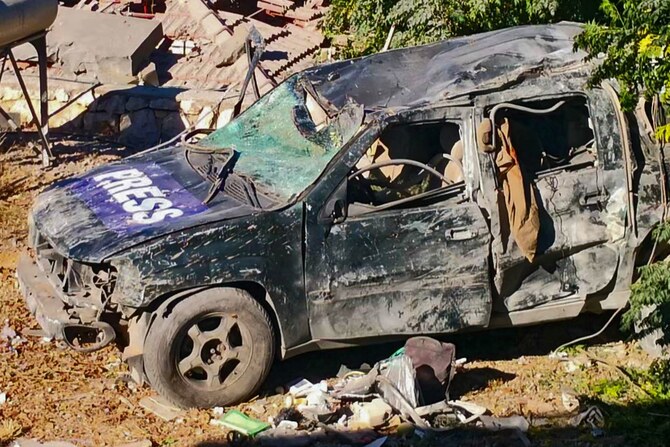

LONDON: A US-made weapon was used by Israel in an airstrike that killed three journalists and injured three others in southern Lebanon, according to an investigation by The Guardian published on Monday.
The British newspaper revealed that munitions manufactured in the US targeted cameraman Ghassan Najjar and technician Mohammad Reda from Iran-backed Hezbollah outlet Al-Mayadeen, as well as cameraman Wissam Qassem from the Hezbollah-affiliated Al-Manar channel. Experts have called the attack a potential war crime.
The strike, which was carried out on the night of Oct. 25, hit a chalet in Hasbaya that was being used as a press station by several media workers, including journalists from Al Jazeera, Sky News Arabia, and TRT.
The Israeli military claimed it targeted a “Hezbollah military structure” in which “terrorists were located,” but later said that the incident was under review after learning journalists were among the casualties.
Nadim Houry, a human rights lawyer and executive director of the Arab Reform Initiative, told The Guardian: “All the indications show that this would have been a deliberate targeting of journalists: a war crime.
“This was clearly delineated as a place where journalists were staying.”
The investigation found no evidence to support Israel’s claims. Cars marked with “Press” signs were parked outside the chalet, and no military activity was detected in the area before the strike.
Witnesses said Israeli drones constantly monitored the site during the 23 days it was used as a press hub.
Ahmed Baydoun, an Amsterdam-based open-source intelligence researcher who was among the first to geolocate the strike, told Arab News that while satellite imagery and eyewitness video analysis pinpointed the chalet’s exact coordinates, providing both “accuracy” and a “tangible grasp of the gravity of the situation” in Hasbaya, definitive conclusions about the incident “would require shrapnel or remnants of the ammunition from the site.”
Geolocated #Israel’s airstrike on the residence of Lebanese journalists in Hasbaya, Lebanon that happened at 4:21 AM. Coordinates: 33.407794, 35.673511. #Lebanon https://t.co/f9Pw8OkjSZ pic.twitter.com/CONQAbvr3P
— A. Baydoun (@weatherwar) October 25, 2024
Remnants of munitions at the scene indicated that at least one weapon used was a 500lb MK-80 series bomb equipped with a Boeing-made JDAM (joint direct attack munition) kit, which converts unguided bombs into precision-guided weapons. The use of such a bomb suggests the site was deliberately selected as a target.
Under US law, the use of American-made weapons in attacks that constitute crimes against humanity requires the suspension of arms supplies to the country in question. Both Israel and the US have denied such accusations.
The journalists killed in the strike were not members of Hezbollah, although one coffin was draped in a Hezbollah flag during burial.
Experts noted that such practices often signify political affiliation but do not indicate military or operational involvement.
Janina Dill, co-director of the Oxford Institute for Ethics, Law, and Armed Conflict, said targeting journalists based on assumed political affiliations was “a dangerous trend already witnessed in Gaza” and “not compatible with international law.”
The Committee to Protect Journalists reports that since the conflict began on Oct. 7, 2023, Israel has killed six journalists in Lebanon and at least 129 in Gaza, marking the deadliest period for the profession in over four decades.
Irene Khan, the UN special rapporteur on the promotion and protection of the right to freedom of opinion and expression, accused Israeli authorities of “blatantly ignoring” their international legal obligations to safeguard journalists.


