

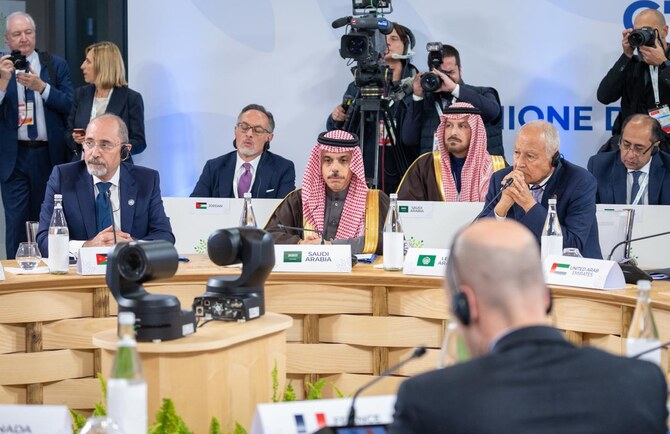
Saudi FM pushes for regional stability at G7-Arab foreign ministers meeting

Saudi Foreign Minister Prince Faisal bin Farhan took part in an expanded session of the second meeting between G7 foreign ministers and their counterparts from Arab nations on Monday. (SPA)
Short Url
Updated 25 November 2024
Follow

Saudi FM pushes for regional stability at G7-Arab foreign ministers meeting

  • In his address, Prince Faisal highlighted the ongoing crises in Gaza and Lebanon

RIYADH: Saudi Foreign Minister Prince Faisal bin Farhan took part in an expanded session of the second meeting between G7 foreign ministers and their counterparts from Arab nations on Monday, the Saudi Press Agency reported.

The meeting was hosted in Italy under the theme “Together for the Stability of the Middle East.”

The session, which addressed pressing regional and international challenges, was held with the participation of Saudi, Jordanian, Emirati, Qatari and Egyptian officials, as well as the secretary-general of the Arab League.

In his address, Prince Faisal emphasized the importance of strengthening partnerships to address these challenges effectively.

He highlighted the ongoing crises in Gaza and Lebanon, urging the international community to act immediately to secure a ceasefire, facilitate unrestricted humanitarian aid, and progress toward establishing an independent Palestinian state.

He also called for respect for Lebanon’s sovereignty, and renewed international efforts to resolve the crisis in Sudan and alleviate the resulting human suffering.

The meeting was also attended by Prince Faisal bin Sattam bin Abdul Aziz, Saudi ambassador to Italy, the SPA reported.


Economic growth and resilience at heart of 2nd AlUla Emerging Market Economies Conference

Updated 03 February 2026
Follow

Economic growth and resilience at heart of 2nd AlUla Emerging Market Economies Conference

  • Event on Feb. 8 and 9 will bring together ministers, governors of central banks, policymakers, economic experts and international financial institutions
  • Emerging-market economies a ‘pivotal element’ in global economic system due to effect they have on growth and stability, says Saudi Finance Minister Mohammed Al-Jadaan

RIYADH: The second annual AlUla Conference for Emerging Market Economies, which Saudi Arabia will host next week, offers a platform to exchange views on global developments and discuss policies and reforms that support inclusive growth and strengthen economic resilience, the Kingdom’s finance minister said.

The event on Feb. 8 and 9 will bring together finance ministers, governors of central banks and policymakers, alongside economic experts and representatives of international financial institutions.

Organized by the Saudi Ministry of Finance in partnership with the International Monetary Fund, it takes place as emerging-market economies face mounting challenges amid rapid global economic change.

Finance Minister Mohammed Al-Jadaan said the decision to host the conference reflects Saudi Arabia’s ongoing commitment to efforts that support global financial and economic stability, and highlights the growing influence of emerging economies on worldwide growth.

Emerging-market economies represent a “pivotal element” in the global economic system due to the direct impact they have on economic growth and stability, he added.

“The AlUla Conference for Emerging Market Economies provides a unique platform for exchanging views on global economic developments, and discussing policies and reforms that will support inclusive growth and enhance economic resilience, in light of broader international cooperation that contributes to confronting common challenges,” Al-Jadaan said.

Kristalina Georgieva, managing director of the IMF, said the event would help emerging economies deal with growing uncertainty driven by technological change, demographic shifts and geopolitical tensions.

“The AlUla conference provides a vital platform for emerging economies to discuss how they can navigate the risks and embrace the opportunities ahead,” she said.

“In these times of sweeping transformations in the global economy, policymakers face a more challenging and uncertain environment. Countries should work together to strengthen resilience through sound macroeconomic and financial policies.”