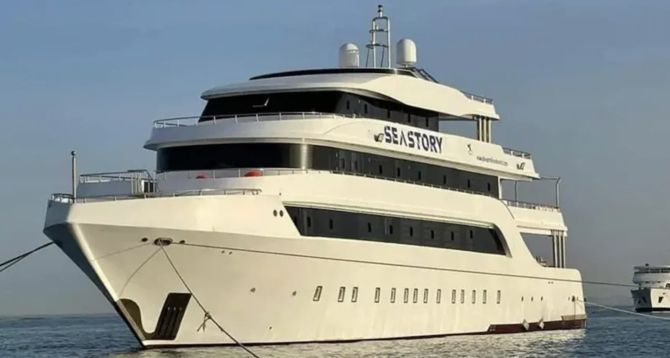
CAIRO: Egyptian authorities said 17 people including British nationals and other foreigners were missing after a tourist yacht capsized off the country’s Red Sea coast on Monday, with 28 others rescued.
The vessel, which was carrying 31 tourists of various nationalities and a 14-member crew, sent out a distress call at 5:30 am (0330 GMT), said a statement from Egypt’s Red Sea governorate.
An AFP tally confirmed that tourists involved in the incident include nationals from the UK, China, Finland, Poland and Spain.
The “Sea Story” embarked on Sunday on a multi-day diving trip from Port Ghalib near Marsa Alam in the southeast, and had been due to dock on Friday at the town of Hurghada, 200 kilometers (124 miles) north.
Governor Amr Hanafi said that some survivors were rescued by an aircraft, while others were transported to safety aboard a warship.
“Intensive search operations are underway in coordination with the navy and the armed forces,” Hanafi added in a statement.
Authorities have not confirmed the nationalities of the tourists.
Beijing’s embassy in Egypt said two of its nationals were “in good health” after being “rescued in the cruise ship sinking accident in the Red Sea,” Chinese state media reported.
The Finnish foreign ministry confirmed to AFP that one of its nationals is missing.
Polish foreign ministry spokesman Pawel Wronski said authorities “have information that two of the tourists may have had Polish citizenship.”
“That’s all we know about them. That’s all we can say for now,” he told national news agency PAP.The Red Sea governor’s office did not immediately respond to AFP’s request for comment about the possible cause of the accident.
According to a manager of a diving resort close to the rescue operation, one surviving crew member said they were “hit by a wave in the middle of the night, throwing the vessel on its side.”
Authorities in the Red Sea capital of Hurghada on Sunday shut down marine activities and the city’s port due to “bad weather conditions.”
But winds around Marsa Alam had remained favorable until Sunday night, the diving manager told AFP, before calming again by morning.
By Monday afternoon, it became increasingly “unlikely that the 17 missing would be rescued after 12 hours in the water,” he said, requesting anonymity because he was not authorized to speak to the media.
The Marsa Alam area saw at least two similar boat accidents earlier this year but there were no fatalities.
The Red Sea coast is a major tourist destination in Egypt, a country of 105 million that is in the grip of a serious economic crisis. Nationally, the tourism sector employs two million people and generates more than 10 percent of GDP.
Dozens of dive boats criss-cross between coral reefs and islands off Egypt’s eastern coast every day, where safety regulations are robust but unevenly enforced.
Earlier this month, 30 people were rescued from a sinking dive boat near the Red Sea’s Daedalus reef.
In June, two dozen French tourists were evacuated safely before their boat sank in a similar accident.
Last year, three British tourists died when a fire broke out on their yacht, engulfing it in flames.


![]()


Egypt says 17 missing after Red Sea tourist boat capsizes
Short Url
https://arab.news/n32qc
Egypt says 17 missing after Red Sea tourist boat capsizes
- Governor Amr Hanafi said that some survivors were rescued by an aircraft, while others were transported to safety aboard a warship


How succession works in Iran and who will be the country’s next supreme leader?
DUBAI: The death of Iran’s Supreme Leader Ayatollah Ali Khamenei after almost 37 years in power raises paramount questions about the country’s future. The contours of a complex succession process began to take shape the morning after Khamenei’s assassination.
Here is what to know:
A temporary leadership council assumes duties
As outlined in its constitution, Iran on Sunday formed a council to assume leadership duties and govern the country.
The council is made up of Iran’s sitting president, the head of the country’s judiciary and a member of the Guardian Council chosen by Iran’s Expediency Council, which advises the supreme leader and settles disputes with parliament.
Iran’s reformist President Masoud Pezeshkian and hard-line judiciary chief Gholamhossein Mohseni Ejei are its members who will step in and “temporarily assume all the duties of leadership.”
A panel of clerics selects a new supreme leader
Though the leadership council will govern in the interim, an 88-member panel called the Assembly of Experts “must, as soon as possible” pick a new supreme leader under Iranian law.
The panel consists entirely of Shiite clerics who are popularly elected every eight years and whose candidacies are approved by the Guardian Council, Iran’s constitutional watchdog. That body is known for disqualifying candidates in various elections in Iran and the Assembly of Experts is no different. The Guardian Council barred former Iranian President Hassan Rouhani, a relative moderate whose administration struck the 2015 nuclear deal with world powers, from election for the Assembly of Experts in March 2024.
Khamenei’s son could be a possible contender
Clerical deliberations about succession and machinations over it take place far from the public eye, making it hard to gauge who may be a top contender.
Previously, it was thought Khamenei’s protégé, hard-line President Ebrahim Raisi, may try to take the mantle. However, he was killed in a May 2024 helicopter crash. That has left one of Khamenei’s sons, Mojtaba, a 56-year-old Shiite cleric, as a potential candidate, though he has never held government office. But a father-to-son transfer in the case of a supreme leader could spark anger, not only among Iranians already critical of clerical rule, but also among supporters of the system. Some may see it as un-Islamic and in line with creating a new, religious dynasty after the 1979 collapse of the US-backed Shah Mohammad Reza Pahlavi’s government.
A transition like this has happened only once before
There has been only one other transfer of power in the office of supreme leader of Iran, the paramount decision-maker since the country’s 1979 Islamic Revolution.
In 1989, Grand Ayatollah Ruhollah Khomeini died at age 86 after being the figurehead of the revolution and leading Iran through its bloody eight-year war with Iraq. This transition now comes after Israel launched a 12-day war against Iran in June 2025 as well.
The vast powers of a supreme leader
The supreme leader is at the heart of Iran’s complex power-sharing Shiite theocracy and has final say over all matters of state.
He also serves as the commander-in-chief of the country’s military and the powerful Revolutionary Guard, a paramilitary force that the United States designated a terrorist organization in 2019 and which Khamenei empowered during his rule. The Guard, which has led the self-described “Axis of Resistance,” a series of militant groups and allies across the Middle East meant to counter the US and Israel, also has extensive wealth and holdings in Iran.
Here is what to know:
A temporary leadership council assumes duties
As outlined in its constitution, Iran on Sunday formed a council to assume leadership duties and govern the country.
The council is made up of Iran’s sitting president, the head of the country’s judiciary and a member of the Guardian Council chosen by Iran’s Expediency Council, which advises the supreme leader and settles disputes with parliament.
Iran’s reformist President Masoud Pezeshkian and hard-line judiciary chief Gholamhossein Mohseni Ejei are its members who will step in and “temporarily assume all the duties of leadership.”
A panel of clerics selects a new supreme leader
Though the leadership council will govern in the interim, an 88-member panel called the Assembly of Experts “must, as soon as possible” pick a new supreme leader under Iranian law.
The panel consists entirely of Shiite clerics who are popularly elected every eight years and whose candidacies are approved by the Guardian Council, Iran’s constitutional watchdog. That body is known for disqualifying candidates in various elections in Iran and the Assembly of Experts is no different. The Guardian Council barred former Iranian President Hassan Rouhani, a relative moderate whose administration struck the 2015 nuclear deal with world powers, from election for the Assembly of Experts in March 2024.
Khamenei’s son could be a possible contender
Clerical deliberations about succession and machinations over it take place far from the public eye, making it hard to gauge who may be a top contender.
Previously, it was thought Khamenei’s protégé, hard-line President Ebrahim Raisi, may try to take the mantle. However, he was killed in a May 2024 helicopter crash. That has left one of Khamenei’s sons, Mojtaba, a 56-year-old Shiite cleric, as a potential candidate, though he has never held government office. But a father-to-son transfer in the case of a supreme leader could spark anger, not only among Iranians already critical of clerical rule, but also among supporters of the system. Some may see it as un-Islamic and in line with creating a new, religious dynasty after the 1979 collapse of the US-backed Shah Mohammad Reza Pahlavi’s government.
A transition like this has happened only once before
There has been only one other transfer of power in the office of supreme leader of Iran, the paramount decision-maker since the country’s 1979 Islamic Revolution.
In 1989, Grand Ayatollah Ruhollah Khomeini died at age 86 after being the figurehead of the revolution and leading Iran through its bloody eight-year war with Iraq. This transition now comes after Israel launched a 12-day war against Iran in June 2025 as well.
The vast powers of a supreme leader
The supreme leader is at the heart of Iran’s complex power-sharing Shiite theocracy and has final say over all matters of state.
He also serves as the commander-in-chief of the country’s military and the powerful Revolutionary Guard, a paramilitary force that the United States designated a terrorist organization in 2019 and which Khamenei empowered during his rule. The Guard, which has led the self-described “Axis of Resistance,” a series of militant groups and allies across the Middle East meant to counter the US and Israel, also has extensive wealth and holdings in Iran.
Latest updates


© 2026 SAUDI RESEARCH & PUBLISHING COMPANY, All Rights Reserved And subject to Terms of Use Agreement.