Turkiye’s Erdogan to discuss Ukraine war with NATO chief

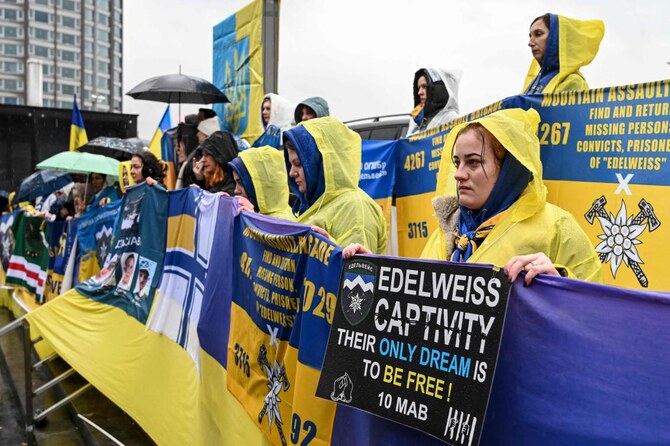
Protesters holding banners and placards take part in a demonstration against the Russian invasion of Ukraine, at the Beyoglu district of Istanbul on November 23, 2024. (AFP)
Short Url
Updated 23 October 2025
Follow

Turkiye’s Erdogan to discuss Ukraine war with NATO chief

ANKARA: Turkish President Tayyip Erdogan will discuss the latest developments in the Russia-Ukraine war with NATO Secretary General Mark Rutte on Monday during his visit to Ankara, a Turkish official said on Sunday.
Russia struck Ukraine with a new hypersonic medium-range ballistic missile on Thursday in response to Kyiv’s use of US and British missiles against Russia, marking an escalation in the war that began when Moscow launched a full-scale invasion of its neighbor in February 2022.
NATO member Turkiye, which has condemned the Russian invasion, says it supports Ukraine’s territorial integrity and it has provided Kyiv with military support.
But Turkiye, a Black Sea neighbor of both Russia and Ukraine, also opposes Western sanctions against Moscow, with which it shares important defense, energy and tourism ties.
On Wednesday, Erdogan opposed a US decision to allow Ukraine to use long-range missiles to attack inside Russia, saying it would further inflame the conflict, according to a readout shared by his office.
Moscow says that by giving the green light for Ukraine to fire Western missiles deep inside Russia, the US and its allies are entering into direct conflict with Russia. On Tuesday, Putin approved policy changes that lowered the threshold for Russia to use nuclear weapons in response to an attack with conventional weapons.
During their talks on Monday, Erdogan and Rutte will also discuss the removal of defense procurement obstacles between NATO allies and the military alliance’s joint fight against terrorism, the Turkish official said.


Philippines eyes closer cooperation on advanced defense tech with UAE

Updated 7 sec ago
Follow

Philippines eyes closer cooperation on advanced defense tech with UAE

  • Philippine-UAE defense agreement is Manila’s first with a Gulf country
  • Philippines says new deal will also help modernize the Philippine military

MANILA: The Philippines is seeking stronger cooperation with the UAE on advanced defense technologies under their new defense pact — its first such deal with a Gulf country — the Department of National Defense said on Friday.

The Memorandum of Understanding on Defense Cooperation was signed during President Ferdinand Marcos Jr.’s visit to Abu Dhabi earlier this week, which also saw the Philippines and the UAE signing a comprehensive economic partnership agreement, marking Manila’s first free trade pact with a Middle Eastern nation.

The Philippines-UAE defense agreement “seeks to deepen cooperation on advanced defense technologies and strengthen the security relations” between the two countries, DND spokesperson Assistant Secretary Arsenio Andolong said in a statement.

The MoU “will serve as a platform for collaboration on unmanned aerial systems, electronic warfare, and naval systems, in line with the ongoing capability development and modernization of the Armed Forces of the Philippines,” he added.

It is also expected to further military relations through education and training, intelligence and security sharing, and cooperation in the fields of anti-terrorism, maritime security, and peacekeeping operations.

The UAE’s Ministry of Foreign Affairs has described security and defense as “very promising fields” in Philippine-UAE ties, pointing to Abu Dhabi being the location of Manila’s first defense attache office in the Middle East.

The UAE is the latest in a growing list of countries with defense and security deals with the Philippines, which also signed a new defense pact with Japan this week.

“I would argue that this is more significant than it looks on first read, precisely because it’s the Philippines’ first formal defense cooperation agreement with a Gulf state. It signals diversification,” Rikard Jalkebro, associate professor at the Anwar Gargash Diplomatic Academy in Abu Dhabi, told Arab News.

“Manila is widening its security partnerships beyond its traditional circles at a time when strategic pressure is rising in the South China Sea, and the global security environment is (volatile) across regions.”

Though the MoU is not an alliance and does not create mutual defense obligations, it provides a “framework for the practical stuff that matters,” including access, training pathways, procurement discussions and structured channels” for security cooperation, he added.

“For the UAE, the timing also makes sense, seeing that Abu Dhabi is no longer only a defense buyer; it’s increasingly a producer and exporter, particularly in areas like UAS (unmanned aerial systems) and enabling technologies. That opens a new lane for Manila to explore capability-building, technology transfer, and industry-to-industry links,” Jalkebro said.

The defense deal also matters geopolitically, as events in the Middle East and the Indo-Pacific region have ripple effects on global stability and commerce.

“So, a Philippines–UAE defense framework can be read as a pragmatic hedge, strengthening resilience and options without formally taking sides,” Jalkebro said.