Mounting economic costs of India’s killer smog

1 / 2
Pedestrians walk along the Kartavya Path engulfed in thick smog, near India Gate in New Delhi on November 18, 2024. (AFP)
2 / 2
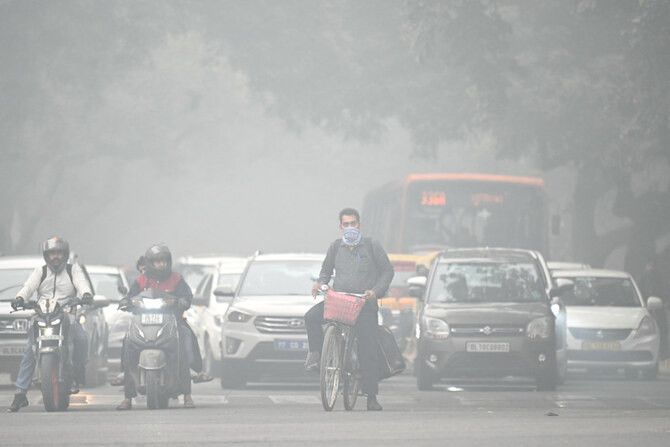
Motorists ride along a street on a cold smoggy morning in New Delhi on Nov. 18, 2024. (AFP)
Short Url
Updated 24 November 2024
Follow

Mounting economic costs of India’s killer smog

  • India’s capital New Delhi frequently ranks among the world’s most polluted cities
  • One study estimate India’s economic losses due to worsening air pollution at $95 billion yearly


NEW DELHI: Noxious smog smothering the plains of north India is not only choking the lungs of residents and killing millions, but also slowing the country’s economic growth.
India’s capital New Delhi frequently ranks among the world’s most polluted cities. Each winter, vehicle and factory emissions couple with farm fires from surrounding states to blanket the city in a dystopian haze.
Acrid smog this month contains more than 50 times the World Health Organization recommended limit of fine particulate matter — dangerous cancer-causing microparticles known as PM2.5 pollutants, that enter the bloodstream through the lungs.
Experts say India’s worsening air pollution is having a ruinous impact on its economy — with one study estimating losses to the tune of $95 billion annually, or roughly three percent of the country’s GDP.
The true extent of the economic price India is paying could be even greater.
“The externality costs are huge and you can’t assign a value to it,” said Vibhuti Garg, of the Institute for Energy Economics and Financial Analysis.
Bhargav Krishna of the Delhi-based research collective Sustainable Futures Collaborative said “costs add up in every phase.”
“From missing a day at work to developing chronic illness, the health costs associated with that, to premature death and the impact that has on the family of the person,” Krishna told AFP.


A school teacher conducts an online class near a basketball court at Swami Sivananda Memorial Institute in New Delhi on Nov. 22, 2024. (AFP)


Still, several studies have tried to quantify the damage.
One by the global consultancy firm Dalberg concluded that in 2019, air pollution cost Indian businesses $95 billion due to “reduced productivity, work absences and premature death.”
The amount is nearly three percent of India’s budget, and roughly twice its annual public health expenditure.
“India lost 3.8 billion working days in 2019, costing $44 billion to air pollution caused by deaths,” according to the study which calculated that toxic air “contributes to 18 percent of all deaths in India.”
Pollution has also had a debilitating impact on the consumer economy because of direct health-related eventualities, the study said, reducing footfall and causing annual losses of $22 billion.
The numbers are even more staggering for Delhi, the epicenter of the crisis, with the capital province losing as much as six percent of its GDP annually to air pollution.
Restaurateur Sandeep Anand Goyle called the smog a “health and wealth hazard.”
“People who are health conscious avoid stepping out so we suffer,” said Goyle, who heads the Delhi chapter of the National Restaurant Association of India.
Tourism has also been impacted, as the smog season coincides with the period when foreigners traditionally visit northern India — too hot for many during the blisteringly hot summers.
“The smog is giving a bad name to India’s image,” said Rajiv Mehra of the Indian Association of Tour Operators.
Delhi faces an average 275 days of unhealthy air a year, according to monitors.

Piecemeal initiatives by the government — that critics call half-hearted — have failed to adequately address the problem.
Academic research indicates that its detrimental impact on the Indian economy is adding up.
A 2023 World Bank paper said that air pollution’s “micro-level” impacts on the economy translate to “macro-level effects that can be observed in year-to-year changes in GDP.”
The paper estimates that India’s GDP would have been 4.5 percent higher at the end of 2023, had the country managed to curb pollution by half in the previous 25 years.
Another study published in the Lancet health journal on the direct health impacts of air pollution in 2019 estimated an annual GDP deceleration of 1.36 percent due to “lost output from premature deaths and morbidity.”
Desperate emergency curbs — such as shuttering schools to reduce traffic emissions as well as banning construction — come with their own economic costs.
“Stopping work for weeks on end every winter makes our schedules go awry, and we end up overshooting budgets,” said Sanjeev Bansal, the chairman of the Delhi unit of the Builders Association of India.
Pollution’s impact on the Indian economy is likely to get worse if action is not taken.
With India’s median age expected to rise to 32 by 2030, the Dalberg study predicts that “susceptibility to air pollution will increase, as will the impact on mortality.”


Trump says US could run Venezuela and its oil for years

Updated 58 min 2 sec ago
Follow

Trump says US could run Venezuela and its oil for years

  • US president made the comments less than a week after Washington seized Maduro in a raid on Caracus
  • Oil has emerged as the key to US control over Venezuela, which has the world’s largest proven reserves

WASHINGTON: The United States could run Venezuela and tap into its oil reserves for years, President Donald Trump said in an interview published Thursday, less than a week after toppling its leader Nicolas Maduro.
“Only time will tell” how long Washington would demand direct oversight of the South American country, Trump told The New York Times.
But when asked whether that meant three months, six months or a year, he replied: “I would say much longer.”
The 79-year-old US leader also said he wanted to travel to Venezuela eventually. “I think at some point it’ll be safe,” he said.
US special forces snatched president Maduro and his wife in a lightning raid on Saturday and whisked them to New York to face trial on drug and weapons charges, underscoring what Trump has called the “Donroe Doctrine” of US hegemony over its backyard.
Since then Trump has repeatedly asserted that the United States will “run” Venezuela, despite the fact that it has no boots on the ground.
Venezuela’s interim leader Delcy Rodriguez insisted that no foreign power was governing her country. “There is a stain on our relations such as had never occurred in our history,” Rodriguez said of the US attack.
But she added it was “not unusual or irregular” to trade with the United States now, following an announcement by state oil firm PDVSA that it was in negotiations to sell crude to the United States.

‘Tangled mess’

Oil has in fact emerged as the key to US control over Venezuela, which has the world’s largest proven reserves.
Trump announced a plan earlier this week for the United States to sell between 30 million and 50 million barrels of Venezuelan crude, with Caracas then using the money to buy US-made products.
On the streets of Caracas, opinions remain mixed about the oil plan.
“I feel we’ll have more opportunities if the oil is in the hands of the United States than in the hands of the government,” said Jose Antonio Blanco, 26. “The decisions they’ll make are better.”
Teresa Gonzalez, 52, said she didn’t know if the oil sales plan was good or bad.
“It’s a tangled mess. What we do is try to survive, if we don’t work, we don’t eat,” she added.
Trump, who will meet oil executives on Friday, is also considering a plan for the US to exert some control over Venezuela’s PDVSA, the Wall Street Journal reported.
The US would then have a hand in controlling most of the oil reserves in the Western Hemisphere, as Trump aims to drive oil prices down to $50 a barrel, the paper reported.
Vice President JD Vance underscored that “the way that we control Venezuela is we control the purse strings.”
“We tell the regime, ‘you’re allowed to sell the oil so long as you serve America’s national interest,’” he told Fox News host Jesse Watters in an interview broadcast late Wednesday.

‘Go like Maduro’

Vance, an Iraq veteran who is himself a skeptic of US military adventures, also addressed concerns from Trump’s “Make America Great Again,” saying the plan would exert pressure “without wasting a single American life.”
The US Senate is voting Thursday on a “war powers” resolution to require congressional authorization for military force against Venezuela, a test of Republican support for Trump’s actions.
Caracas announced on Wednesday that at least 100 people had been killed in the US attack and a similar number wounded. Havana says 32 Cuban soldiers were among them.
Trump’s administration has so far indicated it intends to stick with Rodriguez and sideline opposition figures, including Nobel Peace Prize winner Maria Corina Machado.
But Rodriguez’s leadership faces internal pressures, analysts have told AFP, notably from her powerful Interior Minister Diosdado Cabello and Defense Minister Vladimir Padrino Lopez.
“Her power comes from Washington, not from the internal structure. If Trump decides she’s no longer useful, she’ll go like Maduro,” Venezuela’s former information minister Andres Izarra told AFP in an email.
The US operation in Venezuela — and Trump’s hints that other countries could be next — spread shockwaves through the Americas, but but he has since dialed down tensions with Colombia.
A day after Colombia’s leftist President Gustavo Petro spoke with Trump on Wednedsday, Bogota said Thursday it had agreed to take “joint action” against cocaine-smuggling guerrillas on the border with Venezuela.