

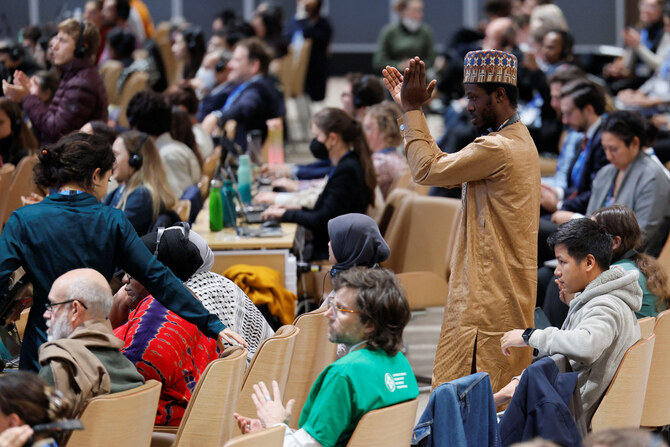


BAKU, Azerbaijan: United Nations climate talks adopted a deal to inject at least $300 billion annually in humanity’s fight against climate change, aimed at helping developing nations cope with the ravages of global warming in tense negotiations.
The $300 billion will go to developing countries who need the cash to wean themselves off the coal, oil and gas that causes the globe to overheat, adapt to future warming and pay for the damage caused by climate change’s extreme weather. It’s not near the full amount of $1.3 trillion that developing countries were asking for, but it’s three times a deal of $100 billion a year from 2009 that is expiring. Some delegations said this deal is headed in the right direction, with hopes that more money flows in the future.
But it was not quite the agreement by consensus that these meetings usually operate with and some developing nations were livid about being ignored.
COP29 President Mukhtar Babayev gaveled the deal into acceptance before any nation had a chance to speak. When they did they blasted him for being unfair to them, the deal for not being enough and the world’s rich nations for being too stingy.
“It’s a paltry sum,” India negotiator Chandni Raina said, repeatedly saying how India objected to rousing cheers. “I’m sorry to say we cannot accept it.”
She told The Associated Press that she has lost faith in the United Nations system.
After a deal, nations express their discontent
A long line of nations agreed with India and piled on, with Nigeria’s Nkiruka Maduekwe, CEO of the National Council on Climate Change, calling the deal an insult and a joke.
“I’m disappointed. It’s definitely below the benchmark that we have been fighting for for so long,” said Juan Carlos Monterrey, of the Panama delegation. He noted that a few changes, including the inclusion of the words “at least” before the number $300 billion and an opportunity for revision by 2030, helped push them to the finish line.
“Our heart goes out to all those nations that feel like they were walked over,” he said.
The final package pushed through “does not speak or reflect or inspire confidence,” India’s Raina said.
“We absolutely object to the unfair means followed for adoption,” Raina said. “We are extremely hurt by this action by the president and the secretariat.”

Evans Njewa, an environmental officer at Malawi's Environmental Affairs Department, attends the COP29 United Nations Climate Change Conference, in Baku, Azerbaijan, on Nov. 23, 2024. (REUTERS)
Speaking for nearly 50 of the poorest nations of the world, Evans Davie Njewa of Malawi was more mild, expressing what he called reservations with the deal. And the Alliance of Small Island States’ Cedric Schuster said he had more hope “that the process would protect the interests of the most vulnerable” but nevertheless expressed tempered support for the deal.
UN Secretary-General Antonio Guterres said in a post on X that he hoped for a “more ambitious outcome.” But he said the agreement “provides a base on which to build.”
Some see deal as relief following tough talks
There were somewhat satisfied parties, with European Union’s Wopke Hoekstra calling it a new era of climate funding, working hard to help the most vulnerable. But activists in the plenary hall could be heard coughing over Hoekstra’s speech in an attempt to disrupt it.
Eamon Ryan, Ireland’s environment minister, called the agreement “a huge relief.”
“It was not certain. This was tough,” he said. “Because it’s a time of division, of war, of (a) multilateral system having real difficulties, the fact that we could get it through in these difficult circumstances is really important.”
UN Climate Change’s Executive Secretary Simon Stiell called the deal an “insurance policy for humanity,” adding that like insurance, “it only works if the premiums are paid in full, and on time.”

Simon Stiell, Executive Secretary of UNFCCC, speaks during a closing plenary meeting at the COP29 United Nations Climate Change Conference, in Baku, Azerbaijan, on Nov. 24, 2024. (REUTERS)
The deal is seen as a step toward helping countries on the receiving end create more ambitious targets to limit or cut emissions of heat-trapping gases that are due early next year. It’s part of the plan to keep cutting pollution with new targets every five years, which the world agreed to at the UN talks in Paris in 2015.
The Paris agreement set the system of regular ratcheting up climate fighting ambition as away to keep warming under 1.5 degrees Celsius (2.7 degrees Fahrenheit) above pre-industrial levels. The world is already at 1.3 degrees Celsius (2.3 degrees Fahrenheit) and carbon emissions keep rising.
Hopes that more climate cash will follow
Countries also anticipate that this deal will send signals that help drive funding from other sources, like multilateral development banks and private sources. That was always part of the discussion at these talks — rich countries didn’t think it was realistic to only rely on public funding sources — but poor countries worried that if the money came in loans instead of grants, it would send them sliding further backward into debt that they already struggle with.

Wopke Hoekstra, EU climate commissioner, speaks to members of the media at the COP29 UN Climate Summit, on Nov. 24, 2024, in Baku, Azerbaijan. (AP)
“The $300 billion goal is not enough, but is an important down payment toward a safer, more equitable future,” said World Resources Institute President Ani Dasgupta. “This deal gets us off the starting block. Now the race is on to raise much more climate finance from a range of public and private sources, putting the whole financial system to work behind developing countries’ transitions.”
And even though it’s far from the needed $1.3 trillion, it’s more than the $250 billion that was on the table in an earlier draft of the text, which outraged many countries and led to a period of frustration and stalling over the final hours of the summit.
Other deals agreed at COP29
The several different texts adopted early Sunday morning included a vague but not specific reference to last year’s Global Stocktake approved in Dubai. Last year there was a battle about first-of-its-kind language on getting rid of the oil, coal and natural gas, but instead it called for a transition away from fossil fuels. The latest talks only referred to the Dubai deal, but did not explicitly repeat the call for a transition away from fossil fuels.
Countries also agreed on the adoption of Article 6, creating markets to trade carbon pollution rights, an idea that was set up as part of the Paris Agreement to help nations work together to reduce climate-causing pollution. Part of that was a system of carbon credits, allowing nations to put planet-warming gasses in the air if they offset emissions elsewhere. Backers said a UN-backed market could generate up to an additional $250 billion a year in climate financial aid.
Despite its approval, carbon markets remain a contentious plan because many experts say the new rules adopted don’t prevent misuse, don’t work and give big polluters an excuse to continue spewing emissions.
“What they’ve done essentially is undermine the mandate to try to reach 1.5,” said Tamara Gilbertson, climate justice program coordinator with the Indigenous Environmental Network. Greenpeace’s An Lambrechts, called it a “climate scam” with many loopholes.
With this deal wrapped up as crews dismantle the temporary venue, many have eyes on next year’s climate talks in Belem, Brazil.


